

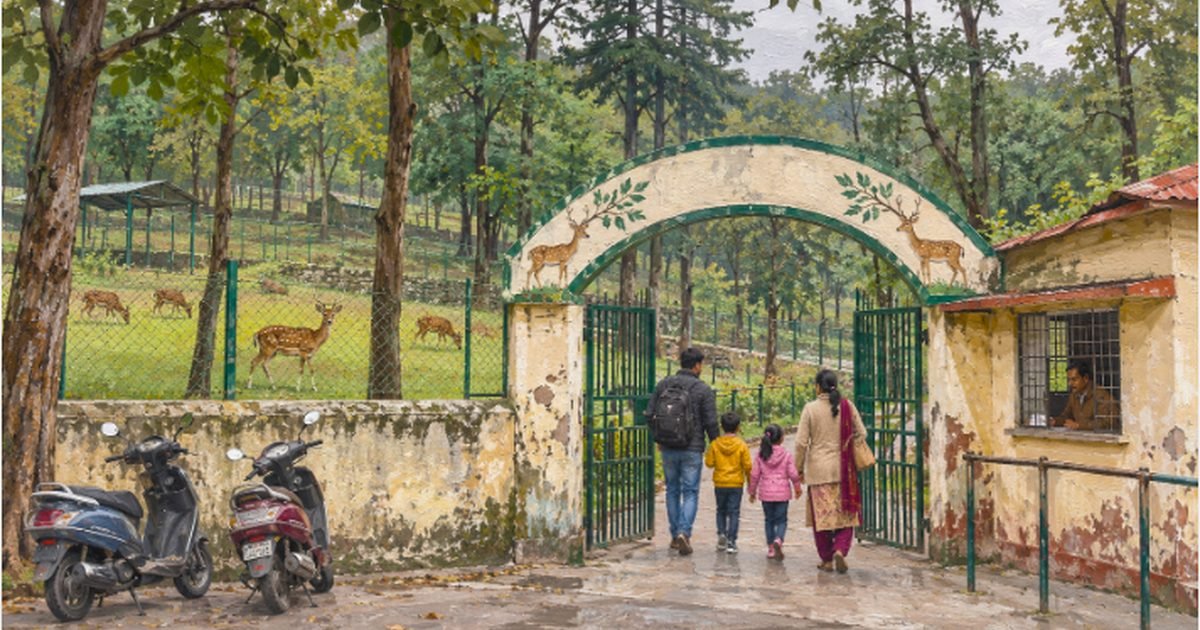
Malsi Deer Park is the most searched attraction in Dehradun and the least accurately described. Half the internet still quotes a ₹20 ticket that has not been the price for years. A fair number of pages place it “10 km from Mussoorie Road” — a sentence that means nothing, because the park is on Mussoorie Road. And almost none of them mention the thing that actually defines the place in 2026: that Uttarakhand’s first white tiger is in an enclosure behind the quarantine fence, and you cannot see him yet.
The park’s real story is better than the listicle version. It began in 1976 as a forest awareness centre holding three spotted deer and five budgerigars. It became a recognised mini zoo in 2012, a management society in 2016, and — after two Bengal tigers arrived in 2024 — one of the few places in the state where a family can see a big cat at all. Twenty-five hectares of Shivalik foothill forest, of which only about five are open to visitors.
This guide covers what it actually is and where the boundary runs, why it is called Malsi, what happened between 1976 and the tigers, what you will and will not see on a visit this month, the white tiger’s quarantine, what the zoo costs, how to get there, and what it is like to live on the Mussoorie road beside it.
Last verified: 3 November 2026, against the zoo’s own Central Zoo Authority annual report for 2019–20, the Nagar Nigam Dehradun page for the park, Uttarakhand Forest Department and Dehradun Zoo Management Society figures as reported, the Times of India, New Indian Express, Garhwal Post and Dainik Bhaskar’s 2026 reporting on the white tiger transfer, the 2012 mini-zoo recognition as recorded by the Tribune, live Magicbricks, 99acres and Square Yards listings, and road distances measured on the OSRM routing graph.
Quick answer: Malsi Deer Park is the old name of Dehradun Zoo, on Mussoorie Road at Malsi — 9.1 km from the Clock Tower (about 9 minutes), 248009. It is 25 hectares in all, but only about 5 are open to visitors. Entry is about ₹100 for adults, free for children under 12, and the zoo is closed on Mondays, 10 am to 5 pm otherwise. Allow 2–3 hours. The white tiger Tejas arrived on 28 September 2026 and was still in quarantine at the end of October, with no opening date announced.
01The park at a glance
| What it is | A 25-hectare zoological park in the Shivalik foothills, run as a recognised mini zoo by the Dehradun Zoo Management Society for the Uttarakhand Forest Department |
|---|---|
| Also called | Dehradun Zoo, Doon Zoo, Dehradun Mini Zoo; formerly Malsi Deer Park, and before that Van Chetna Kendra |
| Address | Mussoorie diversion, Malsi, Dehradun, Uttarakhand 248009 |
| Distance from the Clock Tower | 9.1 km by road, about 9 minutes outside peak hours, measured on the OSRM routing graph |
| Entry | About ₹100 for adults; children under 12 free. Aquarium, 3D theatre and cactus garden are ticketed separately. No official tariff is published online |
| Hours | 10 am–5 pm, Tuesday to Sunday. Closed Mondays. Some listings give 9 am–5.30 pm, and a summer/winter split of 8.30–6 and 9–5 |
| Time needed | 2–3 hours at an unhurried pace; 90 minutes if you skip the aquarium and the 3D show |
| Area | 25 hectares total, of which about 5 hectares are open to visitors |
| What is there | Deer, sambar, goral, Himalayan black bears, leopards, Bengal tigers, crocodiles, snakes, an aquarium, an aviary, a cactus garden and a children’s play area |
| The white tiger | Tejas, about two years old, arrived from Gwalior on 28 September 2026; in quarantine, with the enclosure opening not scheduled before Diwali (8 November 2026) |
| Best months | October–March. Mornings, before 11 am, when the animals are active and the light is good |
| Watch out for | Mondays — the single most common wasted trip. And the fee: most of the internet still says ₹20 |
02What and where it really is
Dehradun sits in a doon — a flat, gravel-filled valley between the Shivalik foothills to the south and the first Himalayan ridge to the north. Malsi is on the northern edge of that valley, where the Mussoorie road begins to climb. The zoo occupies a bowl of forest at that transition: sal and mixed deciduous cover on the lower slopes, the ridge above it, and a stream line running through the lower part of the site.
That geography is the point. The park is not a walled municipal garden with cages in rows; it is a fenced piece of hillside with enclosures cut into it, which is why the walking is on gradients and why the animals look better than the enclosures’ age would suggest. It also explains the water: a hill site with natural drainage, which matters in a place that gets the monsoon Dehradun gets.
The location is why it works commercially. Every vehicle going to Mussoorie passes the gate, which puts the zoo on the itinerary of a large share of the state’s tourists without anyone having to plan it. The Nagar Nigam’s own page describes it, accurately, as “one of the best places to visit on the way to Mussoorie”.
The location is also why it is mispriced by visitors. At 9.1 km from the Clock Tower it is inside the city’s daily reach — a school trip, a Sunday morning, an hour and a half out — not a day excursion. Guides that treat it as a half-day trip to the hills are describing the drive, not the visit.
03The names: Malsi, Van Chetna Kendra, Dehradun Zoo
Malsi is the village and the stretch of road. The zoo is named for it because that is where it is: a forest block on the Mussoorie diversion at Malsi, in the Dehradun forest division.
Van Chetna Kendra — literally a forest awareness centre — is what it was founded as in 1976. That name survives in the zoo’s own institutional history and explains what it was for: not display, but showing city schoolchildren what a forest is.
Malsi Deer Park is the name the city still uses and the name that dominates search. It reflects a period when the site held mostly chital, sambar and barking deer, and it is now misleading: the park has held tigers since 2024 and a white tiger since September 2026.
Dehradun Zoo is the official name since its recognition as a mini zoo. The Central Zoo Authority lists it as Dehradun Mini Zoo; the state calls it Dehradun Zoo; the signboards still say both. If you are giving directions to a driver, “Malsi Zoo” or “Malsi Deer Park” is what will be understood. Nobody says Van Chetna Kendra.
041976 to 2012: five birds and three deer
The zoo’s own annual report to the Central Zoo Authority gives the founding inventory, and it is worth quoting because it explains everything about the place’s later trajectory: the park opened in 1976 with three spotted deer, one goral, two barking deer, three peafowl and five budgerigars.
For 36 years that was roughly the scale of it — a forest department awareness centre with deer, a few birds and a picnic lawn, managed by the Malsi range of the Dehradun forest division. The Tribune, reporting on the leopard-proof fencing that was part of the upgrade, recorded the site then as 22 hectares ringed by 2,200 metres of fence, and described it as the city’s only introduction to wildlife, with “space and other limitations”.
- 1976. Established as Van Chetna Kendra at Malsi, with 11 animals and birds across five species.
- 9 March 2012. Recognised as a mini zoo by the Central Zoo Authority under the Wildlife (Protection) Act, 1972 — the formal moment the deer park became a zoo.
- 2013 and 2016. The first master layout plan is approved by the CZA, then revised.
- 2014. A separate zoo unit is created within the forest department, instead of management through the Malsi range.
- 2016. The Uttarakhand government forms the Dehradun Zoo Management Society to run the zoo; it registers under the Societies Act and receives income-tax exemption under sections 12A and 80G in 2017.
- December 2017. A separate director is posted to the zoo — the point at which it becomes an institution rather than a range function.
The results show in the numbers the zoo reported for 2019–20: 6,15,317 visitors in the financial year (including 2,149 foreigners), 413 animals and birds maintained, 42 births and 5 deaths, and 27 rescued animals treated. By 2022 the visitor figure had risen to about 7.65 lakh and revenue to roughly ₹3.35 crore — money that, under the society’s model, goes back into feed, enclosures and veterinary care.
05What you actually see
Start with the number that governs the visit: of 25 hectares, about five are open to the public. The rest is enclosure, rescue area, fodder plantation and hillside. That is why the zoo feels smaller than its reputation — and why the tiger safari proposal keeps coming back, because four-fifths of the site is unused from a visitor’s point of view.
- The deer. Chital, sambar, barking deer and goral in open paddocks near the entrance. This is the old deer park, and on a quiet morning it is still the best part: animals at eye level, no bars, children at the fence.
- The big cats. Tigers and leopards in fenced enclosures with viewing galleries set back from the mesh. Two Bengal tigers were the draw from 2024; one, Bhola, left for Gwalior in September 2026 in exchange for the white tiger.
- The bears. Four Himalayan black bears, according to the zoo’s veterinary officer in June 2026 — a species most visitors have never seen, and the one that generates the most interest in the adoption scheme.
- The reptiles and the aquarium. Crocodiles, a snake house and a tank-and-fish aquarium, all separately ticketed. Small, old-fashioned, and popular with children.
- The birds. An aviary with ostrich, emu, macaws, parakeets, peafowl and pheasants. The zoo’s own 2019–20 inventory runs to dozens of species across birds, mammals and reptiles.
- The extras. A cactus garden, a 3D theatre, a children’s play area, a canteen, rest sheds, drinking water and paid parking. Lockers are available at the gate.
What is not there: a safari, a ropeway, a night visit, or any interpretation worth the name. Signage is basic. The zoo is a place to look at animals with children, not a place to learn ecology — which is exactly the gap the society says it wants to close.
06The animals, honestly
The zoo’s collection is small, regional and heavy on rescued animals, which is the correct way to read it. A recognised Indian mini zoo is not a competitor to a national park; it is a holding and rescue facility that is also open to the public, and the CZA’s conditions are about animal welfare rather than spectacle.
What that means in practice: the enclosures are old, some are being renovated, and several were built for a smaller collection than the zoo now holds. The zoo has added an aquarium, a 3D theatre and a cactus garden over the years — visitor infrastructure rather than animal infrastructure — and has been pressing for a safari to use the unused 20 hectares.
The rescue role is real and mostly invisible. The 2019–20 report records 27 rescued animals treated in a year, and the zoo takes leopard and bear cases from the surrounding districts. A good share of what you see on a weekday is there because it could not be released.
One piece of housekeeping that surprises visitors: the carnivores are fasted on Tuesdays, as a deliberate part of their diet management. If you go on a Tuesday expecting active big cats, you will be disappointed for a reason.
07The white tiger, and what a quarantine actually means
This is the reason searches for the zoo spiked in October 2026, and the reason most of those searches end in disappointment.
Tejas, a white tiger about two years and three months old, arrived at Dehradun Zoo from Gwalior Zoological Park on 28 September 2026. He travelled roughly 556 km by road in a specially designed rescue vehicle over 12 to 14 hours, accompanied by a 13-member team of veterinarians and forest officials. Dainik Bhaskar’s report, quoting the zoo’s range officer and in-charge Diksha Bhatt, records that he was neither fed nor tranquilised during the journey.
In exchange, Bhola, the zoo’s nearly five-year-old Royal Bengal tiger and its main attraction for two years, went to Gwalior. The Central Zoo Authority had cleared the transfer of two white tigers to Uttarakhand in early September 2026 — one from Gwalior, one from Nandankanan in Odisha — and the Odisha transfer’s terms were still being negotiated.
Then came the quarantine, which is where the visitor information breaks down. Every animal moved between zoos goes into isolation for observation — 20 days under the zoo’s own account, 30 days under the CZA norm quoted by local reporting. On 26 October 2026, Bhatt told Dainik Bhaskar that the enclosure opening was unlikely before Diwali and that no date had been fixed. Diwali fell on 8 November 2026.
So the honest position at the start of November: Tejas is healthy, eating and under daily observation, and he is not on public display. If you are going specifically to see a white tiger, ring the zoo first — and treat any page that says “see Tejas now” as unverified. When he does go on display he will be Uttarakhand’s first white tiger, and the queue will be substantial for the first few weekends.
082026: the safari, the adoption scheme, the fee
Three things are happening at the zoo this year that are worth knowing before you go.
The safari is still a plan. The zoo has been working towards a tiger safari on the unused part of its 25 hectares — 11 enclosures, and electric vehicles instead of gypsies to keep noise and exhaust down. A Central Zoo Authority team has inspected the site, and permission is the gate. It has not opened. Every “safari opening soon” item you will find traces back to the same proposal.
The adoption scheme is working. Under the forest department’s animal adoption programme, an individual or family can fund an animal’s upkeep for a year: ₹50,000 for a tiger or a Himalayan black bear, ₹25,000 for a leopard, ₹20,000 for a snake. In June 2026 the zoo told the New Indian Express that seven people had adopted nine animals that year, with the bears and big cats the most sought after.
The fee is ₹100, and the internet has not caught up. The adult ticket rose to about ₹100 after the Bengal tigers arrived in late 2024; children under 12 go free. A large number of pages — including some that rank well — still quote ₹20, ₹30 or ₹50, which were the rates in earlier years. There is no official tariff page: the park’s own website, dehradunzoo.org, did not respond when we checked it on 3 November 2026, and the Nagar Nigam page carries no fees. Budget ₹100 a head plus parking, and carry cash.
09Practicalities
- Closed Mondays. Not a maintenance day you can talk your way past — the gate is shut. Every other day, 10 am to 5 pm, with the ticket counter closing before the gate does.
- Entry and extras. About ₹100 for adults, free under 12. The aquarium, 3D theatre and cactus garden carry separate small tickets, so a family of four can spend ₹400–600 without trying.
- Parking. Paid, at the gate: about ₹20 for a two-wheeler and ₹50 for a car, with buses and tempo travellers charged more at weekends and holidays. It fills on Sunday afternoons.
- Cash. The counter and the small kiosks inside are not reliably card- or UPI-enabled. Network coverage on the stretch is patchy.
- Walking. The site is on a slope with concrete paths and steps; the five open hectares take an hour of walking. Not a wheelchair route, and not a pram route beyond the first lawn.
- What to carry. Water, hats, and shoes with grip. There is a canteen and a food court, but the queues at 1 pm are long.
- Cameras. Stills are allowed; a camera fee has been charged at times, so ask at the counter. Flash near the animals is not welcome and does nothing useful through mesh.
- Allow two to three hours. Ninety minutes if you skip the aquarium and the 3D show, half a day if you have small children and a picnic.
10How to reach Malsi Deer Park
All distances below were measured on the OSRM routing graph from fixed points to the zoo gate, because the published figures — including the zoo’s own — are out of date.
| From | Road distance | Notes |
|---|---|---|
| Clock Tower / city centre | 9.1 km | About 9 minutes outside peak hours, straight up Rajpur Road and on past Pacific Mall |
| Pacific Mall, Rajpur Road | 3.3 km | The last commercial landmark before the climb |
| Dehradun railway station | 10.9 km | About 12 minutes |
| ISBT Dehradun | 16.9 km | About 17 minutes via Haridwar Road and the city centre |
| Jolly Grant airport | 32.7 km | About 39 minutes |
| Mussoorie (town) | 20.1 km | About 21 minutes further up the same road |
By bus, any Mussoorie-bound vehicle from ISBT will drop you at the Malsi diversion, and shared Vikrams on the Rajpur route run to the gate. By car, it is a single straight run up Rajpur Road; the turning is signposted and the car park is at the entrance.
11The best time to go
| Window | What you get | The trade-off |
|---|---|---|
| October–November | The best conditions of the year: cool, clear, animals active, the forest still green | Diwali week is the busiest stretch after the summer holidays |
| December–February | The quietest mornings; mist on the ridge, deer in the open | Cold and damp, and some animals stay inside |
| March–June | Long light, school-holiday energy, the aquarium and 3D theatre at full swing | Heat by 11 am, and the peak crowd season |
| July–September | Green, dramatic, almost empty on weekdays | Wet paths, leeches on the upper slopes, and closures after heavy rain |
| Weekday, 10–11.30 am | The window that works: animals fed and moving, no queue at the counter | Nothing — this is the visit to aim for |
| Sunday afternoon | Everything open, children’s area busy | The worst crowds of the week and a full car park |
One visit, if you get one: a weekday in late November, at opening, straight to the deer paddocks before the school groups arrive, then the big cats at 11 while they are still walking. Two hours, and you have seen the zoo at its best.
12Five things the standard guides get wrong
- The entry fee is not ₹20. Nor ₹30, nor ₹50. The adult ticket has been about ₹100 since the Bengal tigers arrived in late 2024, with under-12s free. The older figures are still on dozens of pages — including tourism portals that look authoritative — because nobody updates a fee. There is no official tariff page to check against, which is why the stale number survives.
- “10 km from Mussoorie Road” is not a location. One popular tourism page opens with exactly that. The park is on the Mussoorie road, at Malsi, 9.1 km from the Clock Tower by measurement. The sentence is a garbled version of “10 km from Dehradun, on the Mussoorie road”, and it has been copied onward without anyone reading it.
- It is 25 hectares, not 22 acres. The zoo’s own CZA annual report gives 25 ha, of which about 5 ha are open to visitors; the 2012 fencing coverage was reported as 22 hectares. A Hindi report in October 2026 described the site as “about 22 acres”, which would be under 9 hectares — an acre/hectare conversion that would make the park a third of its real size.
- The zoo’s own distance table is out of date. Its published profile lists the airport at 45 km, the railway station at 15 km and ISBT at 20 km. Measured on the routing graph today: 32.7 km, 10.9 km and 16.9 km. The bypasses changed the drive, not the document.
- “Malsi Deer Park is a deer park.” It has been a recognised mini zoo since a Central Zoo Authority order of 9 March 2012 and has held tigers since 2024 and a white tiger since September 2026. The old name persists because the city uses it, not because it describes the place — and visitors arriving for a deer paddock are surprised by the crowd at a big-cat enclosure.
13What living at Malsi is actually like
Malsi is where the Mussoorie road stops being a city street. The properties are a mix of older independent houses on small plots, gated apartment projects built in the last fifteen years, and a scatter of guest houses serving the Mussoorie traffic. It is a family locality — schools, a hospital, the zoo, and the forest at the back door.
It is also the cheapest way to live on the Rajpur–Mussoorie corridor. Flats at Malsi average about ₹8,800 a sq ft against ₹9,366–10,150 on Rajpur Road a few kilometres down, and rents for a 2 BHK run from about ₹21,000 to ₹35,000 a month.
| Segment | Current range, November 2026 | Source |
|---|---|---|
| Flats, average asking | ₹8,800 a sq ft (−11.95% on the quarter); ready-to-move projects averaging ₹5,300, under-construction ₹4,300 | Square Yards Malsi locality page, October 2026 |
| Named project | Tak The Forest Residency at ₹7,950 a sq ft, up 10.33% | Square Yards, October 2026 |
| 2 BHK rent, apartments | ₹25,000 for 1,400 sq ft unfurnished in Tak The Forest Residency; ₹25,000 for 1,300 sq ft semi-furnished; ₹29,000 for 1,100 sq ft furnished; ₹24,000–45,000 in Infinity Greens, plus ₹4,500–5,600 maintenance | Magicbricks and Square Yards listings, live this season |
| 2 BHK average rent | ₹26,000 a month | Square Yards, October 2026 |
| Independent houses, rent | ₹21,000 for 1,800 sq ft furnished; ₹35,000 for a new 1,500 sq ft house with parking for four | Square Yards listings, live this season |
| Demand driver | The zoo and the Mussoorie road, the schools in the Jakhan–Malsi belt, the hospital cluster, and second-home buyers who want the forest edge without the Rajpur Road price | — |
Read the rent figures with the maintenance line attached. A ₹24,000 flat with ₹5,500 maintenance is a ₹29,500 flat, which is the same as a “furnished, no maintenance” listing further down the road. Ask for the total monthly outgo, not the rent.
The honest downsides:
- The road is the tourist road. From April to June and again at Christmas, the Mussoorie traffic backs up past the zoo gate. A 9 km run to the city can take 40 minutes in season.
- Monsoon risk. Hill-edge construction, retaining walls and slope drainage. Ask who built the retaining wall, when, and whether it has been inspected since the last monsoon.
- Water. Malsi depends on local sources and tankers in the dry months. Ask for the borewell depth and the tanker frequency in May.
- Distance from services. No large market at the door; the nearest hospitals and the malls are 3–6 km down the road, and every errand is a drive.
- Weekend noise. The zoo car park, the picnic crowd and the Mussoorie-bound traffic all arrive at the same time on a Sunday.
What is on the board here is on our marketplace, and owners can list free, without brokerage. If you are letting a house rather than looking for one, start with how to rent out a flat in Dehradun without a broker. Anyone buying a plot on this slope should run our plot and title checks before paying a token — hill-edge land carries questions that a flat does not.
14Frequently asked questions
Is Malsi Deer Park the same as Dehradun Zoo?
Yes. Malsi Deer Park is the old and still-popular name for Dehradun Zoo, which has been a recognised mini zoo since 2012. The gate, the address on Mussoorie Road at Malsi, and the 248009 pincode are the same for both names.
What is the entry fee at Malsi Deer Park?
About ₹100 per adult, with children under 12 free. The aquarium, 3D theatre and cactus garden are charged separately. The ₹20 and ₹30 figures still widely quoted are old rates, and there is no official published tariff to check — confirm at the counter.
What are the timings, and which day is it closed?
10 am to 5 pm, Tuesday to Sunday, closed on Mondays. Some listings give 9 am to 5.30 pm, and a summer/winter split of 8.30–6 and 9–5. The ticket counter shuts before the gate, so arrive by 3.30 pm to be safe.
Can I see the white tiger now?
Not as of the start of November 2026. Tejas arrived from Gwalior on 28 September 2026 and went into quarantine; on 26 October the zoo said the enclosure would not open before Diwali (8 November) and had fixed no date. Ring the zoo before making a trip for him specifically.
How far is it from the Clock Tower?
9.1 km by road, about nine minutes outside peak hours, measured on the OSRM routing graph. It is 3.3 km past Pacific Mall on the same road, and 20.1 km short of Mussoorie.
How long does a visit take?
Two to three hours at an unhurried pace. Ninety minutes if you skip the aquarium and the 3D show. Only about five of the zoo’s 25 hectares are open to visitors, so it is a compact walk with a slope.
Is there parking at the zoo?
Yes, paid, at the gate — about ₹20 for a two-wheeler and ₹50 for a car, with higher charges for buses and tempo travellers at weekends and on holidays. It fills on Sunday afternoons and during the summer tourist season.
Is it worth visiting with children?
Yes — it is the most child-friendly wildlife stop within the city, with deer at eye level, a play area, a 3D theatre and an aquarium. The walking is on gradients, so it suits children who can manage an hour on their feet.
Why is it called Malsi?
After the village and the stretch of the Mussoorie road where it sits. The park was founded in 1976 as Van Chetna Kendra, a forest awareness centre, and took the Malsi Deer Park name from the deer it held before it became a zoo.
15Where to go next
The zoo is a stop on a road worth doing properly. Rajpur Road is the corridor that brings you here — its history, its old village and its property market are the other half of this guide. Continue past the zoo and the same road climbs 20 km to Mussoorie; turn back and, 3.3 km down, Pacific Mall marks the end of the hill and the start of the city.
Two more stops within half an hour. Sahastradhara, off the Rajpur Road at Jakhan, is the sulphur-spring and ropeway site on the other side of the ridge. Robber’s Cave, on the Sahastradhara Road, is the stream gorge that children remember longer than any zoo. And if the forest is what brought you here, the Forest Research Institute at the other end of the city is the same forest department’s colonial showpiece, with six museums in it. For the city rather than the trees, the Clock Tower is where every distance in this guide is measured from.
If Malsi is on your list as somewhere to live, drive up on a weekday morning and again at 6 pm in the tourist season before you decide. The traffic on the Mussoorie road, the state of the retaining walls after rain and the water situation in May will tell you more than any listing will. Our marketplace carries what is currently listed; owners can add a property free.
Dates, distances and rates in this guide were checked on 3 November 2026 against Dehradun Zoo’s Central Zoo Authority annual report for 2019–20, the Nagar Nigam Dehradun page for the park, the Times of India, New Indian Express, Garhwal Post, NDTV and Dainik Bhaskar’s September–October 2026 reporting on the white tiger transfer and quarantine, the Tribune’s report on the 2012 mini-zoo upgrade, the June 2026 New Indian Express report on the adoption scheme, live Magicbricks, 99acres and Square Yards pages, and road distances measured on the OSRM routing graph. Fees, timings and the white tiger’s display date change without notice — ring before travelling.
0 Comments
No comments yet — be the first to share your thoughts.