

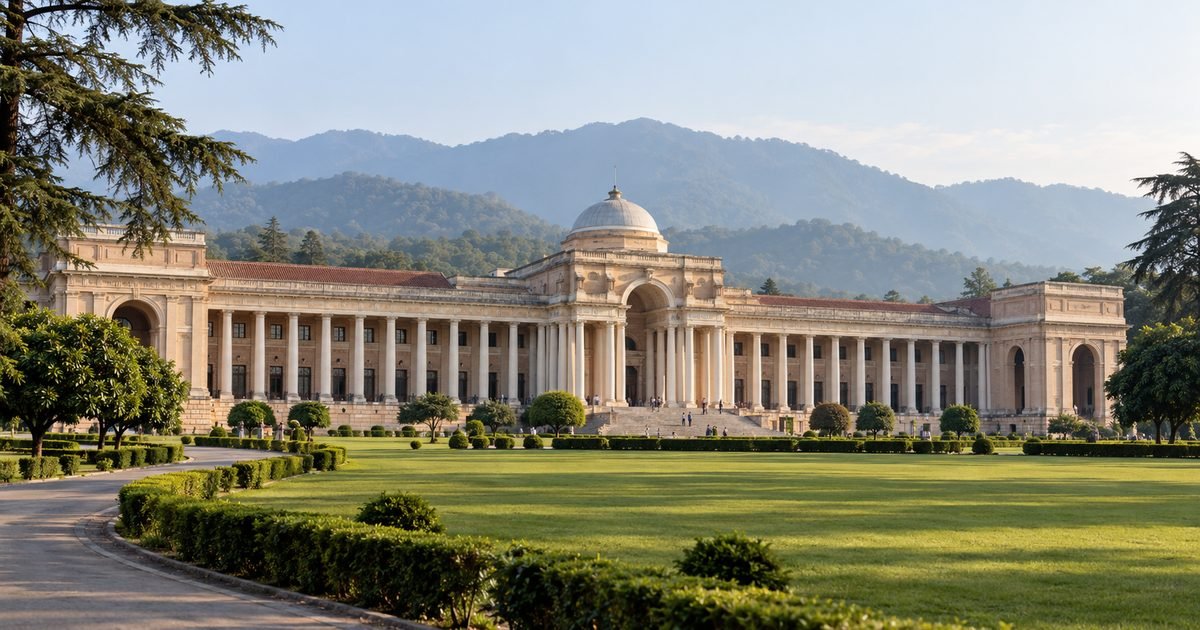
The Forest Research Institute is the building that convinces visitors Dehradun was once important — because it was. A 1,021-foot colonnade in cream stone, a seven-acre plinth, a dome, and an avenue of trees planted to make an imperial institution look inevitable. It is also, still, a working research campus with laboratories in it, which is the fact every travel page leaves out.
FRI is worth an afternoon for three reasons that have nothing to do with the photograph. The museums are genuinely good — 900 diseased-wood exhibits, 3,000 insects, a cross-section of a deodar that was 704 years old when it was felled in 1919, with Indian history from the Qutub Minar to Jallianwala Bagh marked on its rings. The herbarium behind it holds around 300,000 plant specimens and is one of the oldest in Asia. And the building itself is the best surviving statement of what scientific forestry meant to the British Empire: not a palace, an argument.
What follows is the practical version — what is inside, what it costs since the 2026 fee revision, when the gates actually open, what the six museums hold, what the standard guides get wrong (a lot, including the year the building opened), and what it is like to live in the colony FRI built around itself.
Quick answer: FRI Dehradun is open to visitors again: it reopened on 25 May 2026 with a ₹100 gate fee for Indian visitors plus ₹150 for the museums, in two sessions reported as 10:00–13:30 and 13:30–17:00. The building was inaugurated on 7 November 1929 by Lord Irwin, its colonnade runs 1,021 feet, and it stands 4.9 km from the Clock Tower on Chakrata Road. Budget two hours; the Timber Museum’s 704-year-old deodar and the 900 exhibits of diseased wood in the pathology room are the two hours worth spending.
Last verified: 30 October 2026, against the institute’s own heritage and museum documentation, the May 2026 reopening as reported in the press, the Dehra Dun Herbarium’s published history, and road distances measured on the OSRM routing graph.
01FRI at a glance
| What it is | India’s oldest forestry research institute (1906), in a building inaugurated in 1929, on a campus that is also a herbarium, an arboretum, a deemed university and the training ground for the Indian Forest Service |
|---|---|
| Full name | Forest Research Institute, Dehradun — under the Indian Council of Forestry Research and Education (ICFRE) |
| Address | Chakrata Road, FRI and College Area, Dehradun, Uttarakhand 248006 |
| Distance from the Clock Tower | 4.9 km by road, about 15 minutes outside peak hours |
| Entry | ₹100 per Indian visitor, ₹1,000 for foreign nationals — the rate set when it reopened on 25 May 2026 |
| Museums | ₹150 for Indian visitors, ₹500 for foreign nationals, on top of the gate fee |
| Hours | Two sessions, reported as 10:00–13:30 and 13:30–17:00. Arrive at the start of one |
| Time needed | 2 hours for the building and two museums; 4 hours for all six |
| The building in numbers | 7-acre plinth, 1,021 ft frontage, 276 ft deep, 63,000 sq ft of laboratories and offices, 26,000 sq ft of museum |
| Best months | October–November and February–March |
| Closed | Shut to visitors from January to 25 May 2026 during a security transition; the museums have at times been closed at weekends |
02Where FRI is, and why it is there
The institute sits on Chakrata Road, west of the city, in a forest estate it has occupied since the 1920s. In 1950 the Food and Agriculture Organization described the setting precisely: an institution standing on 1,100 acres of land four miles west of Dehra Dun at the foot of the Himalayas, on an estate called New Forest, which was “a detached residential colony in which most of the workers of the Institute live”, with its own school and hospital.
That last detail matters more than it sounds. FRI is not a monument in a city park; it is the centre of a small township built around a research campus, which is why the locality around it is still called the FRI and College Area and why the campus has residential quarters, a dispensary, and gates that get locked at night. The FAO account also noted the effect the arrangement had on visitors: the combination of research and teaching gave the place “the character and atmosphere of a Forest University”, sustained by “the fact that the Institute stands in a small detached township of its own”.
The land itself explains the siting. This is the belt where the Doon valley’s sal and deodar forest runs up towards the Mussoorie ridge, with deep soil and reliable rain — the reason Dehradun became a forestry town in the 1870s in the first place. The campus is now quoted at about 450 hectares, roughly 1,110 acres, which is a shorter measure of the same estate after a century of institutional neighbours, roads and residential colonies took their share.
03The four names, and why the file is confusing
FRI has been renamed more often than most institutions its age, and the names are not interchangeable.
- Forest School (1878). Established at Dehradun by the Government of the North-Western Provinces to train rangers and foresters — the beginning of scientific forestry in India, and the reason Dehradun rather than any other hill town became the discipline’s capital.
- Imperial Forest College (1884). The school was transferred to the Government of India and renamed — the name most histories render as Imperial Forest School, which is the same institution at a different moment.
- Imperial Forest Research Institute (1906). The research arm separated out on 5 June 1906 as an adjunct to the college. It was, by the FAO’s count, the second central research institute the Government of India set up, after the Imperial Agricultural Research Institute in 1901.
- Forest Research Institute (post-1947). “Imperial” went at independence. FRI now reports to ICFRE, the Indian Council of Forestry Research and Education, and is a deemed university under the UGC since 1991.
Two more names attach to the place and confuse searches. New Forest is the estate, not the institute. And the surrounding locality’s official name is FRI and College Area — a census town in its own right, which is why property listings and pin codes treat it as a place rather than a campus.
041878 to 1929: an empire builds an institute
The chronology is worth setting out because it is the part most guides compress into “built by the British in 1929” and lose the story.
The Forest School opened in 1878. The first research post proper — a Forest Entomologist — was created in 1900. In 1906 the Forest Research Institute was constituted with five branches: silviculture, economics, botany, entomology and chemistry. The institute moved into new quarters at Chandbagh, completed in 1914, and began the Provincial Forestry Course for officers in 1912; Chandbagh is the site the Doon School occupies today, which is why older Dehradun families still talk about the forest institute being “in town”.
By 1920 the institute had outgrown it. The government acquired an estate of about 1,200 acres in New Forest for a purpose-built campus, and construction of the main building ran through the early 1920s. It was inaugurated on 7 November 1929 by the Viceroy, Lord Irwin, and the herbarium moved across with it the same year.
The scale of the thing was deliberate. The institute’s own conservation documentation records a plinth area of seven acres, a frontage of 1,021 feet, a depth of 276 feet, 63,000 square feet of laboratories and offices and 26,000 square feet of museum space, built at a cost of ₹90 lakh. The architect was C. G. Blomfield; the contractor was Ranjeet Singh.
What FRI was for, by then, was the administration of an empire’s timber. The FAO’s 1950 account is blunt about the reach: before partition the institute’s functions extended to what is now India and Pakistan and, until Burma separated in 1937, to Burma — which kept using its research facilities afterwards anyway. Nearly every Indian Forest Service officer recruited since 1928 was trained in this building, along with the provincial services and most of the country’s forest rangers.
05The building Blomfield built
Greco-Roman is the usual label; stripped classicism is the accurate one. The colonnade runs the full 1,021 feet without ornament, because the ornament is the repetition — column after column, in the same pale stone, at the same interval, for a fifth of a mile. There is a recessed central portico, a shallow dome, and almost nothing else: no sculpture, no frieze, no imperial boasts in stone. For an institution meant to project scientific authority, restraint was the argument.
It is a brick building, and for a period it was listed in the Guinness Book of Records as the largest purely brick structure in the world — a claim that says more about 1929 than about bricks, but it is the kind of fact that sticks. The interior is institutional in the best sense: long corridors, high ceilings, terrazzo and timber, and windows placed for north light because the laboratories needed it.
Two things to do that most visitors skip. Walk the colonnade end to end rather than photographing the steps and turning back — the building only reads as architecture from the far end, where the perspective does the work. And look at the avenue: the trees along the approach are not landscaping, they are a collection, planted as an arboretum of species from across India and four continents. The reason the building sits so far back from the road is that the avenue was part of the design.
06Inside: the six museums
This is the part worth the ticket. FRI’s museums are not dioramas of stuffed animals; they are working reference collections opened to the public, and the ICFRE’s own descriptions give the numbers. Six rooms, in the order you will meet them:
- Silviculture Museum. The renovated gallery was inaugurated on 17 December 2018 by the Director General of Forests, with the renovation funded by the Ministry of Culture. It covers the evolution of forests, forest growth, and the threats — deforestation, fire, shifting cultivation, invasive plants, pests — through dioramas of tropical and temperate forest, samples of seeds, roots and bark, and models of silvicultural systems and working plans.
- Timber Museum. 126 commercially important species displayed as planks along the walls, the lower half left in its natural state and the upper half oiled with linseed so you can see what finishing does. Above each plank hang a photograph of the tree and a map of where it grows in India, and a case of photomicrographs shows the same woods at cellular scale. There is seasoning arithmetic on the wall — a cubic foot of green wood holds about 16 litres of water, and 2.7 litres remain even after seasoning — and models of air, steam and solar-kiln drying.
- The centrepiece. In the timber room: a transverse section of a 704-year-old deodar felled in 1919 in the hills of what was then the United Provinces, with events from the building of the Qutub Minar to the Jallianwala Bagh massacre marked against its rings. Beside it, a 330-year-old teak, walnut and padauk burr, and a gun-carriage wheel built from rosewood, shisham and Andaman padauk. If you look at one thing in FRI, look at this.
- Non-Wood Forest Products Museum. Resin tapping shown twice — the old conventional method against the newer rill method — with turpentine and rosin samples, bamboo species from across the country, and the commercial minor products: katha, cutch, lac, essential oils, edible and fatty oils, spices, drugs, tans and gums, along with the things made from them (walking sticks, sports goods, paper, matches, baskets).
- Social Forestry Museum. The least glamorous and the most Indian room: village productivity with and without trees, nursery techniques, planting and protection, models of improved smokeless chulhas, and the cottage industries that social forestry was supposed to support.
- Pathology Museum. 900 exhibits of tree disease and timber decay, arranged by host group — hardwood and conifer — and then by the part affected: root, stem, foliage. Heart-rot in khair, sal, teak and deodar; root-rot in khair, sal and pine; the fungi that cause it all, plus the mycorrhizal ones that help trees grow, and the edible ones.
- Entomology Museum. About 3,000 exhibits of insect pests at every stage, arranged alphabetically by plant genus: the sal heart-wood borer, teak defoliator, Meliaceae shoot borer, poplar and deodar and sissoo defoliators, babul stem and root borer, with the biology and the control methods. The termite section — life history, damage, and timber species graded by termite resistance — is the one that changes how you think about your own furniture.
Practical note: the museum ticket is separate from the gate ticket, and the museums are inside the main building. If you only have an hour, timber and pathology are the two rooms to choose; they are also the two where the exhibits are least like something you have seen before.
07Beyond the museums: herbarium, arboretum, school
Three parts of FRI that visitors mostly do not know exist.
The herbarium. The Dehra Dun Herbarium began in 1890 as the Forest School Herbarium, built on James Sykes Gamble’s own collections from Madras and Bengal plus private herbaria donated by forest officers. The Saharanpur Herbarium, started in 1816, was transferred to it in 1908; the whole collection moved to New Forest with the institute in 1929; and in 1978 it was rehoused in a modern air-conditioned building modelled on the herbaria at Edinburgh and Kew. It holds over 0.3 million specimens, was modernised again from 2017, and has a carpological museum of about 1,000 fruit and seed samples attached to it.
The campus as an arboretum. New Forest is where the institute tested species: the avenue trees, the plantation blocks, the deodar and sal stands behind the building. It is also where the Wildlife Institute of India began life before moving to Chandrabani, and where the Indira Gandhi National Forest Academy now trains Indian Forest Service officers — the same job the Forest School was founded to do in 1878.
The institute itself. FRI still runs the research divisions it was founded with — silviculture, forest protection, forest products, chemistry — and publishes the Indian Forester, among the oldest forestry journals in the world. It became a deemed university in 1991. None of that is open to casual visitors, which is the point: there is work going on behind the colonnade.
082026: the year the gates shut, and the new prices
FRI has always had an awkward double life — a research campus that also receives visitors — and in January 2026 the tension resolved into a closure. The institute shut its gates to the public during a “transition in security arrangements” and stayed shut for nearly four months.
It reopened on Monday, 25 May 2026, and on the first day recorded about 1,400 visitors. The reopening came with the first fee revision in roughly eight years, and the increase is steep: Indian visitors went from ₹20 to ₹100, foreign nationals from ₹150 to ₹1,000. Museum entry is charged separately at ₹150 and ₹500. Children pay ₹30, school groups ₹50, and vehicles are charged on top — ₹150 for a car or taxi, ₹100 for an auto-rickshaw, ₹50 for a two-wheeler, ₹300 for a bus or truck.
What visitors should take from that episode is not the price rise but the fragility. The campus closes when the institute needs it to, sessions are enforced, the museums have been reported shut at weekends, and the only reliable way to know is to ring the institute before you drive across town. The state tourism department’s own FRI page still advertises ₹20 and 9:00–17:30, which tells you how quickly the official record lags.
09Practicalities: fees, sessions, what to expect
- Gate fee: ₹100 per Indian visitor, ₹1,000 for foreign nationals. Pay at the main gate; there is no online booking.
- Museums: ₹150 for Indian visitors, ₹500 for foreign nationals — per person, on top of the gate. Children ₹30, school groups ₹50.
- Vehicle: car or taxi ₹150, auto ₹100, two-wheeler ₹50, bus or truck ₹300. If you are arriving by cab, agree who pays the vehicle charge before you start.
- Sessions: reported as 10:00–13:30 and 13:30–17:00. Two sessions means one hard cut-off in the middle of the day; plan around it rather than discovering it at the counter.
- Weekends: the museums have been reported closed at weekends during parts of 2026. If a Saturday visit matters, ring first — the institute’s number is on the campus website.
- Photography: restricted inside the campus and policed unevenly. Ask at the counter; do not assume.
- Carry: water, because the walk from gate to building is fully exposed and long, and cash or UPI for the museum ticket. There is no cafe worth the name inside.
- Accessibility: the colonnade and museums are on the level, with steps at the main portico. The grounds are large and the distances are real.
10How to reach FRI
FRI is the easiest major site in Dehradun to reach: on Chakrata Road, signed, with a proper gate and a car park.
| From | Road distance | Notes |
|---|---|---|
| Clock Tower / city centre | 4.9 km | 15 minutes outside peak hours |
| Dehradun railway station | 6.1 km | Direct along the same axis |
| ISBT | 8.7 km | Auto or city bus towards Chakrata Road |
| Jolly Grant airport | 29.1 km | 40–50 minutes |
| Robber’s Cave (Gucchupani) | About 12 km | The other end of the same half-day |
11The best time to go
| Window | What you get | The trade-off |
|---|---|---|
| October–November | Clear light on the colonnade, the ridge visible behind, comfortable walking | Post-monsoon crowds at weekends |
| December–February | Empty museums, cold, and the clearest long views of the year | Fog can hide the ridge until 10 am, and the building is colder than the city |
| March–April | The lawn season; flowering trees; the best all-round visit | School groups and family weekends |
| May–June | Early mornings are still cool, and the light is hard and clear | Hot on the walk from gate to building; go at 10 am sharp |
| July–September | The campus at its greenest, with the forest at full leaf | Flat light, wet grounds, and the museums can shut without notice |
If you have one visit in you: a weekday in February or late October, first session, straight to the timber museum before the groups arrive.
12Five things the standard sources get wrong
- “Inaugurated in 1926” — or “by Lord Willingdon”. Both appear on Wikipedia, in the same article, and they contradict each other. The institute’s own conservation documentation is explicit: inaugurated by the Viceroy, Lord Irwin, on 7 November 1929. The campus page gives the same 1929 date. Lord Willingdon was not Viceroy in 1929.
- “Entry is ₹20.” It was, until 25 May 2026. It is now ₹100 for Indian visitors with ₹150 for the museums and separate vehicle charges. The state tourism department still publishes the old figure, and so does every blog that copied it.
- “FRI is 7 km from the Clock Tower.” Measured on today’s roads it is 4.9 km, about fifteen minutes. The 7 km figure is repeated from Wikipedia down and is closer to the distance from the railway station (6.1 km) than from the Clock Tower.
- “Six museums” vs “five museums”, unresolved. FRI’s own museum navigation lists five; the ICFRE museum page describes six, including the Social Forestry Museum; the institute’s heritage document counts five museums plus a Technology Demonstration Centre. The six rooms exist — the arithmetic differs by what you count as a museum. Plan for six.
- “The campus is 450 hectares” — or 1,100 acres, or 1,200. All three appear, and all three are describing different moments: 1,200 acres acquired in 1920, 1,100 acres in the FAO’s 1950 survey, about 450 hectares (roughly 1,110 acres) for today’s campus. The land did not shrink so much as get measured differently and, in places, handed to neighbours.
13What living in the FRI and College Area is like
This is one of Dehradun’s older institutional neighbourhoods, and it behaves like one: wide roads, deep plots, mature trees, and a mix of government quarters, family houses and small societies built in the last fifteen years. The FRI gate is the landmark, but the locality’s identity is the forest — the campus edge, the Chandrabani side, the road up to Kaulagarh.
What is within reach: FRI itself at 0.3 km from the locality centre, Synergy Institute of Medical Sciences at 1.4 km, Vikas Mall at 2.1 km, Ann Mary School at 2.2 km, and the Balliwala Chowk bus stop at 2.3 km. The Clock Tower is 4.9 km. That combination — a hospital, a school, a mall and the city centre all inside five kilometres, with a forest campus on the doorstep — is why this area holds its value without much new supply.
| Segment | Current range (late 2026) |
|---|---|
| Buy — plots in Chandrabani (the FRI side) | ₹2,850–4,900 per sq ft on land; a 280 sq yd plot listed at ₹71.4 lakh, a 288 sq yd plot at ₹57.6 lakh, a 345 sq yd plot at ₹88.96 lakh |
| Buy — smaller plots | From about ₹2,350 per sq ft at the bottom of the range (a 1,274 sq ft plot at ₹30 lakh) |
| Rent — 2 BHK independent house, Kaulagarh Road | About ₹19,000 for 2,000 sq ft, semi-furnished |
| Rent — 1 BHK independent house, Van Vihar side | About ₹16,000 for 1,500 sq ft, furnished |
| City reference | Dehradun flats average about ₹7,450–8,100 per sq ft; the Sahastradhara Road corridor runs ₹5,917–10,619 |
| Market direction | The NHB RESIDEX index for Dehradun rose about 12.4% year-on-year to June 2026 — one of the steeper rises in the country |
The honest downsides:
- Institutional land, institutional rules. Large parts of this area are campus, government quarters or defence-adjacent land. Title and land-use questions are not academic here; a plot that looks like a bargain is often one with a restricted transfer or an unclear tenure.
- Chakrata Road traffic. The road is the only approach and it carries the Selaqui–Dehradun commute. The 4.9 km to the Clock Tower is fifteen minutes at 8 am and thirty at 6 pm.
- Thin rental supply. Rentals here are mostly individual houses and quarters, not societies with amenities. If you want a gym, a lift and a guard, you are looking at the wrong side of town.
- Water. Ask specifically about supply hours and whether the building runs a tanker in May. It is the standard Dehradun question, and the older colonies answer it less well than the new ones.
- Nothing new is being built. That is the upside for value and the downside for choice: the stock is what it is, and the good houses pass between families rather than reaching the portals.
Current rentals and listings in the area are on our marketplace, and owners can add a property free. If you are buying rather than renting, run the checks we do before shortlisting a plot — in this locality the title question decides more purchases than the price does. Tenants new to the city should start with where to look for a PG in Dehradun.
14Frequently asked questions
Is FRI Dehradun open to visitors now?
Yes. It closed in January 2026 during a security transition and reopened on 25 May 2026. Visitor hours are reported as two sessions, 10:00–13:30 and 13:30–17:00, with the museums sometimes closed at weekends.
What is the FRI entry fee in 2026?
₹100 per Indian visitor at the gate, ₹1,000 for foreign nationals. The museums cost ₹150 for Indians and ₹500 for foreign visitors, charged separately. Children pay ₹30 and school groups ₹50.
How many museums are there at FRI?
Six: silviculture, timber, non-wood forest products, social forestry, pathology and entomology. The institute’s own navigation lists five and its heritage document counts five plus a Technology Demonstration Centre; the ICFRE museum page describes all six.
How far is FRI from the Clock Tower?
4.9 km by road, about fifteen minutes outside peak hours. It is 6.1 km from the railway station and 8.7 km from ISBT.
What is the most interesting thing inside FRI?
The transverse section of a 704-year-old deodar in the Timber Museum, felled in 1919, with dates from the Qutub Minar to Jallianwala Bagh marked against its growth rings. The Pathology Museum’s 900 diseased-wood exhibits are the other room worth real time.
Can you visit FRI’s herbarium?
Not casually — it is a research facility holding over 300,000 specimens, not a public gallery, and access is by arrangement. The museums are the public part of the collection.
Is photography allowed at FRI?
It is restricted inside the campus and enforced unevenly. Ask at the ticket counter before you start; the building is photographed constantly from the lawn, and the museums are stricter.
Was FRI built in 1929?
The building was inaugurated on 7 November 1929 by the Viceroy, Lord Irwin. The institution is older: the Forest School dates to 1878 and the Imperial Forest Research Institute to 1906.
Is FRI worth visiting?
Yes, if you like buildings or trees. It is the best colonial building in Dehradun and the museums are better than any forestry display in the country. It is not a theme park, there is nowhere good to eat, and ninety minutes is a waste of the ticket.
15Where to go next
FRI pairs naturally with the forest side of the valley. Robber’s Cave at Gucchupani is a narrow stream gorge about twenty minutes away and makes the other half of a morning, while Sahastradhara further up the same road is the springs-and-ropeway outing. For the city centre — market, parking, and what it costs to live there — the Clock Tower and Paltan Bazaar guide is the companion piece.
And if the FRI area is on your shortlist as somewhere to live, walk it on a weekday morning rather than a Sunday: the campus edge, the Chakrata Road traffic, the walk to the school and the distance to a supermarket all become obvious in twenty minutes. Our marketplace carries what is currently listed; owners can add theirs.
Two more Doon places, same treatment. Mindrolling Monastery in Clement Town is free to enter, has a 185-ft stupa you can walk up, and sits in the one Tibetan town in the valley — with Clement Town rents and rates in the same piece. Tapkeshwar Mahadev is the other end of the same idea: a natural cave 5.7 km from the Clock Tower where water drips onto an uncarved shivalinga, and the guide covers the flood risk and the Garhi Cantt rental market.
Fees, hours and dates in this guide were checked on 30 October 2026 against FRI’s heritage documentation, the institute’s museum descriptions, the Dehra Dun Herbarium’s published history, the FAO’s 1950 survey of the estate, the May 2026 reopening as reported in the press, and road distances measured on the OSRM routing graph. Sessions and museum hours change without notice — ring before travelling.
1 Comment
[…] is the southern anchor of the valley. FRI is the other great institutional building in the city — a 1,021-foot colonnade, six museums and a […]