

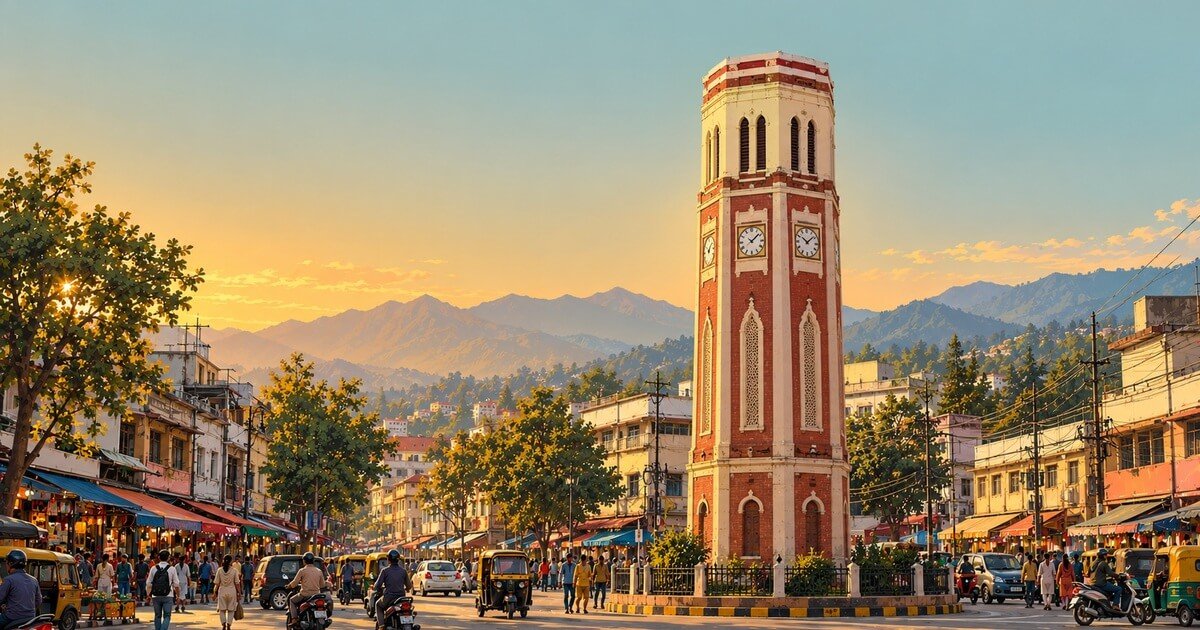
Every road in Dehradun eventually makes its way to the Clock Tower. Rajpur Road comes down from Mussoorie into it, Chakrata Road arrives from the west, Haridwar Road from the south, and Paltan Bazaar Road runs into its base. Locals call it Ghanta Ghar. Ask for directions anywhere in the city and the answer will involve it. Buses stop near it, vikrams pass it, three generations of Dehradun residents have used it as the place to meet.
It is also the most over-described and least verified monument in Uttarakhand. Travel sites tell you it is built by the British, that it is 85 metres tall, and that Sarojini Naidu inaugurated it. All three are wrong. This guide covers what the tower actually is, when it was built and by whom, why the six dials have been silent more often than not over the last two decades, and the practical things nobody puts in a listicle — where to park, when the bazaar closes to vehicles, and what living this close to the centre actually means.
Last verified: 28 October 2026, against Dehradun Municipal Corporation reporting, district administration notices and the contemporary press record.
01The Clock Tower at a glance
| What it is | Hexagonal, six-faced clock tower — the geographic and commercial centre of Dehradun |
|---|---|
| Local name | Ghanta Ghar. Originally named Balbir Clock Tower |
| Construction began | 24 July 1948 — foundation stone laid by Sarojini Naidu, then Governor of the United Provinces |
| Inaugurated | 1953, by Lal Bahadur Shastri, then Union Minister for Railways |
| Built in memory of | Lala Balbir Singh, commissioned by his son Lala Sher Singh |
| Address | Clock Tower, Paltan Bazaar Road, Chukkuwala, Dehradun 248001 |
| Entry fee | None. It is a traffic junction, not a ticketed monument |
| Can you go inside | No. There is no public access or staircase to the top for visitors |
| Time needed | 20–30 minutes for the tower, 1–3 hours if you walk Paltan Bazaar |
| Railway station | About 2 km |
| ISBT | About 7 km |
| Jolly Grant airport | About 26 km |
| Best hours | Before 9 am, or after 7 pm. Full-day pedestrian access, no barrier |
02Where it actually stands, and why the city grew around it
The Clock Tower sits at a junction that no city planner designed but every planner has had to live with. Four of Dehradun’s main arteries meet in a ring around it: Rajpur Road on the north side, Chakrata Road to the west, Haridwar Road heading south-east, and Paltan Bazaar Road running through the market. That single fact explains most of what the place is — the commercial centre, the busiest traffic point, and the default meeting spot, all at once.
The bazaar in front of it was the trading spine of Dehradun long before the tower existed. Timber, grain and cloth moved through this corridor in the colonial period, and the lanes running off it — Dhamawala, Peepal Mandi, Macchi Bazaar, Chukkuwala — still follow the old grain-and-timber layout rather than anything modern. When the tower was finally raised in the early 1950s, it was placed on ground that had already been the centre of town for the better part of a century. The city did not grow around the tower; the tower was dropped into the middle of a city that was already there.
That is why the surrounding streets are so tight. This is not a planned plaza with setbacks and footpaths; it is a market street that happened to get a 1950s monument built over the crossroads. It also means the tower works as a landmark in the way a roundabout does — it orients you, it is where autos and vikrams change direction, and every local reference to “the Clock Tower” means the area as much as the building.
03The history, properly dated
The commonly repeated version — “built by the British before independence” — is simply not true, and the confusion is understandable: the bazaar looks colonial, and the tower is brick and cream in the same idiom as the Raj-era buildings a kilometre away. But the tower is a post-independence structure, and the record is unusually precise about it.
Construction began on 24 July 1948. The foundation stone was laid by Sarojini Naidu, who was then Governor of the United Provinces. The tower was raised in memory of Lala Balbir Singh, a local resident, at the instance of his son Lala Sher Singh — which is where the original name, Balbir Clock Tower, comes from. It took roughly five years to complete and was inaugurated in 1953 by Lal Bahadur Shastri, at that time the Union Minister for Railways.
The tower was conceived as a marker of independence as much as a timepiece. A gold plaque inside the premises carries the names of Dehradun’s freedom fighters, and a commemorative plaque inside records the construction history — including the fact that the total cost came to somewhere around ₹1.5 lakh, a serious sum for a municipal project in 1948.
| Year | Event |
|---|---|
| 24 July 1948 | Foundation stone laid by Sarojini Naidu, Governor of the United Provinces |
| 1948–1953 | Construction of the hexagonal tower; six Swiss clock movements installed |
| 1953 | Inaugurated by Lal Bahadur Shastri, Union Minister for Railways |
| c. 2009–2015 | Original pulley-wound movements fail and then stop showing time altogether |
| 29 August 2019 | Six new electronic clocks installed; the tower chimes again after about a decade |
| September 2024 | Copper wiring and mechanism stolen; all six dials go silent — the third such incident in recent years |
| After 2024 | District administration funds a full repair: wiring, GPS unit, loudspeaker and bell system replaced |
04The clocks have their own story
The original clocks were Swiss, and they were mechanical. Someone had to wind each movement with a pulley every morning, which tells you how the tower was meant to be run: as a piece of maintained civic machinery, not a decorative object. That arrangement survived for decades and then quietly failed. By the late 2000s the chimes had stopped; a few years later the hands stopped moving as well.
In August 2019 the municipal corporation replaced all six movements with electronic clocks bought from a Chennai supplier, at a reported cost of about ₹9 lakh. A dedicated power connection and an inverter were installed so the tower would keep time through outages, and the six faces began striking the hour again on 29 August 2019 — the first time in roughly a decade.
That lasted five years. In September 2024 the tower went silent again, and this time it was not wear. Thieves had got in, cut the wiring and dismantled the copper components; municipal engineers found signs of forced entry. It was reported as the third such attack on the tower in recent years, and the police said they had learned about it from media reports rather than a complaint. The story got national coverage, largely because of what the silence meant to people who had grown up hearing those bells.
The repair that followed was ordered at district level and carried out by a Chennai-based clock specialist, which replaced the faulty wiring along with the GPS module, loudspeaker and bell system. The chimes are working again as of the most recent reporting. The pattern is worth understanding when you visit: this is a monument whose clock has spent a large share of the last twenty years either broken, silent, or being repaired. If you happen to hear it strike while you are standing there, you are getting the good version.
05What you actually see when you get there
Six faces on a hexagonal brick body, cream-painted, with arched openings and a small domed cap. That is it — and that is the point. The tower is roughly six storeys of masonry, not a cathedral, and it reads best at street level with the bazaar moving around it rather than as a monument you contemplate.
- Photographs: the classic frame is from the south-west, with the tower and the Rajpur Road traffic behind it. Early morning gives you clean light and empty roads; after dark the tower is lit and the junction is a mess of headlights.
- The plaque: the gold plaque with the freedom fighters’ names and the commemorative plaque recording the tower’s construction are at the base. Most visitors walk past them.
- No climbing: there is no public staircase to the top and no viewing gallery. Guides that promise a view over the city are describing a different building or a different decade.
- Accessibility: the pavements around the junction are narrow, broken in places, and often occupied by parked two-wheelers. Anyone with a stroller or a wheelchair should approach from the Paltan Bazaar side, where the pedestrian zone gives you actual space.
06The bazaar around it is the real attraction
The tower takes twenty minutes. Paltan Bazaar takes the afternoon. The market running south from the junction is where Dehradun shops — garments, shoes, fabrics, school uniforms, kitchenware, mobile repairs, sweets — and it is one of the few genuinely old commercial streets left in the city.
Since the traffic plan was reworked, Paltan Bazaar, Dhamawala, Macchi Bazaar and Peepal Mandi are vehicle-free zones for most of the day. Only pedestrians get in. Loading vehicles are barred from Paltan Bazaar between 10 am and 9 pm, and traders need tokens to bring vehicles inside at all. Practically, this means the shopping street is walkable in a way most of Dehradun is not — and it also means you cannot drive up to a shop door, so plan to park first and walk in.
Within a short walk of the tower you also have the GPO, the Parade Ground, Gandhi Park, Astley Hall, the Tibetan Market and Gurdwara Nanaksar. That cluster is what makes the Clock Tower useful as a base for a half-day in the city rather than a single photo stop.
07How to reach the Clock Tower
Everything converges here, which makes it the easiest place in Dehradun to reach and the hardest to drive through.
| From | Distance | Best option |
|---|---|---|
| Dehradun railway station | ~2 km | Auto or a 25-minute walk down Gandhi Road |
| ISBT | ~7 km | City bus or vikram; both run towards the centre |
| Jolly Grant airport | ~26 km | Taxi; 45–60 minutes outside peak hours |
| Rajpur Road / Mussoorie side | — | Any Rajpur Road vikram or bus terminating in the city |
| Haridwar / Rishikesh | — | Bus to ISBT, then local transport; or get off at Saharanpur Chowk |
Vikrams and city buses no longer drop passengers right at the junction. Drop and pick-up points have been shifted to Globe Chowk, Survey Chowk, Doon Chowk, MKP Chowk, Orient Chowk and Rangers Ground, all within a short walk. If a driver offers to take you “right up to the tower”, expect to be waved off a couple of hundred metres away.
08Parking and the traffic rules nobody tells you
The Clock Tower junction is a barricade point. Under the traffic plan, police put up barriers at Clock Tower, Buddha Chowk, Survey Chowk, Darshan Lal Chowk and Raja Road to stop vehicles entering the market core, and during heavy flow traffic coming from Darshan Lal Chowk towards the tower is diverted to Lansdowne Chowk.
- Cars: the MDDA parking complex at the Clock Tower is the main option, with Rangers Ground, the Nagar Nigam premises and the Rajiv Gandhi shopping complex as overflow.
- Two-wheelers: Gandhi Inter College and CNI School near the market are the designated lots; both are a short walk from the bazaar.
- Fines: illegal parking in the core is being enforced at ₹1,200. The roadside stretches near Paltan Bazaar are the usual target.
- Timing matters: the market core is pedestrian-only for most of the day, so an early arrival is not just about crowds — it is the difference between parking near the tower and parking four hundred metres away.
09The best time to go
Two windows work, for opposite reasons.
| Window | What it gives you | Trade-off |
|---|---|---|
| 6:30–9:00 am | Empty roads, clean light, tea and jalebi stalls setting up, easy parking | Most shops still shut |
| 10 am–1 pm | Full bazaar, everything open | Peak congestion, worst parking |
| 5–8 pm | Tower lit up, evening shopping, food stalls out | Heaviest traffic of the day, festival crowds near Diwali |
| Monsoon (Jul–Aug) | Fewer visitors | Waterlogging and open drains around the junction |
If you want the tower itself rather than the bazaar, come before 9 am. If you want to understand why Dehradun treats this spot as its centre, come on a weekday evening and watch the junction work.
10What it is actually like to live this close to the Clock Tower
Plenty of people do — the lanes behind Paltan Bazaar and around Chukkuwala are full of rented rooms and small flats, and the whole appeal is obvious: you can walk to the market, the hospital end of town, the railway station and half the offices in the city without touching a vehicle.
What that convenience costs you is worth knowing before you sign anything.
- Noise is constant. Not the bazaar chatter — the traffic. The junction carries Rajpur Road traffic into an intersection, so horns start before 8 am and continue past 9 pm. Flats facing the ring road are materially louder than flats one lane back.
- Parking is the binding constraint. If your rental does not come with an allotted space, you are competing for a public lot several hundred metres away, and you are parking and walking every single day. Ask specifically where the vehicle goes before you agree to anything.
- One lane back changes everything. The difference between a first-floor room over Paltan Bazaar Road and a room in the lane behind it is bigger than the rent difference suggests.
- Water and drainage. The core is old-city infrastructure. Ask about supply hours and check the lane after rain, not in the dry season.
- Festival weeks. Diwali and Dhanteras turn the whole area into a pedestrian crush with diversions and barricades. If you work from home, that is a week you will not enjoy.
For anyone doing the maths on a move to the centre, the honest framing is: you are buying walkability with noise and parking. If you need a vehicle daily, the trade rarely pays. If you do not, it is one of the few parts of Dehradun where you genuinely do not need one.
If you are looking for a place in this belt, the current rental and PG listings are on our marketplace, filtered by area — and if you own a flat or run a PG within walking distance of the Clock Tower, you can list it here. Two related guides are worth reading first: where to look for a PG in Dehradun and whether a PG or a rented flat makes more sense. Owners should read how to rent out a flat without a broker and the documents to have ready before you list.
11Four things the standard guides get wrong
Almost every listicle about the Clock Tower repeats the same four errors. They matter, because they are the reason the tower is described as a colonial monument when it is really one of the first things independent Dehradun built for itself.
- “Built by the British before independence.” No. Construction started on 24 July 1948, after independence, and finished in 1953. The bazaar around it is older; the tower is not.
- “Sarojini Naidu inaugurated it in 1953.” She laid the foundation stone in 1948, as Governor of the United Provinces. The inauguration was by Lal Bahadur Shastri in 1953. Both are true statements about two different events, and they get merged constantly.
- “85 metres tall.” This figure is copy-pasted across travel sites and does not survive a look at the building. The tower is a six-storey brick structure; 85 m would make it roughly three times the height of the buildings around it. Treat the number as an error that spread, not a measurement.
- “The clocks are Swiss and still working.” The originals were Swiss and mechanical, wound daily by pulley. They were replaced wholesale in 2019 with electronic movements, then stripped by thieves in 2024 and repaired again. The Swiss clockworks are history, not hardware.
12Frequently asked questions
Why is it called Ghanta Ghar?
Ghanta Ghar is Hindi for “clock house”. The tower’s original name was Balbir Clock Tower, after Lala Balbir Singh, in whose memory it was built. Ghanta Ghar is what the city actually calls it.
Is the Clock Tower clock working now?
It was restored after the September 2024 theft of its copper wiring and mechanism, with the wiring, GPS module, loudspeaker and bell system replaced. It has been broken or silent for long stretches over the last twenty years, so do not plan a visit around hearing it chime.
Can you go inside or climb the Clock Tower?
No. There is no public access and no viewing gallery at the top. It is viewed from the junction and photographed from street level. Entry is free because there is no ticketed area.
What is the best time to visit the Clock Tower?
Before 9 am for clean light, empty roads and easy parking, or after 5 pm when the tower is lit and the bazaar is at full volume. Avoid 11 am to 4 pm if you are driving — that is peak congestion at the junction.
Where do you park near the Clock Tower?
The MDDA parking complex at the Clock Tower is the main car park, with Rangers Ground, Nagar Nigam premises and the Rajiv Gandhi shopping complex as overflow. Two-wheelers use the Gandhi Inter College and CNI School lots. Illegal parking is fined ₹1,200, so use the lots.
How far is the Clock Tower from Dehradun railway station?
About 2 km — a short auto ride or a 25-minute walk. It is roughly 7 km from ISBT and 26 km from Jolly Grant airport.
Is the Clock Tower the centre of Dehradun?
Yes, in every practical sense. Rajpur Road, Chakrata Road, Haridwar Road and Paltan Bazaar Road all meet here, and the main market runs off the junction. Distances in the city are routinely described from it.
Why does the tower have six faces?
It is hexagonal, so there is a dial on each of its six sides. That is what makes it unusual — most Indian clock towers are square with four faces, and a six-faced tower is rare enough that it is the building’s defining feature.
13Where to go next
The Clock Tower is the natural starting point for the centre of Dehradun rather than a destination on its own: walk the bazaar, cross to the Parade Ground, and you have covered most of what the old city offers on foot. If you are new to the city and working out where to live, start with the areas around this junction and then work outwards — the rental and PG listings are on our marketplace, and owners listing a flat or PG in the centre can put it up here.
Dates, costs and repair details in this guide are checked against municipal and district reporting as of 28 October 2026. The clock’s operational status changes — the tower has been broken, stolen from and repaired repeatedly since 2019 — so treat the current condition as the last known state, not a guarantee.