

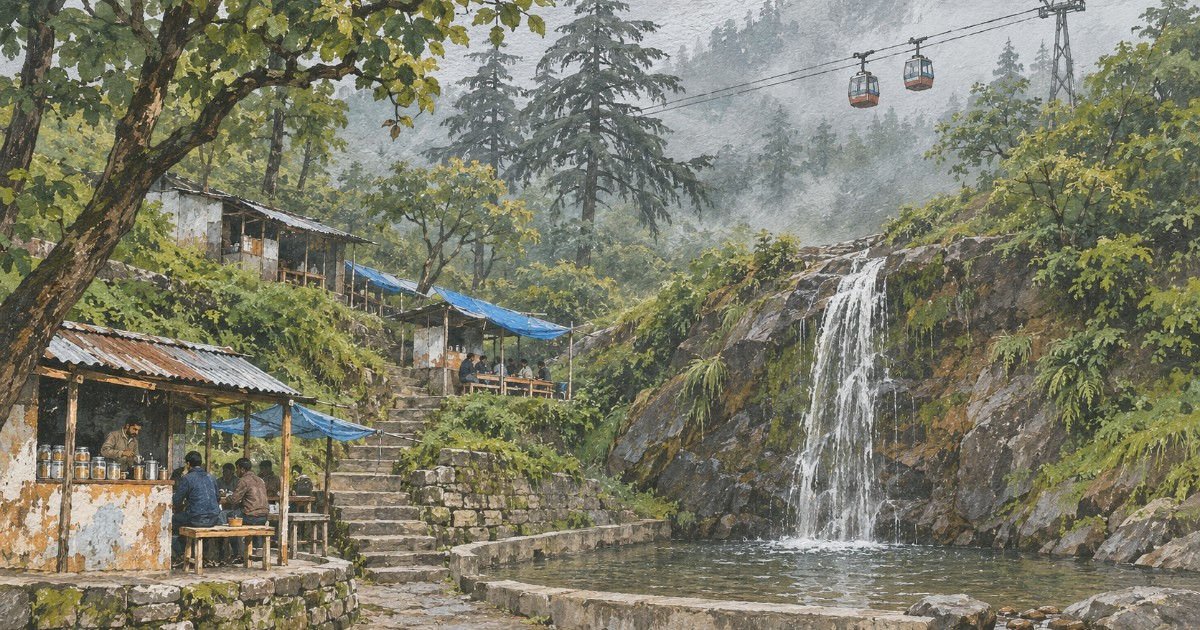
Bhatta Falls is the waterfall you pass on the way up to Mussoorie without noticing. It sits below the road, eight kilometres short of the town, at the bottom of a steep stair of shops and tea stalls — a modest fall of about thirty feet dropping into a rock pool that children splash in all summer.
It is also, and this is the part almost no guide mentions, the visible end of a power scheme running since 1907. The water that falls at Bhatta is the water that turns the turbines at Galogi, one of the first hydro-electric stations the British built in India and the only one of its generation still generating. That fact explains most of what is odd here: the concrete pools, the level that jumps after rain, and the deepest structure on the site not being a swimming pool at all.
This guide covers both, the picnic and the machinery, because the safety advice only makes sense once you know what is upstream.
Quick answer: Bhatta Falls is a free-to-enter, roughly 30-ft waterfall and bathing pool in Bhatta Gaon, 30.5 km from Dehradun’s Clock Tower and 8.2 km short of Mussoorie on the Dehradun–Mussoorie road. Entry costs nothing; the ropeway from the road costs about ₹150–250 return depending on which year’s fare list you read. It is open roughly 8 am to 5 pm. One man drowned in the pool on 6 February 2024, there is no lifeguard, and the water rises fast after rain in the catchment above.
Last verified: 5 November 2026, against the Dehradun district administration’s Mussoorie page, Navbharat Times and Amar Ujala reporting, Times of India’s 2014 investigation and its 2015 report on the Galogi power station, Himalaya Today’s September 2025 flood coverage, a July 2026 Amar Ujala report on the fall’s water level, live Square Yards locality pages, and distances measured on the OSRM routing graph the same day.
01At a glance
| What it is | A stepped waterfall and concreted bathing pool in the Bhatta gad, with a short passenger ropeway from the road and tea stalls above it |
|---|---|
| Where | Bhatta Gaon, Mussoorie, Dehradun district 248179 — on the Dehradun–Mussoorie road, below Barlowganj |
| Distance from the Clock Tower | 30.5 km, about 31 minutes on the routing graph (measured 5 November 2026); 8.2 km short of Mussoorie town |
| Entry | Free to the falls. The ropeway is a separate paid ride; the children’s park has its own charge |
| Timings | Roughly 8 am to 5 pm. Listings saying 6 pm are quoting the ropeway’s summer hours |
| Time needed | One and a half to two and a half hours, including the descent and the stalls |
| Best months | October–November and March–June. Avoid July to mid-September |
| Watch out for | Slippery steps, no lifeguard, a pool deeper than it looks, and a level that jumps after rain upstream |
02What and where it really is
The Dehradun–Mussoorie road climbs out of the Doon valley through Rajpur and Malsi and then works along the southern face of the ridge. Eight kilometres before the town, at a bend called Kyar Kuli, a side road drops into Bhatta Gaon, and at the bottom of that drop a stream comes off the ridge and falls over a step of rock.
The stream is the Bhatta gad, and it is not a mountain river in any grand sense. It drains the slope directly above — orchards, deodar and oak — and, importantly, the town. Most of the rainwater falling on Mussoorie’s built-up area runs off into this one channel. That is why the fall exists, and why it behaves as it does: Amar Ujala reported on 31 July 2026 that after a night of heavy rain the level rose suddenly and the fall “showed its furious form” — the town’s runoff arrives all at once.
Geologically you are on the limestone and dolomite belt under the whole ridge — the same rock that gives Sahastradhara its tufa terraces. The step the water falls over is a harder band in that sequence, and the pool below is not a natural plunge basin: engineers impounded it, and decades of bathers concreted it.
03The name
Bhatta is the village, and the fall is named for it. Bhatta Gaon is an old settlement on the Mussoorie face — older than the resort above it, which the district administration dates to Captain Young’s arrival in 1827 — and the area appears on maps as Kyar Kuli Bhatta, pairing the village with the spur above it. The pincode on this side is 248179.
Bhatta in this part of Garhwal usually attaches to a clan name or a stone-built quarter, and local accounts treat it that way; there is no published etymology, and travel sites offering one are guessing. The spelling is worth knowing: Google’s place record is bhatta falls, and the pin it drops sits on the stream below the road rather than at the gate. Some listings render it Bhatta Fall, others Bhattafall as one word. The Hindi is भट्टा फॉल.
Two distinctions matter when you search. This is not Kempty, eleven kilometres beyond the town, bigger, busier, and where the coach traffic goes. And the falls are in Dehradun district even though listings file them under Mussoorie — the municipal boundary runs through here, and the shops’ address says Mussoorie.
04A waterfall built for a power station
In 1902 the Mussoorie Municipal Board began planning a hydro-electric scheme. The first choice of site was the water at Kempty, five miles down the ridge; the story in local histories is that the Tehri princely estate would not part with it, and the board turned to the Bhatta gad instead. The foundation stone at Galogi was laid on 4 October 1907 by H W Reynolds, then commissioner of Meerut. Six hundred labourers built it, materials came up on bullock carts, and the bill was ₹7.5 lakh.
The plant went into service with two 500 kW turbines; two more of 1,000 kW followed in 1933. Water reaches it through a pipeline nearly 1.4 km long, laid from Bhatta Gad with sixteen thrust anchors to hold it against the pressure. Galogi is 22 km from Dehradun, and Barlowganj and parts of the Doon valley are still on it. The Times of India, visiting in 2015, found it working after more than a century: the only survivor of four plants the British commissioned that year at Chamba, Darjeeling, Mysore and here.
Two good sources contradict each other on the first supply. The Times of India gives 9 November 1912 for the first electricity and the lighting of houses; the Miedema history of Mussoorie, excerpted in the Economic Times, gives 24 May 1909 — Empire Day — for the town’s electric lights, and notes Mussoorie had electricity before Lucknow. Both can be right about different things: a plant generates before a network reaches every house. What is not in doubt is that the scheme was running by 1909 and that this waterfall is its intake.
The pool below the fall is therefore not primarily a swimming pool; it is part of a working water system. The Times of India’s 2014 report describes water from the fall being stored here and sent down to Galogi, and the deepest structure — about 70 feet — as an unmanned pool with no railings, inside a compound marked by a rusted tin sign saying the area is closed to the public. Standing at the bathing pool looking up at the fall, the machinery that matters is behind you.
05What you actually see
A rock face about thirty feet high, with water coming over it in a sheet that thins to a trickle by late winter and turns brown and loud for a week after a monsoon storm. Below it, a concrete-edged pool, knee to waist deep for most of its width, with a deeper corner filling with leaf litter. Around it, a horseshoe of small shops — Maggi, tea, corn, swimwear — built into the slope.
The ropeway is the other half of the view: two 12-seat cabins running from a station at road level to a landing beside the pool, a ride of a few minutes that clears the canopy and is the only place you see the fall from above. On a Sunday the queue at the top is longer than the ride.
What there is not: no changing rooms worth the name, no lifeguard, no depth markers, no lighting after dusk, no signage you would call an official safety notice. Children’s swings sit on the terrace above the shops; parking is on the road shoulder and in a rough lot at the ropeway station.
And it is small — a village spot rather than a natural spectacle. The pleasure is proximity: twenty minutes off the highway, cold water, tea arriving. Not scale.
06Current condition: what the last three years did to it
Bhatta’s modern history is a place handed between custodians. In 2014 the Times of India found it managed by the Mussoorie Nagar Palika after the Hotel Association of Mussoorie gave it up; the association’s president recalled a first year of 50,000 visitors and years of unanswered complaints. The report describes railings broken for five or six years, plastic in the water and no sign on the road pointing to the falls.
The ropeway changed the arithmetic. It opened in July 2019 — the date the travel listings give is 1 July — and is run by a private concessionaire, Shail Shikhar Ropeway Private Limited, whose address is Bhatta Gaon. Two cabins, twelve seats each. Whatever else it did, it put a paying attraction at the bottom of a village that earned nothing from the waterfall, and the strip of shops above the pool grew around it.
Then came the accident. On the night of 6 February 2024 a man slipped and drowned in the pool beside the falls. Amar Ujala and Garhwal Kesari name him as Yogesh Thapa, 50, a security guard from Chandrabani in Dehradun; the Mussoorie station officer, Arvind Chaudhary, said his foot slipped and he went into the water at about 10 pm. Police and fire service recovered the body. It is the only death at the falls I have been able to document, and it happened at night, at a site with no lighting and no barrier.
The water has done more damage than the visitors. On 15–16 September 2025 the Doon valley took a storm that killed 31 people across the district, and at Bhatta the fall came down in spate: Himalaya Today reported on 17 September that water and debris had filled more than seven shops beside the fall, destroying stock and furniture, and quoted a shopkeeper, Deepak. It happened again on 31 July 2026, when Amar Ujala photographed the fall in flood after a night of rain.
The slower damage is what tourism officials talk about. In September 2024 the Times of India reported environmentalists naming Kempty and Bhatta as the two Mussoorie falls already degraded by unchecked tourism — litter, bathing in what is effectively the town’s drainage, no waste management. A proposal in that report, an “ecosystem service fee” at popular falls to fund toilets, waste collection and policing, has not been implemented at Bhatta, where the only charge is the ropeway.
07Practicalities
The fees are the most confused thing here, so, bluntly: entry to the falls is free. You pay for the ropeway and, if you use it, the children’s park. Navbharat Times, writing in 2024, put the cable ride at ₹150 and confirmed there is no entry fee; reports through 2025 and 2026 quote ₹200 and ₹250, and several 2026 listings still print ₹100. They cannot all be right. Carry ₹250; the fare is cash at the counter.
| Item | Detail |
|---|---|
| Entry to the falls | Free — no ticket counter at the fall itself |
| Ropeway, return | Quoted at ₹150 (2024 reporting) and ₹250 (2024–26 visitor reports). Cash only |
| Children’s park | Separate small charge; the figure quoted locally is ₹50 |
| Parking | Road shoulder and a rough lot at the ropeway station; ₹40–50 for a car |
| Timings | About 8 am to 5 pm; the ropeway runs to about 6 pm in summer |
| Walking down | 500 m of steep steps and path, 15–20 minutes down, longer up |
| Toilets | None official. The shops will point you at something |
| Swimming | People bathe; no lifeguard, no marked depth, no barrier at the deep corner |
The one rule that matters. If it has rained hard on the Mussoorie ridge in the previous twelve hours, stay out of the water. This catchment is the town’s roof: the water arrives fast, brown, and without warning while the sun is out over the Doon valley. The February 2024 death was a slip in the dark; the commoner risk is being in the pool when the level comes up.
What to carry. Grip footwear for wet concrete, a change of clothes, cash for the ropeway and stalls, and a bag for your rubbish — nothing is collected at the pool. The steps are slick with algae at the bottom and the handrail is intermittent.
08How to reach
Route: Clock Tower → Rajpur Road → Malsi → the Dehradun–Mussoorie road → Kyar Kuli → Bhatta Gaon. The falls are signed from the highway, badly; the turn is at the Kyar Kuli bend and the ropeway station is a few hundred metres down the side road.
| From | Road distance | Drive time |
|---|---|---|
| Clock Tower, Dehradun | 30.5 km | 31 min on the graph; allow 60–75 in traffic |
| Dehradun railway station | 32.4 km | 35 min on the graph |
| ISBT Dehradun | 38.5 km | 39 min on the graph |
| Jolly Grant airport | 54.3 km | 62 min on the graph |
| Mussoorie (Library Chowk) | 8.2 km | 12 min on the graph |
| Sahastradhara | 31.9 km | 38 min on the graph |
These are measured on the OSRM driving graph from each point’s coordinates to the falls pin on 5 November 2026. The router takes the loop past Barlowganj to reach the stream, which is why the Clock Tower figure reads higher than the “22 km” some listings print; the honest answer is that the distance depends on where the pin sits, and the drive from Dehradun is an hour, not half of one.
Buses and shared taxis run from Dehradun to Mussoorie all day and drop you at the Bhatta turning, from where it is a walk down. From Mussoorie, any Dehradun-bound bus or jeep stops at the same place for ₹20–30.
09Best time
| Season | What you get | The trade-off |
|---|---|---|
| October–November | Clear, cold water, clean rock, thin crowds, the best light of the year | Short days; the pool is bracing rather than pleasant |
| December–February | Empty and quiet, the fall at its thinnest, the town at its cheapest | Too cold to bathe; ice on shaded steps early morning |
| March–June | The season it was built for: warm water, long evenings, everything open | Weekend crowds, ropeway queues, 40°C on the road by noon |
| July–mid-September | The fall at full force, brown and loud, the photographs everyone shares | Genuinely unsafe water, shop flooding, a road that slides |
The best window is the fortnight after Diwali, when the monsoon has drained and the water is clear without being freezing. Go on a weekday, arrive at opening, and you will have the pool to yourself for an hour, before a day of bathers.
10What the standard guides get wrong
- The height is not agreed, and nobody has measured it. Navbharat Times says 30 feet and a pool; other listings say 35 feet, 50 feet and 15 metres; no official page publishes a figure. Thirty feet is what the mainstream Hindi press uses and what this guide follows — “towering cascade” is writing, not measurement.
- “Free entry” and “₹50 entry” are both half-true. The falls are free. The ₹50 that reviews mention is the children’s park, and the ₹250 is the ropeway. Guides that bundle all three into one “entry fee” line send people to the counter expecting the wrong thing.
- Every ropeway fare you read is from a different year. ₹100, ₹150, ₹200 and ₹250 all appear on 2026-dated pages; the low figures trace back to the ride’s first years after 2019. A page that does not date its fare is not a source.
- “7 km from Mussoorie” is a straight-line number. On the road graph the falls are 8.2 km from Library Chowk and 30.5 km from the Clock Tower, not the 22 km some listings print. The pin sits on the stream below the road, which is why routing engines disagree with brochures.
- The 2019 story is the ropeway, not an accident. You will find pages implying a fatal incident in 2019; I could find no report of one. The documented death is 6 February 2024, when a 50-year-old man slipped into the pool at night. What did happen in 2019 is that the ropeway opened, in July.
11What living near Bhatta is actually like
Nobody lives at the falls. The village above is a slope of small plots and orchards, and the market that matters is the corridor it sits on: the Dehradun–Mussoorie road from Malsi up through Kyar Kuli to Barlowganj. That corridor is two markets at once — the Dehradun end for commuters, the Mussoorie end for second houses rented out for the season.
| Type | Current range, September–November 2026 | Source |
|---|---|---|
| Apartment, Mussoorie Road | ₹7,900 per sq ft average asking price, up 0.9% on the year | Square Yards Mussoorie Road locality page, September 2026 |
| Ready-to-move, same corridor | ₹4,300 per sq ft across one project | Square Yards, same page |
| Rent, 2 BHK, Mussoorie Road | ₹29,000 a month | Square Yards rental trends, same page |
| Rent per sq ft, Rajpur / Kulhan / Jakhan | ₹50 per sq ft a month, broadly uniform across the belt | Square Yards, same page |
| Kulhan / Malsi / Rajpur Road | ₹9,950 / ₹8,400 (down 4.7%) / ₹10,150 (down 12.5%) per sq ft | Square Yards locality comparison, same page |
| Bhatta Gaon and Barlowganj | No published locality rate; deals are private and priced on view and access | No portal listing exists for either village; treat broker figures as unverified |
Why people buy on this road. It is the shortest commute from Dehradun into the hills that still has a market, schools at Barlowganj and Kyar Kuli, and a bus every few minutes. The altitude takes the edge off a Doon summer without the winter of Mussoorie town, and a second house here rents to the season crowd from April to June.
What nobody tells you. Buy above the road, never below it. Everything on the downhill side between Kyar Kuli and Barlowganj is in the catchment described above — the same slope that funnels Mussoorie’s runoff into the Bhatta gad and, in September 2025 and again in July 2026, into the shops at the bottom of it. A plot with a view down the valley is a plot with water above it. Ask how the site drained in September 2025, ask to see the demarcation, and ask what the retaining wall is founded on. If the answer is dry-stone and no drawings, walk away.
The practical downsides, in the order they will annoy you: a single carriageway that is a parking lot on Sunday evenings in season; no footpath, so the walk to the bus stop is on the road; a water line that thins out as you climb; and the fact that this is the access road for every coach to Mussoorie, so landslides close it rather than inconvenience it.
If you want this corridor, buy within walking distance of the highway on the uphill side, with a survey number, a road and a wall. Listings across the Mussoorie Road belt and the rest of the district are on the Doon marketplace, and a free account will tell you when something new appears in the locality you are watching.
12Frequently asked questions
Is there an entry fee at Bhatta Falls?
No. There is no ticket counter at the falls. You pay for the ropeway — ₹150 in 2024 reporting, ₹250 in recent visitor reports — plus small charges for the children’s park and parking.
How far is Bhatta Falls from Dehradun and from Mussoorie?
30.5 km from the Clock Tower on the OSRM routing graph, and 8.2 km short of Mussoorie’s Library Chowk on the same road. The 22 km figure on some listings is measured to a different point on the highway, not to the falls.
Can you swim at Bhatta Falls?
People do, in a concreted pool below the fall, and on a summer afternoon it is full of children. There is no lifeguard, no marked depth and no barrier at the deep corner, and the pool is part of a working water system, not a designed bathing tank.
Has anyone died at Bhatta Falls?
One death is documented: on 6 February 2024 a 50-year-old man, Yogesh Thapa of Chandrabani, slipped into the pool at about 10 pm and drowned. Police and fire service recovered the body. There is no record of a fatal accident at the falls in 2019, despite pages that suggest one.
What are the timings?
Roughly 8 am to 5 pm, as Navbharat Times and the local listings give; the ropeway runs later in summer, to about 6 pm. There is no gate, so the real limit is daylight and the last cabin.
Is the ropeway safe?
It is a two-cabin system with twelve-seat cars running since July 2019, built for a short hop and inspected as a passenger lift. It stops in heavy wind and rain, and a stoppage leaves people sitting in the air until the operator runs the rescue. If that bothers you, the steps take twenty minutes.
Why is the water brown after rain?
Because the catchment is Mussoorie town. Most of the rainwater falling on the built-up area runs off into this one channel, so the fall responds within minutes to rain on the ridge — even when the sun is out where you are standing.
Is Bhatta Falls worth visiting?
Yes, if you are passing on the Mussoorie road with an hour to spare: it is free, close, the water cold and the tea hot. It is not worth a dedicated trip from Delhi, and it is not Kempty.
13Where to go next
The natural pairing is Sahastradhara, on the other side of the Doon valley, where the same limestone belt produces warm sulphur springs instead of a cold plunge pool — and where the bathing is ticketed and supervised in a way Bhatta’s is not. If you want a stream you can walk into rather than stand under, Robber’s Cave is the other classic, a gorge rather than a fall.
For the town end of the drive, start at the Clock Tower, walk Paltan Bazaar for the shopping, and read FRI if colonial architecture is why you came. Tapkeshwar Mahadev is the other place here where a stream and a structure are inseparable, and it took the same September 2025 flood that filled the shops at Bhatta. Two quieter stops on the same ridge: Mindrolling Monastery and the Sikh shrine at Guru Ram Rai Darbar.
And if the property section changed how you read that hillside, the marketplace is where to see what is actually for sale on the Mussoorie road — locality, plot size and asking price, written down.
Last verified: 5 November 2026. Fees and timings are from Navbharat Times reporting in 2024 and visitor reports through 2026, which disagree and are flagged above; the February 2024 drowning is from Amar Ujala and Garhwal Kesari; the September 2025 flood damage is from Himalaya Today’s report of 17 September 2025 and the July 2026 level rise from Amar Ujala of 31 July 2026; the Galogi history is from Times of India reports of 2014 and 2015 and the Miedema history excerpted in the Economic Times; distances are measured on the OSRM driving graph; property figures are from Square Yards locality pages read in November 2026 and will move.
1 Comment
[…] Kalsi with Bhatta Falls only if you have a full day and a car: they sit on opposite sides of the district, one above the […]