

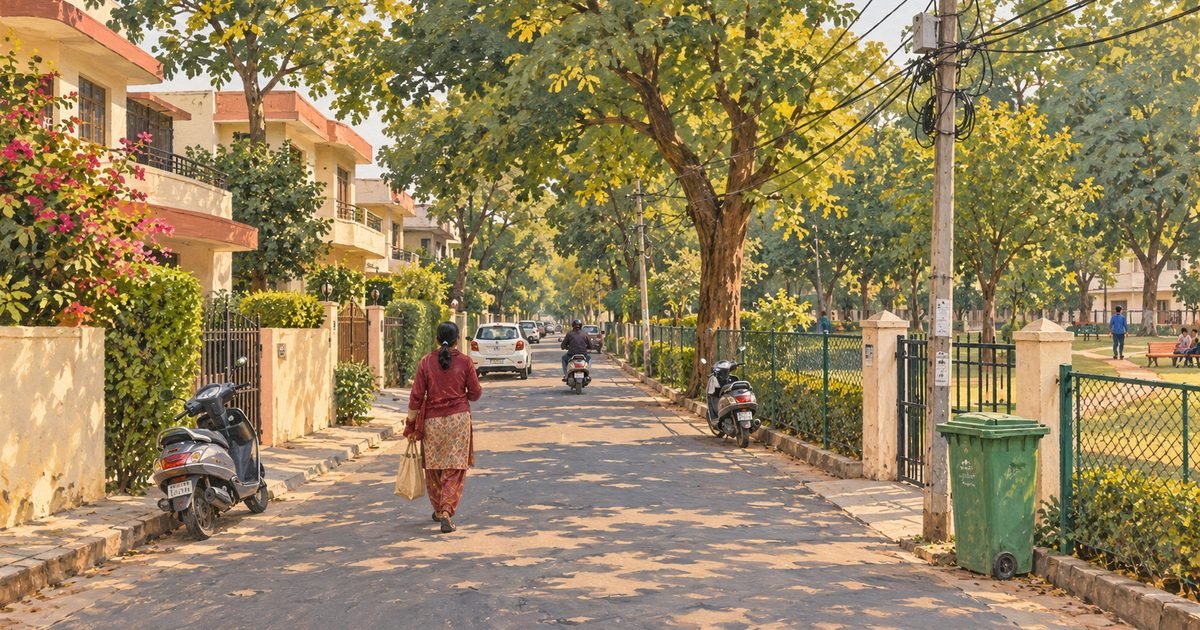
Vasant Vihar is not a neighbourhood in the ordinary Dehradun sense. It is a company town for the Indian state’s officer class: 200 acres off Kanwali Road, 660 plots, one co-operative society registered in 1966, and a membership rule that has shaped every street in it since — gazetted officers of the central and state governments, and Class I officers of nationalised banks, commissions and public sector undertakings established by the Centre or the state.
That one rule explains what you see. Wide tarred lanes the society lays and repairs itself, fourteen fenced parks, a shopping complex and a community hall, three schools run by the Shri Guru Ram Rai Education Mission on land leased from the society, and a club registered in 1992. It also explains the oddities a buyer trips over: the land is on perpetual lease, plots cannot be sub-divided, and a resale needs the society’s permission before it needs a bank’s.
This guide covers Vasant Vihar as it stands in November 2026 — how the society actually works, what the “4 km from the Clock Tower” line in every listing really measures, what a flat or a house costs now, and the honest case against the address if your name is not on a gazette.
Quick answer: Vasant Vihar is the 200-acre, 660-plot colony of the Doon Valley Officers Cooperative Housing Society, off Kanwali Road in south-central Dehradun, PIN 248006. It is 5.7 km from the Clock Tower on the OSRM routing graph (about 7 minutes) and 4.8 km from the railway station. Houses and flats are listed at Rs 70 lakh to Rs 3.5 crore and rent at Rs 13,000 to Rs 42,000 a month; the land is on perpetual lease, plots cannot be sub-divided, and membership is restricted to gazetted and Class I officers.
Last verified: 9 November 2026, against the society’s own website (About DVOCHS and Our Services), live Magicbricks and Square Yards sale and rent listings read the same day, the Times of India’s report of 15 April 2023 on the draft master plan, the MDDA Master Plan 2041 draft published in July 2026, and road distances measured on the OSRM routing graph.
01At a glance
| What it is | A private co-operative housing colony of 660 plots on 200 acres, developed in two phases by the Doon Valley Officers Cooperative Housing Society Ltd (DVOCHSL) |
|---|---|
| Where | Vasant Vihar, Dehradun district, Uttarakhand 248006 — off Kanwali Road, north of Balliwala and south of the Forest Research Institute estate |
| Distance from the Clock Tower | 5.7 km, about 7 minutes on the OSRM routing graph (measured 9 November 2026) |
| Known for | Tree-lined avenues, fourteen parks totalling 15 acres, SGRR schools inside the colony, and a residents’ club registered in 1992 |
| Who may live here | Members of the society: gazetted officers of the central and state governments, and Class I officers of nationalised banks, commissions and PSUs |
| Land tenure | Perpetual lease from the society; plots cannot be sub-divided; transfer of a lease needs the society’s prior permission |
| Houses and flats on sale | Rs 70 lakh to Rs 3.5 crore on Magicbricks, with a single 4,000 sq ft house asking Rs 15 crore on Square Yards, November 2026 |
| Rents | Rs 13,000 to Rs 42,000 a month for ordinary homes; a 10,500 sq ft furnished house asks Rs 1.5 lakh |
| Society maintenance | Rs 7,200 a year from FY 2023-24, up from Rs 3,600 in FY 2022-23 |
| Best months to inspect | October to March; the parks and the tree canopy are the reason people pay for this address |
02What and where Vasant Vihar really is
Dehradun sits in a gravel bowl between the Mussoorie ridge and the Siwaliks, and its older residential quarters occupy the raised terraces where the ground drains. Vasant Vihar takes one of those terraces in the south-central city: the Forest Research Institute’s woods to the north, Kanwali Road and Balliwala to the east, Indira Nagar and the GMS Road corridor to the south, and open ground towards Prem Nagar to the west.
The society’s own account of itself is unusually precise, which is a gift in a city where most colonies have no records at all. DVOCHSL was registered as a co-operative housing society in 1966. It is spread over 200 acres of land that the society owns, divided into 660 plots in two phases — 297 in Phase 1 and 363 in Phase 2. The plots were given out on perpetual lease rather than sold freehold, cannot be sub-divided, and cannot change hands without the society’s permission.
That date matters more than it looks. The Mussoorie Dehradun Development Authority was only created in 1984, and Dehradun’s first master plan, covering 1981 to 2001, was finalised in 1985 — both well after Vasant Vihar’s lanes were laid out. The colony is therefore not a municipal layout the city later adopted. It is a private estate that predates the planning authority, which is why its roads, parks, street lights and waste collection are a society operation with the Municipal Corporation at the edge. Phase 1 sits closest to Kanwali Road and the Balliwala market; Phase 2 runs west and north towards the FRI side, quieter and closer to the institutional green.
03The name
Vasant is spring, and vihar is an abode or a pleasure garden — the name is a piece of 1960s optimism, a promise of a garden suburb, and the fourteen parks are the part of the promise that got built. The registered name is a mouthful that nobody uses: the Doon Valley Officers Cooperative Housing Society Limited. In speech the colony is “Vasant Vihar”, the office is “the society”, and the address on a lease deed is “Vasant Vihar, Dehradun 248006”.
Two naming habits are worth knowing before you go house-hunting. First, the colony is numbered by phase and by lane, not by block or sector — a “Lane 9, Phase 2” address is not a postal street that a courier will find without the phase. Second, the name is often used loosely for the whole pocket between Kanwali Road and the FRI, including colonies that are not part of the society at all. Indira Nagar, Balliwala, Raj Vihar and Mohit Nagar are separate localities with separate rates; a portal listing that says “Vasant Vihar” and then gives an Indira Nagar landmark is telling you which side of Kanwali Road it is on.
04The society, the schools and the lease
The colony’s history is administrative rather than dramatic, which is why it is worth reading. In 1966 a group of senior officers registered a co-operative to do what the market was not: buy land on the city’s edge and lay out plots for members at cost. The society is self-financed and takes no grant from the government, which its website states plainly. Two hundred acres were acquired and carved into two phases.
Because the plots were leased rather than sold, the society kept the powers that a landlord would have kept: it can refuse a transfer, it can refuse a sub-division, and it can charge maintenance. The bye-laws describe a committee of management of eight members elected by delegates from eight wards, with co-opted members — a small private government with a voting system, which is why the society’s notices and AGM minutes read like a municipality’s.
Three institutions arrived inside the colony rather than around it. The Shri Guru Ram Rai Education Mission runs a primary, a middle and a higher secondary school on land leased from the society, which is why a school bell is part of the address. The community centre next to Park Number 3 in Phase 1 houses the Vasant Vihar Club, registered under the Societies Registration Act of 1860 in 1992 and run by an elected body.
What the colony has never had is a gate. Its own services page says so in as many words — “Vasant Vihar is not a gated society” — and explains the consequence: six security guards, two by day and four by night, for 660 plots. That is a neighbourhood watch with a uniform rather than a gate.
05What you actually see
The first thing you see is the canopy. The avenue trees are mature, the plots are generous enough to keep them, and the light on a winter morning is the reason the colony’s reputation survives every change in the city around it. The second thing you see is that the roads are good — tarred, edged, and swept two or three times a week by the society’s own workers, a standard that most municipal colonies in Dehradun cannot match.
The parks are the colony’s signature: fourteen of them, fifteen acres in total, all fenced with gates, most with walking tracks and benches, maintained by the society rather than the city. In a place where “park” often means an unbuilt plot with a boundary wall, fifteen acres of maintained open space inside a 200-acre colony is genuinely unusual.
What is not there matters as much. There is no commercial frontage inside the colony — the shopping complex is modest, and the real market is on Kanwali Road and at Balliwala Chowk. There are no high-rise apartments: the lease forbids the sub-division that would produce them, so the stock is houses and low-rise builder floors. And there is no gate, no boom barrier and no residents’ card, which is either the charm or the problem depending on what you are used to.
06Current condition: the zoning question and the Kanwali Road seam
The live issue in Vasant Vihar is not potholes or water. It is zoning. In April 2023 the draft master plan prepared by the Mussoorie Dehradun Development Authority put several primarily residential localities — Kaulagarh, Race Course and Vasant Vihar among them — into “mixed land use”, which would have opened them to commercial activity. Residents objected in the plainest terms; the Times of India’s report of 15 April 2023 quoted a Vasant Vihar resident saying people move to such localities for peace and quiet, and that mixed use would make the area chaotic.
Three years on, the question is open and the document has changed. MDDA’s draft Master Plan 2041, published in July 2026 and out for public consultation, proposes 1,587.62 hectares of mixed land use — 9.46 per cent of the developable area — across the planning area, against 57.18 per cent residential. Whether a given Vasant Vihar lane sits inside one of those patches is a question for the land-use map, not the text.
The second live issue is the seam at Kanwali Road. The society maintains every internal road and pedestrian path; Kanwali Road is the exception, because it is a city road. That is the friction residents describe: the moment you leave the colony you are on a road with no footpath, heavy two-wheeler traffic, and the Balliwala junction, one of the south city’s chronic choke points at school hours.
Waste collection is split the same way: household waste daily by the Municipal Corporation, green waste and street cleaning two or three times a week by the society, building waste the member’s problem at fixed rates.
07Practicalities
The first practical fact about buying in Vasant Vihar is that you are not buying land. You are taking an assignment of a perpetual lease, and the society has to agree. Its bye-laws require prior permission for any transfer of a plot or house, and they forbid sub-division of the leased plot. That is not a formality: it means the pool of buyers is limited to people who qualify for membership, and it means a sale can be held up by a committee rather than by a bank.
The second is eligibility. Membership is restricted to gazetted officers of the central and state governments and Class I officers of nationalised banks, commissions and PSUs established by the Government of India or the state government. If you are none of those, the colony is not closed to you as a tenant — tenants are a large part of the population — but it is closed to you as an owner, and no amount of negotiation with a seller changes that.
The third is money. Society maintenance was Rs 3,600 a year in 2022-23 and was raised to Rs 7,200 from 2023-24, payable in advance, with 20 per cent interest on late payment under the bye-laws. Against a Dehradun flat’s monthly maintenance that is almost nothing — but it buys only what the society does: security, office, green waste, cleaning and asset maintenance. Not water, electricity or a lift.
The fourth is the commute, and it is better than the address sounds. Kanwali Road puts you on the city’s south-central spine; the railway station is 4.8 km and nine minutes away, closer than from most of Rajpur Road. The airport is the exception — 28.1 km and 38 minutes on the routing graph, and longer at the school-run peak.
08How to reach
Distances are road kilometres measured on the OSRM routing graph on 9 November 2026, from the colony’s Phase 1 lanes. The Clock Tower figure is the one this series measures everything from; the railway station figure is the one that matters if you commute to Delhi.
| From | Road distance | Driving time |
|---|---|---|
| Clock Tower, Dehradun city centre | 5.7 km | 7 min |
| Dehradun railway station | 4.8 km | 9 min |
| ISBT Dehradun | 6.8 km | 11 min |
| Jolly Grant airport | 28.1 km | 38 min |
| Forest Research Institute | 4.3 km | 10 min |
| Balliwala Chowk | 3.2 km | 5 min |
| Clement Town | 10.0 km | 14 min |
09Best time
| Season | What you get | The trade-off |
|---|---|---|
| October–November | Clear air, the canopy still in leaf, the best light for looking at houses and parks | Festival traffic on Kanwali Road and at Balliwala Chowk |
| December–February | The colony at its best — cold, bright mornings, and the parks full of walkers | Houses built for the Doon’s mild winters are genuinely cold inside; check the heating |
| March–June | Long evenings, and the season when rental demand from incoming officers peaks | Heat and dust, and the pre-monsoon water shortage that hits every Dehradun colony |
| July–September | Green and quiet; the best time to see how the drainage actually behaves | The monsoon, and the Kanwali Road outfall — inspect a house in the rain, not after it |
10What the standard guides get wrong
- “About 4 km from the Clock Tower.” That is the society’s own line, and it is repeated by every property blog. Measured on the OSRM driving graph from Ghanta Ghar to the Phase 1 lanes, it is 5.7 km and about seven minutes. The 4 km figure is close to the straight-line distance and understates the drive by a third.
- “Opposite the main gate of the Forest Research Institute, on Sahastradhara Road.” Both halves are wrong. The colony is off Kanwali Road, and the FRI’s main gate is 4.3 km north on the routing graph. Sahastradhara Road is on the other side of the city. The confusion comes from the FRI estate’s southern boundary being the colony’s northern horizon — you can see the woods, not the gate.
- “A gated society.” The society says the opposite on its own services page: Vasant Vihar is not gated, and keeps six guards for 660 plots. Any listing that advertises a gate is describing a different colony.
- The price table. One widely syndicated “posh societies” article prints a Vasant Vihar price table of Rs 23 lakh for a 1 BHK and Rs 2.38 crore for a 4 BHK, with a “Windlass Smart Card” in the connectivity notes. Those are another project’s numbers. The live listings on 9 November 2026 ran from Rs 70 lakh for a 1,150 sq ft two-bedroom flat to Rs 3.5 crore for a 2,500 sq ft house, with a Rs 15 crore 4,000 sq ft house as the outlier.
- The pin code. Some address sites give 248146, which belongs to Seemadwar. The society’s own address, on every page of its website and on its lease deeds, is Vasant Vihar, Dehradun 248006.
11What living in Vasant Vihar is actually like
There are three ways to live here, priced differently. An independent house on its own leased plot, usually 2,500 to 4,000 sq ft, is the top of the market and rarely comes up. A builder floor carved out of one of those houses is the middle. A flat in Siddharth Estate, the complex the listings keep returning to, is the bottom of the ownership market and the top of the rental one.
Magicbricks’ Vasant Vihar sale page carried eight properties on 9 November 2026. The spread is wide because the stock is not comparable: a 1,215 sq ft two-bedroom flat asking Rs 75 lakh prices at Rs 6,173 a sq ft, while a 2,500 sq ft furnished house asking Rs 3.5 crore prices at Rs 14,000 a sq ft. Same colony, same lane system, more than double the rate — the difference is land, not construction.
| Type | Size | Asking price | Rate |
|---|---|---|---|
| 2 BHK flat, Siddharth Estate | 1,150 sq ft built | Rs 70 lakh | Rs 6,087/sq ft |
| 2 BHK flat | 1,215 sq ft carpet | Rs 75 lakh | Rs 6,173/sq ft |
| 3 BHK flat | 1,500 sq ft carpet | Rs 85 lakh | Rs 5,667/sq ft |
| 3 BHK independent house, furnished | 2,500 sq ft built | Rs 3.50 crore | Rs 14,000/sq ft |
Rents tell the same story in monthly form. Square Yards listed fourteen properties in Vasant Vihar on 21 September 2026, and the ordinary residential band ran from Rs 15,000 for a 1,000 sq ft two-bedroom house to Rs 42,000 for a 2,700 sq ft three-bedroom. Magicbricks had a 2 BHK at Rs 13,000 and a 1,800 sq ft builder floor at Rs 25,000. Above that sits a different product entirely: a furnished 3.5-bedroom house on a 10,500 sq ft plot asking Rs 1.5 lakh a month.
| What | Size | Monthly asking |
|---|---|---|
| 2 BHK house, unfurnished | 1,000 sq ft built | Rs 15,000 |
| 2 BHK builder floor, furnished | 1,550 sq ft built | Rs 18,000 |
| 3 BHK builder floor, semi-furnished | 1,780 sq ft built | Rs 23,000 |
| 3 BHK flat, furnished | 1,800 sq ft built | Rs 30,000 |
| 3 BHK house | 2,700 sq ft built | Rs 42,000 |
The demand drivers are durable, which is why the rents hold. The FRI is 4.3 km north and the Indian Military Academy sits on the same western belt; the SGRR schools are inside the colony and Ann Mary School is a kilometre away; Balliwala Chowk, the south city’s main market, is 3.2 km. Officers on two- and three-year postings are the natural tenant, and they rent in the colony they may later join.
The honest downsides are four. The lease and membership rules shrink the buyer pool, so a resale can take months even in a good market. Kanwali Road is the only way in and out, with no footpath and a bad junction. Summer water is a Dehradun problem the colony is not exempt from. And the zoning question hangs over the address: what you are paying for is quiet, and quiet is what a mixed-use notification takes away.
What you are buying, in the end, is a maintained private estate inside a city that does not maintain much. If fifteen acres of fenced park, a mature canopy and a school inside the colony are worth a restricted buyer pool to you, there is nothing else like it in Dehradun. If you need a gate, a lift and a freehold title, the same money buys a newer flat on Rajpur Road — and a very different address.
Start with the marketplace to see what is listed in south Dehradun, and create a buyer account if you want new Vasant Vihar listings as they appear. For the comparison that matters, read Rajpur Road for the newer, freer market, and Dalanwala for the other old-money quarter on the east side of town.
12FAQ
Where exactly is Vasant Vihar in Dehradun?
Off Kanwali Road in south-central Dehradun, between the Forest Research Institute estate to the north and Balliwala to the east, PIN 248006. It is 5.7 km from the Clock Tower and 4.8 km from the railway station on the OSRM routing graph.
Is Vasant Vihar a gated society?
No. The society states on its own services page that Vasant Vihar is not a gated society, and that six security guards — two by day and four by night — cover its 660 plots. There is no boom barrier or residents’ gate.
What is the pin code of Vasant Vihar?
248006, the code the society prints on its own address, its letterhead and its lease deeds. Some address aggregators show 248146, which belongs to Seemadwar and is wrong for the colony.
Can anyone buy a house in Vasant Vihar?
No. Membership of the society is restricted to gazetted officers of the central and state governments and Class I officers of nationalised banks, commissions and government-established PSUs. A resale needs the society’s prior permission, so the buyer pool is defined by the bye-laws, not by the market.
Is the land freehold?
No. The plots were given on perpetual lease, and the bye-laws forbid sub-division of a leased plot. You buy the house and the leasehold interest, with the society as the lessor and the committee of management as the approving authority for any transfer.
How much is the society maintenance charge?
Rs 7,200 a year from the financial year 2023-24, raised from Rs 3,600 in 2022-23, payable in advance. Late payment attracts 20 per cent interest under the bye-laws. The charge covers security, office costs, green waste, cleaning and asset maintenance — not water, electricity or lifts.
How many plots does the colony have?
660 across 200 acres, in two phases: 297 plots in Phase 1 and 363 in Phase 2. Fourteen parks cover fifteen acres, and the society maintains all internal roads except Kanwali Road.
Are there schools inside the colony?
Yes — a primary, a middle and a higher secondary school run by the Shri Guru Ram Rai Education Mission, on land leased from the society. Ann Mary School is about a kilometre away, and the FRI campus is 4.3 km north.
Is Vasant Vihar a good place to rent?
For a family with a school-age child and a two- or three-year posting, it is one of the best addresses in Dehradun: Rs 15,000 to Rs 42,000 a month buys a house or a builder floor in a maintained colony with parks and a school inside it. For a single professional who wants nightlife or a short walk to a café, the same money goes further on Rajpur Road.
13Where to go next
The natural next read is the Forest Research Institute, the 1,000-acre estate whose woods form this colony’s northern horizon — and the institution that gave the whole belt its character. For the other side of the city’s old residential market, Dalanwala is the eastern equivalent: older money, bigger plots, a very different set of rules about who may buy.
If you are weighing a newer building against a leased plot, Rajpur Road is the comparison, and Clement Town shows what the same budget buys 10 km south. Every distance in this series is measured from the Clock Tower.
And if the reason you are reading this is a house rather than a school catchment, the next step is not another guide — it is the marketplace, where south Dehradun is listed with the locality printed on every row.
Last verified: 9 November 2026. The 1966 registration, the 200 acres, the 660 plots (297 in Phase 1, 363 in Phase 2), the perpetual lease and the no-sub-division rule, the fourteen parks covering fifteen acres, the six security guards, the Rs 3,600 to Rs 7,200 maintenance increase, the 1992 club registration and the three SGRR schools all come from the society’s own website, read on 9 November 2026. Sale and rent figures come from Magicbricks and Square Yards listings read the same day. The mixed-land-use dispute is from the Times of India, 15 April 2023; the Master Plan 2041 figures (1,587.62 hectares mixed use, 9.46 per cent of developable land; 57.18 per cent residential) are from MDDA’s draft Part-2 Proposal published in July 2026. Distances were measured on the OSRM routing graph from OpenStreetMap data.
0 Comments
No comments yet — be the first to share your thoughts.