

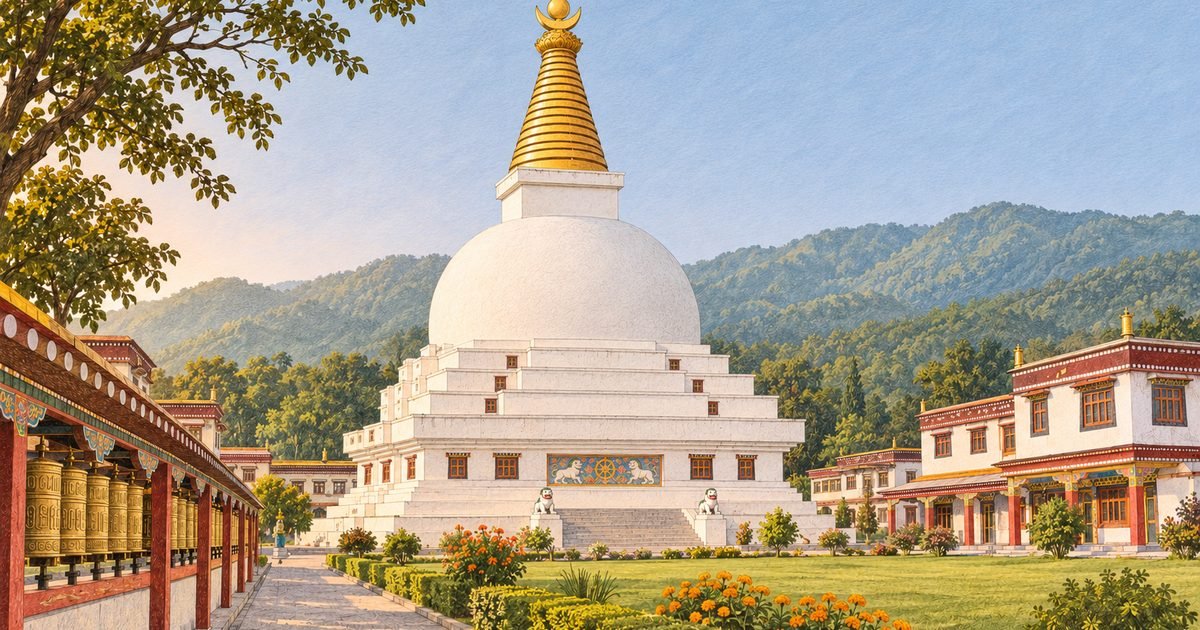
There are two Dehraduns. One is the Clock Tower, the sal avenues and the government offices. The other is nine kilometres south, past the ISBT, where the valley flattens towards the Siwaliks and a Tibetan monastery has been quietly running a university for monks since 1965. Mindrolling is the second one, and most visitors never get there — which is partly why it is still worth going.
What is there is not a monument. It is a 185-foot stupa built between 2000 and 2002 that you can walk into, five floors of shrine rooms painted floor to ceiling, a 103-foot gilded Buddha in the main hall, and around all of it a working institution: a nine-year college for monks, a nunnery up in Mussoorie, a clinic, a dairy, and a Tibetan refugee colony that grew up against the walls. The prayer wheels are not props. Somebody is turning them.
This guide is the practical version — what the stupa actually is, why a monastery ended up inside a colonial cantonment built over an Italian prisoner-of-war camp, what it costs (nothing), when it is open (officially, from 9 am, and the guide sites disagree about everything else), what the standard listings get wrong about its height, its age and its distance, and what it is like to buy or rent in Clement Town.
Last verified: 1 November 2026, against the monastery’s own visitor and history pages, the Clement Town Cantonment Board’s published history and locality page, the monastery’s 2026 event record, and road distances measured on the OSRM routing graph.
Quick answer: Mindrolling Monastery is in Clement Town, 13.2 km by road from the Clock Tower (about 18 minutes outside peak hours). Entry is free and the Great Stupa is open every day from 9 am. The stupa is 185 ft tall on a 100 ft square base, inaugurated on 28 October 2002 by the Dalai Lama, and the gilded Buddha in the main hall is 103 ft (31 m). Plan 90 minutes to two hours.
01Mindrolling at a glance
| What it is | The Dehradun seat of Mindrolling, one of the six “mother monasteries” of the Nyingma school of Tibetan Buddhism, re-established in exile in 1965; home to the Great Peace Stupa and Ngagyur Nyingma College |
|---|---|
| Full name | Og Min Ogyen Mindrolling (also written Mindroling). Locally called the Buddha Temple or the Tibetan Monastery |
| Address | Quarter Deck Road, Bharuwala Colony, Clement Town, Dehradun, Uttarakhand 248002 |
| Monastery office | +91 135 2640556 or +91 135 2640968 |
| Distance from the Clock Tower | 13.2 km by road, about 18 minutes outside peak hours |
| Entry | Free. No ticket, and no booking needed for a daytime stupa visit |
| Hours | The monastery’s own visitor page says the stupa is open every day from 9:00 am. Guide sites publish split hours (8–12 and 2–7 in summer, 9–12 and 1:30–6 in winter) that the monastery does not confirm |
| Time needed | 90 minutes for the stupa and the main hall; half a day if you sit in on a teaching |
| The stupa | 185 ft tall, 100 ft across, with shrine rooms on several floors inside, surrounded by a 2-acre garden |
| The Buddha | A 103 ft (31 m) gilded Shakyamuni in the main temple hall, dedicated to the Dalai Lama |
| Best months | October–November and March–April; late February or March if you want to catch Losar and the Tsechu Cham |
| Watch out for | Photography is barred inside the main hall, and the temple closes to sightseeing when practice begins |
02Where it is, and why a monastery sits inside a cantonment
Clement Town is not a Dehradun suburb in the ordinary sense. It is a cantonment — an autonomous body under the Ministry of Defence, deemed to be a municipality under the Constitution — and it sits on the southern floor of the Doon valley, with Rajaji National Park along its edge. The cantonment board’s own locality page carries both “7 km from clock tower” and “nine km south of Dehradun”, which tells you how loosely these distances get handled even by the authority that publishes them.
The monastery’s address is a good illustration of how layered the place is: Quarter Deck Road, Bharuwala Colony, Clement Town, 248002. Quarter Deck is a military street name. Bharuwala Colony is a Tibetan settlement. The pincode belongs to the cantonment. All three describe the same half-kilometre.
The land was farmland not long ago. The Garhwal Post’s history of the area records that in the early decades of the last century this was open agricultural tract spread across the revenue villages of Sewla Majra, Sewla Khurd and Sewla Kalan, held by Ahluwalia Kalal families who had popularised Dehradun basmati there. Railway officials and Anglo-Indians began buying plots in the 1920s; an Italian priest, Father R. C. Clement, settled in 1934 and in 1936 promoted a cooperative society that sold one-acre and five-acre blocks to Europeans and Anglo-Indians. The town took his name.
Then the war arrived in the wrong direction. Over twenty thousand Italian soldiers surrendered in North Africa, the British shipped the prisoners to India, and the Clement Town society’s land was requisitioned to house them, on a promise that it would be returned afterwards. The cantonment board’s own history page records 1941 for both events — established as a Prisoner of War camp, and upgraded to a Cantonment Board. After independence the barracks that had lately held Italian POWs housed the Joint Services Wing, which later became the National Defence Academy and moved to Khadakvasla. Father Clement, by then in his seventies, sailed for Italy in July 1952 to recover his health and died three days after landing.
The Tibetan colony came next, and the monastery followed the community rather than the other way round. That is the part the travel pages leave out: Mindrolling is not an attraction that happens to be in Clement Town, it is one of the reasons Clement Town is what it is. The monastery’s own campus page describes monastic life as “closely interwoven with that of the Tibetan Refuge Colony of Clement Town, adjacent to Mindrolling”, and notes that the colony’s community prayer hall stands on monastery property, in a building that also houses dormitories and classrooms for young monks.
03The names, and which one to use
Four names attach to this place and they are not interchangeable.
- Mindrolling (སྨིན་གྲོལ་གླིང་). The Tibetan name, rendered by the monastery as “Og Min Ogyen Mindrolling” and translated as “Sublime Island of Ripening Liberation” — or, on the cantonment board’s page, “place of perfect emancipation”. Both translations circulate; they are describing the same three syllables.
- Mindroling. The same name in the older transliteration, still used by the cantonment board and by Wikipedia’s article on the Tibetan original. Neither spelling is wrong; the monastery’s website uses “Mindrolling” in its own masthead and “Mindroling” in quoted history, sometimes on the same page.
- Buddha Temple. What auto-rickshaw drivers, Google Maps and half of Dehradun call it. The stupa has its own site under this name. If you are giving directions, use it.
- The Great Peace Stupa / Stupa of Buddha’s Descent from Devaloka. The formal names of the 2002 structure, which is not the monastery and not the temple hall — it is the tower.
The lineage has a name too: the Nyo lineage, after Terdak Lingpa’s family line, which has held the monastery since 1676.
041676 to 1965: Drachi Valley to Quarter Deck Road
The Tibetan original is in Zhanang county, 43 km east of Lhasa’s airport on the south bank of the Tsangpo, and the Dehradun monastery is a deliberate copy of it rather than a new foundation.
Mindrolling was established in 1676 by the Dharma king Chögyal Terdag Lingpa (1646–1714) in the Drachi valley of Tibet, with his brother Lochen Dharmashri; Wikipedia places the site in Zhanang county, Shannan prefecture, about 43 km east of Lhasa’s airport on the south bank of the Tsangpo. It became one of the six mother monasteries of the Nyingma school — the oldest of the four Tibetan Buddhist schools — and for nearly 300 years trained Nyingma scholars in sutra, tantra, astronomy, the Tibetan calendar, calligraphy and Tibetan medicine, with at one point over a hundred satellite establishments.
It was destroyed once before. The Dzungar Mongols sacked it in 1718; it was rebuilt under the Seventh Dalai Lama by Terdag Lingpa’s son and daughter, Dungsay Rinchen-namgyel and Jetsunma Mingyur Paldron. At the time of the 1959 uprising it held about 300 monks.
The exile story is told in more detail on the monastery’s own site than anywhere else. Trichen Gyurme Kunzang Wangyal left Tibet in 1959 with Kyabje Khochhen Rinpoche — born in Gonjo in eastern Tibet in 1937 and recognised young as the reincarnation of Namdrol Sangpo Rinpoche — and a few attendants. The Trichen’s enthronement as the XIth throne holder had been interrupted by the invasion and took place in exile in 1962. Khochhen Rinpoche and Kyabje Paltrul Jampel Lodoe Rinpoche, known as Dzonang Rinpoche, then selected land near Dehradun and, in the monastery’s own words, were “embarrassed by the wilderness and rough conditions on the land they had selected” — so they built monks’ quarters and the main shrine room first, and only then invited the Trichen to take charge. He moved down from Kalimpong in 1976.
The foundation date the monastery gives for the Indian seat is precise: the 4th day of the 11th month of the Tibetan Wood Dragon year 2091 — 16 January 1965. The 50th anniversary was marked on 6 January 2015 — sixty years after the foundation falls in 2025, a date the monastery has not yet marked publicly. That is why you will see both 1965 and 1976 in print: 1965 is when the land was taken and the first buildings went up, 1976 is when the throne holder arrived and the seat was formally established.
05The Great Stupa: 185 feet, five floors, one door
Almost every stupa in the Buddhist world is a solid object to look at. This one is a building to walk through, which is the single best reason to drive across town.
The monastery’s own page on it gives the measurements. It is 185 feet tall and 100 square feet in width — their phrasing for a 100-foot span, not an area — and stands inside a two-acre landscaped garden. It was inaugurated on 28 October 2002, a date chosen because it is the day of the Buddha’s descent from the Trayastrimsa heaven, and the consecration was performed in the presence of the 14th Dalai Lama.
The design is the Stupa of Descent from Devaloka — the form built at Sankasya to mark the Buddha’s return from the heaven of the thirty-three gods, where he had spent a summer retreat teaching the dharma to the reincarnation of his mother. A stupa, in this tradition, is not a tomb but a representation of the Buddha’s enlightened mind, and the building is meant to be read from the base up as the path.
Inside, on several floors, are shrine rooms with murals in the Tibetan tradition. The monastery names three: a Shakyamuni Buddha room; a Padmasambhava room, with the eight manifestations of Guru Rinpoche and his twenty-five disciples; and the Four Immeasurables, or Mindrolling lineage, room, which holds statues of every Trichen and Khenchen down to the present holders. Relics are sealed inside the structure itself — the monastery’s page lists relics of the Buddha Kashyapa and a tooth relic of Padmasambhava among them. The outer facade carries a painted mural of Maitreya, the future Buddha, with Shakyamuni at the foot of the steps.
Two practical notes. The upper shrine floors are not always open — they are chapels in a working monastery, not galleries — so ask at the entrance rather than assuming. And the climb is a climb: several floors up a stupa stair with no lift.
06What you actually see
The complex is bigger than the photographs suggest and laid out in a rough sequence.
- The approach. You come in off Quarter Deck Road through a gate, past the colony, into a courtyard with rows of brass prayer wheels and benches. The transition from cantonment road to monastery is abrupt and complete.
- The main temple hall. A large Tibetan assembly hall with the 103-foot (31 m) gilded Shakyamuni rising through it, dedicated to the Dalai Lama. This is the image everyone photographs and almost nobody is allowed to photograph from inside.
- The stupa. White, tiered, with the harmika and spire above; the Maitreya mural is on the facade. Walk clockwise, as everybody else does.
- The grounds. Two acres of formal garden around the stupa, plus the wider campus: monks’ quarters, the college, the community prayer hall, a health clinic that runs Tibetan and allopathic medicine, a dairy that the monastery’s own page is disarmingly proud of, a guesthouse and, more recently, small shops and cafés.
- The people. This is the part the listicles miss. You are walking through a functioning institution with several hundred monks in it. Young monks in the courtyard, debate sessions, classes, an office that handles donations.
The cantonment board’s locality page adds a detail worth repeating with the caveat that it is the board’s, not the monastery’s: it says the temple was “designed and painted by around 50 artists who took three years” over the work. Whether the count is exact or not, the murals are the reason to slow down inside the shrine rooms instead of going up and coming straight back down.
07The monastery is a college
Mindrolling in India is one of the largest Buddhist centres in the country, and it pays for that by teaching. The monastery’s own campus overview describes education for over 300 monks, from primary and secondary school upwards, a retreat centre used for three-month and three-year retreats, a translation group publishing liturgies, and a nunnery — Samten Tse, in Mussoorie — that preserves the Jetsunma line of female teachers.
The academic core is Ngagyur Nyingma College, founded in 1991. Wikipedia’s account, which matches the monastery’s, describes a nine-year course in sutra and tantra for roughly a hundred monks, at the end of which graduates receive the title of khenpo. It is one of the largest Buddhist institutes in India, and its library holds Indian and Tibetan commentaries on the canon.
What that means for a visitor is simple: you are in a seminary, and the seminary’s calendar rules the site. Term time looks different from vacation. A teaching in progress outranks a tourist with a camera. If you want to attend a public teaching or a ceremony, the monastery’s calendar page is the only reliable source and it is updated by the monastery, in English.
082026: what has already happened, and what is coming
The monastery’s 2026 news record is unusually full, and it is worth reading before you plan a visit, because on some of these days the temple is not a sightseeing destination.
- The Nyingma Kama transmissions. Kyabje Shechen Rabjam Rinpoche bestowed the precious Kama Wang and Lung from 30 November 2025, and the monastery posted weekly updates as they ran — the sixth week, day forty, on 8 January 2026. That is fifty-odd days of transmission in one season, and it is why the temple grounds were busy through the winter.
- The drubchen season. A seven-day drubchen of Thugje Chenpo Desheg Kundu began on the tenth day of the new Fire Horse year to mark the parinirvana of Kyabje Minling Trichen; the ten-day Kagyed Drubchen ran from 12 to 21 March 2026.
- The Great Tsechu Cham. On 28 March 2026, hundreds of practitioners gathered for the cham ceremony performed each year on Guru Rinpoche’s tenth day of the second lunar month. This is the masked dance most visitors hope to see, and it happens once a year.
- Saga Dawa. The annual seven-day drubchö of Minling Dorsem (Vajrasattva) began on 20 May 2026, in the sacred month.
- The Dalai Lama. In 2026 the 14th Dalai Lama conferred the tsugphü, the hair-cutting ceremony, on Minling Dungse Rinpoche and Minling Jetsün Rinpoche — an event the monastery describes as being of historic significance for the lineage.
None of that is a tourist programme, and it is not advertised as one. But it is the reason the monastery is not a museum, and if your dates are flexible, aligning a visit with the Tsechu Cham or with Losar gives you something no guidebook photograph can.
09Practicalities: fee, hours, photographs, shoes
- Entry is free. There is no ticket for the complex, the courtyards or the stupa. The monastery’s visitor page states plainly that daytime stupa visits need no advance arrangement. Donations are voluntary.
- Hours. The one official statement is that the stupa is open every day from 9:00 am. Everything else — 8–12 and 2–7 in summer, 9–12 and 1:30–6 in winter, 10–5, “closed for lunch” — comes from third-party listings that copy each other. Treat a mid-afternoon arrival as the safe bet and ring the office if you are driving a long way.
- Shoes come off at the temple hall and at the stupa shrine floors. Wear something you can slip off; there is a shoe stand.
- Photography is fine outdoors and barred inside the main hall, where the 103-foot Buddha stands. Expect to be asked to put the phone away, and expect it to be enforced.
- Dress and behaviour. This is an active monastery. Covered shoulders and knees, quiet voices, no flash, no posing on the shrine steps. Walk clockwise around the stupa and the prayer wheels.
- Time the temple, not the traffic. The drive is 18 minutes from the Clock Tower outside peak hours and considerably worse between 5 and 7 pm, when the Selaqui and ISBT traffic meets. Go in the morning.
- What to carry. Water, and cash for the shoe stand and for donations — smaller cafés on the campus have appeared but do not plan a meal around them.
- Accessibility. The courtyard, garden and main hall are level. Everything above the stupa’s ground floor is stairs, and there is no lift.
10How to reach Mindrolling
There is one approach: south along the Chakrata Road / Saharanpur Road axis, past the ISBT, then west into Clement Town. The monastery is 4.7 km from ISBT, which makes the interstate bus stand the obvious arrival point and the railway station a poor one.
| From | Road distance | Notes |
|---|---|---|
| Clock Tower / city centre | 13.2 km | About 18 minutes outside peak hours |
| Dehradun railway station | 13.4 km | No advantage over the Clock Tower; same axis, same traffic |
| ISBT Dehradun | 4.7 km | The closest hub by far — shared autos and city buses run towards Clement Town |
| Jolly Grant airport | 31.2 km | 40–50 minutes; the airport is on the far side of the city |
| Tapkeshwar Mahadev | 13.8 km | Across the city, about 25 minutes — a different half-day |
11The best time to go
| Window | What you get | The trade-off |
|---|---|---|
| October–November | Clear air, the Siwaliks visible, cool walking, gardens at their best | Post-monsoon weekend crowds at the stupa |
| December–January | Empty shrine rooms and the clearest long views of the year | Cold mornings, and dense fog can hide the ridge until 10 am |
| February–March | Losar, the drubchens and the Tsechu Cham — the monastery at full ceremonial strength | Some days the temple is in use and sightseeing is limited |
| April–June | Hot, dry and quiet; the best light on the white stupa | The courtyard is fully exposed; go at 9 am sharp |
| July–September | The valley at its greenest, and the monsoon sky behind the spire | Wet, humid, and the approach road floods in heavy rain |
One visit, if you only get one: a weekday morning in late October, at the 9 am opening, straight up the stupa before the groups arrive, then the main hall.
12Five things the standard guides get wrong
- “Over 200 feet” — or 220. The builder’s own figure is 185 feet tall and 100 feet across, on the monastery’s page for the stupa and repeated by the Clement Town Cantonment Board. Incredible India says “over 200 feet”, Wikipedia’s article on the monastery says 190, and several travel blogs say 220. A 35-foot spread on a building is not a rounding error; the figure creeps upward because a superlative reads better.
- The Buddha statue is 103 feet, not 130. The cantonment board’s own locality page says “103 feet (31 m) high statue of Buddha, dedicated to the Dalai Lama”, and Wikipedia’s list of India’s tallest statues records 32.6 m. Incredible India says “colossal 130-foot” and adds that it is “accessible on Sundays” — a claim no other source makes and which the temple’s own practice of daily prayer contradicts.
- “Re-established in 1976” and “built in 1965” are both right. The monastery dates its Indian foundation to 16 January 1965, when the land was taken and the first monks’ quarters and shrine room built. The XIth Trichen did not move from Kalimpong until 1976 — the date the monastery’s own campus history gives for the move, and the date listings tend to borrow. Neither account is wrong; they describe two different events, ten years apart.
- “7 km from the Clock Tower.” That is the distance to Clement Town as a cantonment, from the cantonment board’s own page and copied by Wikipedia. The monastery gate is 13.2 km from the Clock Tower on the OSRM routing graph, because Clement Town is deep and the monastery is at its far edge. 4.7 km from ISBT is the honest short figure.
- The timings are folklore. Four sites give four schedules: 8–12 and 2–7 summer, 9–12 and 1:30–6 winter, 9 am–7 pm, and 10–5 with a lunch closure. The monastery publishes only “open every day beginning at 9:00 AM”. Plan around 9 am and ring +91 135 2640556 before a long detour.
13What living in Clement Town is actually like
Clement Town is the cheapest way into a Dehradun address with space around it, and it is priced that way for reasons that are structural rather than temporary.
The first is governance. This is a Cantonment Board area, an autonomous body under the Ministry of Defence, not a municipal ward. Construction permissions, building bye-laws, conversions and property transfers run through the Board, and large parts of the area are defence or institutional land. Before you fall for a plot, establish what the land use is and who has to sign the transfer — that single question decides more Clement Town purchases than price does.
The second is distance. You are 13 km from the Clock Tower and 4.7 km from ISBT. That is fine if you work on this side of town or drive; it is a hard daily commute if your life is in Rajpur or Dalanwala.
The third is the edge. The cantonment borders Rajaji National Park, and the sal forest on that boundary is not landscaping. Ask about wildlife movement on any plot near the northern edge, in the same breath as you ask about water.
| Segment | Current range (October 2026) |
|---|---|
| Average asking price, apartments | ₹6,150 per sq ft, based on active listings and recent trends |
| What is actually on the board | A 2 BHK builder floor of 1,000 sq ft at ₹75 lakh; 3 BHK houses of 1,500 sq ft at ₹70 lakh; 3 BHK villas from ₹1.25 crore; a 4 BHK villa of 9,000 sq ft at ₹7 crore |
| The cheapest way in | ₹10.3 lakh for an 806 sq ft house in Bharuwala Colony — the monastery’s own colony. At that price, read the tenure before you read the plan |
| Rent — 2 BHK | ₹18,000–20,000 a month, semi-furnished, 1,000–1,500 sq ft — the whole of the locality’s live rental stock was five listings |
| Supply | Thin. The portals carry five or so sale listings and a handful of rentals for the entire locality, which is a cantonment town of a few thousand households |
The honest downsides:
- Defence administration. A Cantonment Board is efficient and inflexible. Expect the file to move at its own pace, and expect the rules to be enforced.
- Thin new supply. Five or so sale listings and five rentals is the whole of the online board. Choice is limited, and the good houses circulate inside the colony by word of mouth.
- Water and drainage. Ask specifically about supply hours and whether the building runs a tanker in May. The older cantonment colonies answer that question less well than the new private ones.
- Nothing on the doorstep. The monastery, the schools and the market are all within the town, but the town is small; for a mall, a multispecialty hospital or a decent restaurant you are driving 20 minutes.
- Monsoon. The approach roads through Clement Town pond in heavy rain. Check the road, not just the plot, in August.
What is currently on the board in this part of the city is on our marketplace, and owners can list a property free — no brokerage, contact direct. If you are buying rather than renting, run the checks we do before shortlisting a plot; in a cantonment, tenure is the first of them. Tenants new to the city should start with where to look for a PG in Dehradun, and anyone weighing a furnished room against a whole flat should read PG or a rented flat.
14Frequently asked questions
Is there an entry fee at Mindrolling Monastery?
No. Entry to the complex, the courtyards and the Great Stupa is free, and the monastery’s visitor page states that daytime stupa visits need no prior arrangement. Donations are voluntary.
What are the timings?
The monastery publishes one line: the stupa is open every day from 9:00 am. Third-party listings give split hours that vary by season and none of them is authoritative. Arrive in the morning and ring +91 135 2640556 if you are travelling a long way.
How tall is the Great Stupa?
185 feet tall and 100 feet across, on the monastery’s own page — not the “over 200 feet” or “220 feet” that several travel sites publish. It was inaugurated on 28 October 2002.
How tall is the Buddha statue?
103 feet, or 31 metres, according to the Clement Town Cantonment Board, which matches Wikipedia’s record of 32.6 m. It is gilded, it stands inside the main temple hall, and it is dedicated to the Dalai Lama. Photography inside the hall is not allowed.
When was Mindrolling founded in Dehradun?
16 January 1965, when the land was taken and the first buildings went up. The XIth Mindrolling Trichen arrived from Kalimpong in 1976, which is why some sources give that as the date of re-establishment.
Can you go inside the stupa?
Yes, and that is what makes it unusual. There are shrine rooms with murals on several floors inside — a Shakyamuni room, a Padmasambhava room and the Mindrolling lineage room with statues of every Trichen and Khenchen. The upper floors are chapels in a working monastery and are not always open; ask at the entrance.
How far is it from the Clock Tower?
13.2 km by road, about 18 minutes outside peak hours. It is 4.7 km from ISBT, which is the closest transport hub, and 13.4 km from the railway station.
Is it the same as the Tibetan colony?
No, but they are inseparable. The monastic community and the Tibetan refugee colony of Clement Town are adjacent, and the colony’s community prayer hall stands on monastery property. The colony grew first and the monastery was built into it.
Is Mindrolling worth a detour?
Yes, if you have half a day and any interest in buildings or in how Tibetan Buddhism actually runs in exile. It is not a theme park, there is no queue and no ticket, and the thing that makes it worth the drive is that it is a college and a monastery rather than a monument.
15Where to go next
Mindrolling is the southern anchor of the valley. FRI is the other great institutional building in the city — a 1,021-foot colonnade, six museums and a 704-year-old deodar — and pairs with this on the same day only if you start early. Robber’s Cave at Gucchupani is the nearest thing to a natural outing on this side, and Sahastradhara is the springs-and-ropeway day further up the valley. If it is your first time in the city, start with the Clock Tower and Paltan Bazaar guide and work outwards.
And if Clement Town is on your shortlist as somewhere to live, drive it on a weekday morning rather than a Sunday: the run in from ISBT, the cantonment roads, the walk to the market and the 13 km to the city all become obvious in twenty minutes. Our marketplace carries what is currently listed; owners can add theirs free.
Fees, hours and dates in this guide were checked on 1 November 2026 against the monastery’s own Great Stupa page, its visitor information, its history of the Tibetan foundation and its 2026 event record; the Clement Town Cantonment Board’s history and locality page; the Garhwal Post’s history of the town; Buddhistdoor’s account of the stupa’s five shrine rooms; asking prices from 99acres and Squareyards for late 2026; and road distances measured on the OSRM routing graph. Hours and event dates change without notice — ring before travelling.
2 Comments
[…] more Doon places, same treatment. Mindrolling Monastery in Clement Town is free to enter, has a 185-ft stupa you can walk up, and sits in the one Tibetan […]
[…] which is the single fact that puts Clement Town on the tourist map and is covered in detail in our Mindrolling guide. In 1993 the Graphic Era Educational Society was founded, in 1997 it opened the Graphic Era […]