

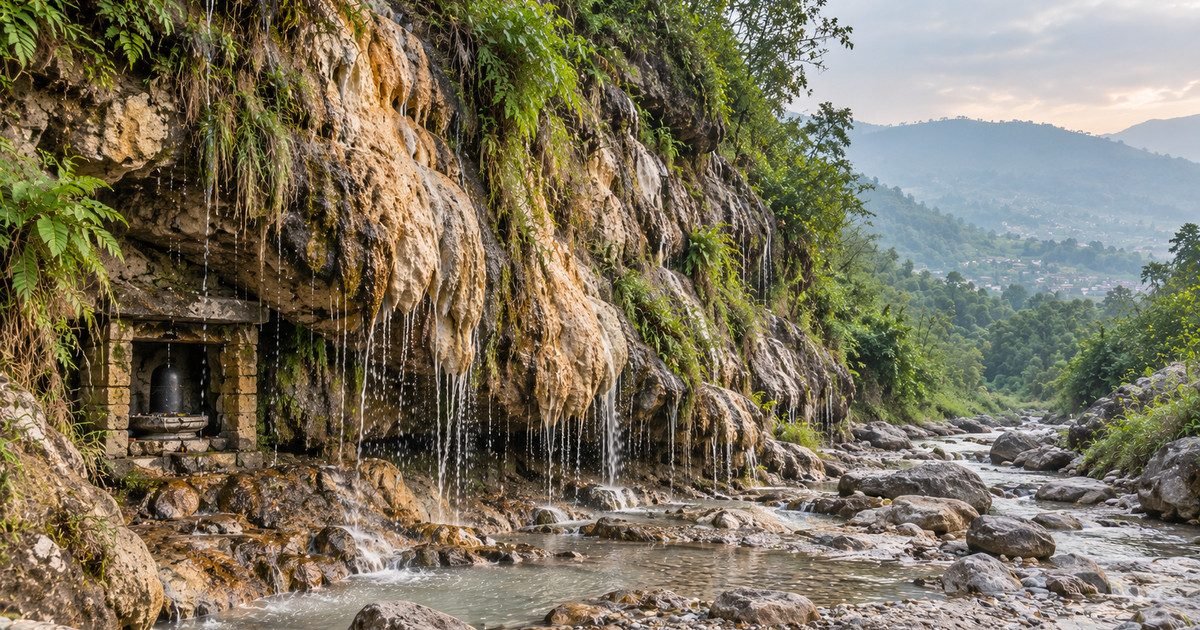
Sahastradhara is the one place in Dehradun that everybody visits and almost nobody describes accurately. Travel portals call it a hot water spring. It is not hot. They promise waterfalls and a river. There are pools, a limestone gorge and a stream. They tell you the sulphur water cures skin disease, and quietly leave out that the busy stretch has been measured as unfit for bathing.
None of that makes it a bad afternoon out. It makes it a place worth understanding before you drive fourteen kilometres to stand in it — especially now, because Sahastradhara is still recovering from the night of 15–16 September 2025, when a cloudburst sent the Karligaad rivulet through the market and took shops, hotels and thirteen lives with it. The site has reopened and the crowds are back. The scars have not fully gone.
This guide covers what the place geologically is, why the name is spelled two ways, what the caves and the temple actually contain, what state everything is in this season, the ropeway that most guides price wrong, and — because this is a property site — what it is genuinely like to live on Sahastradhara Road, the nine-kilometre corridor that leads to it.
Quick answer: Sahastradhara is a cluster of cold sulphur springs — 25.6–27.6 °C, so not a hot spring — seeping from a limestone cliff about 14 km from the Clock Tower, with travertine caves, a small Shiva temple and a 618 m ropeway (about ₹200–300 return, 9:30 am–6 pm). There is no entry fee; parking and the ropeway are charged separately. Allow 1.5–2 hours for the springs, half a day with the ropeway, and do not drink the water: it is very hard and the popular stretch tests as contaminated.
Last verified: 29 October 2026, against district tourism and municipal reporting, the post-flood news record, and published water-quality studies of the stream.
01Sahastradhara at a glance
| What it is | A cluster of cold sulphur springs seeping out of a limestone cliff, with travertine caves and a small Shiva temple |
|---|---|
| Also spelled | Sahasradhara (the correct form). Locals and every signboard use “Sahastradhara” |
| Meaning | Sahasra (thousand) + dhara (stream) — “a thousand streams” |
| Address | Sahastradhara Road, Timli Mansingh, Dehradun 248013 |
| Distance from the Clock Tower | About 14 km, 30–40 minutes by car outside peak hours |
| Entry fee | None for the springs. Parking and the ropeway are charged separately |
| Ropeway | 618 m line, in service since 2018, about ₹200–300 return, 9:30 am–6 pm |
| Time needed | 1.5–2 hours for the springs and caves, half a day with the ropeway and lunch |
| Water temperature | Cold — measured at 25.6–27.6 °C in a water-quality study of the stream, i.e. below body temperature. Not a hot spring |
| Safe to drink | No. Very hard water, and the popular stretch tests as contaminated |
| Current condition | Open and busy; parts of the market still under repair after the September 2025 flood |
| Best months | October–November, then February–March. Avoid the monsoon |
| Footfall | 2,000–3,000 visitors a day in peak season, per the district tourism office |
02What the place actually is, geologically
Dehradun sits in a valley floored by gravel and bounded by two ridges. The northern one is the Mussoorie range, and its rock is Krol dolomitic limestone — the same formation that gives Mussoorie its cliffs and the Doon valley its springs. Rain that falls on that ridge does not run straight off it. It sinks into the limestone, travels through cracks and bedding planes, and comes back out lower down, at the point where the rock meets an impermeable layer. Sahastradhara is one of those exit points.
What makes it look the way it does is what the water carries. Limestone dissolves in slightly acidic rainwater, so the emerging water is loaded with calcium bicarbonate. As it hits the air and loses carbon dioxide, it drops that calcium as travertine — the pale, banded crust that builds up on the cliff, and over centuries builds the caves and ledges the streams run over. The brownish-orange tint that photographs so well is iron and organic staining in that crust, not sulphur.
There is real sulphur chemistry in the catchment, though. Gypsum lenses occur in the upper reaches of the Baldi, a few kilometres above Sahastradhara, and the local water is genuinely described as a sulphur spring — that part of the folklore has a geological basis. Hardness measurements of the stream come out at 505–714 mg/l as calcium carbonate, well past the permissible limit for drinking water, which is exactly what you would expect from water that has spent its journey inside limestone.
The last thing to get straight: Sahastradhara is not a river, and there is no single waterfall. It is a seepage line along a cliff, feeding a short stream — the Baldi — which runs down through the gorge and past the market. The “thousand streams” of the name are hundreds of small drips and threads through the rock, which is spectacular in monsoon and modest in December. Almost every photograph you have seen of it was taken between July and September.
03The name, and the spelling nobody gets right
The word is Sahasradhara: sahasra, a thousand, and dhara, a stream or flow. The “t” in the popular spelling belongs to the first word, not the second, and it has drifted across the join until everyone writes Sahastradhara — including the Nagar Nigam’s own tourism page, the district website, and most of the signboards on the road out.
Practically: search either spelling, because the internet uses both. The officially preferred form is Sahasradhara, and Wikipedia flags the t as incorrect. In conversation nobody will notice or care, and correcting a shopkeeper about it is not a good use of an afternoon.
The same applies to the surrounding names. The stream is the Baldi; the flash flood of September 2025 came down the Karligaad rivulet that joins it; and the locality you pass through on the way is Timli Mansingh, which is why the pincode is 248013 and not the 248001 of the city centre.
04The caves and the temple
The caves are small, and they are the part of Sahastradhara that the day-trippers walk straight past. There are roughly five to seven primary caves and rock shelters in the travertine of the gorge, with stalactites, flowstone and secondary calcite deposits still forming — an unusual thing to find forty minutes from a state capital, since travertine caves are young, soft and short-lived by cave standards.
They have been a religious site for a very long time. Colonial-era visitors recorded the gorge as sacred to Mahadeo as early as the 1830s, and later cavers noted a temple built into the rock with a lingam inside — the small shrine that still sits under the seepage, with water falling directly on the Shivalinga. That is the actual devotional centre of the place; the bathing pools below it are the picnic attraction built around it.
Two honest warnings. The rock inside the shrine and around the pools is wet travertine, which is about as slippery as wet tile, and there is no railing in the parts that matter. And in monsoon or after heavy rain the stream can rise fast enough to cut off the lower gorge — the September 2025 flood is the extreme version of a thing that happens in a smaller way every season.
05The flood, and what state the place is in now
On the night of 15–16 September 2025 a cloudburst over the catchment above Sahastradhara sent the Karligaad rivulet down in flash flood. The water came loaded with boulders and debris, took out the embankments, and ran through the market at the foot of the springs. Shops, restaurants and small hotels were swept away or buried. Across Dehradun district the death toll reached thirteen, with around sixteen more feared missing in the first days; Mussoorie was cut off by the same weather system.
What has happened since is the part that no travel listing has caught up with:
- By April 2026 the site had reopened. The tourism department declared Sahastradhara ready for visitors again, traders had rebuilt or reopened, and the district tourism officer put peak-season footfall at 2,000–3,000 people a day.
- Recovery is partial, not complete. Reporting in April found shops repaired and crowds back, but also units still filled with sand and gravel, and rubble where structures had stood. A June 2026 visit by the Times of India found several shops at the picnic spot still not rebuilt, with safety concerns raised ahead of the monsoon.
- New parking is coming. Tenders had been approved in April 2026 for a 250-car parking facility; the existing roadside parking is the constraint on any weekend visit.
- The monsoon is now the risk window, not the season. The disaster happened in mid-September, at the end of the rains. If you are planning a trip between July and September, check the forecast on the morning you go and do not stand in the gorge during or after heavy rain.
Practically, this means the postcard version — a full market, every shop open, the whole gorge walkable — is close but not yet restored. If you remember Sahastradhara from five years ago, expect a place that is busier than you left it and visibly repaired in patches.
06The ropeway, priced properly
The ropeway station sits opposite the springs, at the foot of the hill the locals call Shree Ganpati Sagar. It is a 618-metre line, in service since 2018, that lifts you to a ridge above the gorge with a 360-degree view across the Doon valley — on a clear day you can pick out the city, the Mussoorie ridge and the road you came in on.
Here is where the listings disagree with each other and with reality. Ticket prices are quoted anywhere from ₹150 to ₹300 per person, and the figure changes with the season and with who is at the counter; budget ₹200–300 for a return trip and treat anything cheaper as a bonus. Running hours are consistently quoted as 9:30 am to 6 pm, all week. Ride time is five to ten minutes each way.
The operator is the other inconsistency. One set of listings names Dev Bhumi Ropeways; the counter signage and several booking pages name Rise Rope Laddre Pvt Ltd. Both appear to describe the same station, so do not spend time resolving it — buy the ticket at the booth.
At the top there is a viewing deck, a small park and food counter, a temple, and the usual cluster of paid activities aimed at families with children. It is not a wilderness experience. It is a good forty minutes and the only way to see the gorge from above, and it works around the middle of the day when the pools are crowded.
07Entry, timings, parking and what to carry
Entry to the springs, the gorge and the temple is free. Nobody gates it. The “timings” you see quoted — 6 am to 6 pm on some sites, 8 am to 7 pm on others, and “open 24 hours” on at least one — are all describing the same ungated site with different guesses attached. The things that actually have hours are the ropeway (9:30–6), the shops (roughly 8 am to dusk) and the temple.
- Parking: roadside and a rough lot near the market, charged by the hour, and the single biggest source of weekend friction. Weekday mornings you park within a hundred metres; Sunday noon you may be several hundred metres up the approach road. The 250-car facility approved in 2026 is not open yet.
- Carry: a towel and a change of clothes if you intend to get in, and footwear with grip. The travertine is slick and the steps are uneven; sandals with no tread are how people fall.
- Do not drink the water. Locals have been told for generations that it is good for the liver. The studies do not support that, and the busy stretch tests badly for contamination — see the next section.
- Children: the pools below the shrine are shallow but the stream below the market is not, and there are no lifeguards anywhere on the site.
- Cash: parking, ropeway and the small stalls all run on cash or UPI with patchy signal. Do not rely on a card.
- Food: the market does Maggi, pakoras, tea and the standard picnic menu. Joyland water park, a short distance away, is the alternative if you have children who need more than a stream.
08How to reach Sahastradhara
One road in, which is both the good news and the bad news. Sahastradhara Road branches east off Rajpur Road and runs about nine kilometres through Chironwali, Aamwala, Aman Vihar, Govind Vihar and Danda Lakhond before climbing to the springs.
| From | Distance | Best option |
|---|---|---|
| Clock Tower / city centre | ~14 km | Taxi or auto; 30–40 minutes outside peak hours |
| Dehradun railway station | ~13 km | Taxi. The IT Park on the way sits 8.5 km from the station |
| ISBT (inter-state bus terminal) | ~17 km | City bus towards Sahastradhara Road, then auto for the last stretch |
| Jolly Grant airport | ~36 km | Taxi; 60–75 minutes |
| Mussoorie | ~38 km | Down to Dehradun first — this is not the Mussoorie road |
| Robber’s Cave (Gucchupani) | ~7 km | Same corridor; the two are routinely combined in one morning |
Two things to know before you set out. First, Sahastradhara is not on the Mussoorie highway — it is the opposite direction, off Rajpur Road at Dilaram Chowk, which is the mistake visitors make most often when they ask a driver to “take us to Sahastradhara” from the Mall Road end of town. Second, the road narrows and the last kilometre climbs through the market, so on a weekend the traffic is the visit.
09The best time to go
| Window | What it gives you | Trade-off |
|---|---|---|
| October–November | Clear light, moderate flow, comfortable air, thinner crowds after Diwali | Water is cold; the gorge is at half its monsoon volume |
| December–February | Almost empty, good for photography | Genuinely cold; the “thousand streams” reduce to a handful |
| March–June | Full flow from snowmelt, families, everything open | Peak season — 2,000–3,000 visitors a day, parking chaos, 40 °C afternoons |
| July–September | The version in all the photographs: the whole cliff running | Flash-flood risk, leeches, and the month of the 2025 disaster. Check the forecast; do not enter the gorge in rain |
If you want one recommendation: a weekday morning in late October or early November. The light is clean, the water is running but not violent, parking works, and the market is open without being a queue.
10Five things the standard guides get wrong
Sahastradhara has been copied from listing to listing for twenty years, and the errors have hardened into facts. These are the five that matter.
- “Hot water spring.” It is not hot and it is not geothermal. There is no heat source under the Doon valley; the water sits at roughly air temperature: a water-quality study of the stream measured 25.6–27.6 °C at the busy stretch, which is below body temperature and well under a 40 °C Doon afternoon. It feels cold when you get in because it is.
- “The sulphur water cures skin disease.” This is the site’s oldest marketing claim and the flimsiest. A water-quality study of the stream found the popular tourist stretch contaminated, with turbidity of 58–80 NTU and raised BOD — the paper’s conclusion was that the water at the two downstream sites is unfit for all uses, while the upstream reference site is fine. Bathing in it is a picnic, not a treatment. Do not drink it, and do not let children swallow it.
- “Sahastradhara waterfall.” There is no single waterfall. It is a seepage line over travertine, feeding pools and a short stream. What you see in July is the whole cliff running; what you see in January is a trickle. Anyone promising “a 30-metre fall” is describing a different place.
- “Open 24 hours” / “8 am to 7 pm” / “6 am to 6 pm.” All three are guesswork. The site is ungated and effectively dawn to dusk. The only fixed hours are the ropeway’s, 9:30 am to 6 pm.
- “11 km from Dehradun” — or 14, 15, 16 or 20, depending on the page. The distances get republished from source to source without anyone measuring. What holds is about 14 km from the Clock Tower; figures measured from ISBT are longer simply because the bus terminal sits at the Delhi end of town, about 17 km out.
11What it is actually like to live on Sahastradhara Road
The springs are the day out; the road is the neighbourhood, and it is one of the fastest-changing addresses in Dehradun. Sahastradhara Road runs about 9.4 km from Rajpur Road out to Danda Lakhond, and roughly 68,000 people live along it — a population the municipal water scheme has been struggling to keep up with.
Two things drive the property market here, and neither of them is tourism.
The IT Park. Doon IT Park sits off Sahastradhara Road at Govind Vihar — about 98 acres developed by SIIDCUL, with 40-plus companies including TCS, Wipro, Tech Mahindra, Nagarro and Genpact, plus an STPI incubation centre and a newer 30,000 sq ft facility. It is roughly 8.5 km from the railway station and 32 km from the airport. That concentration of white-collar jobs is why Govind Vihar, Rajeshwar Nagar, Aman Vihar and Kishanpur have steady rental demand while plenty of prettier parts of Dehradun do not.
The road itself. It is a straight, wide, well-connected corridor to Rajpur Road and the city, which is why the apartment stock along it is newer and denser than the old city’s.
| Typical range (late 2026) | |
|---|---|
| Buy — apartments on Sahastradhara Road | About ₹6,000–9,700 per sq ft, averaging roughly ₹7,500 |
| Rent — 2 BHK | About ₹15,000–27,000 |
| Rent — 3 BHK | About ₹45,000–48,000 in the larger societies |
| Shape of the rental market | Roughly three-quarters of listings fall between ₹20,000 and ₹50,000; about four-fifths are flats |
| Established societies | Pacific Golf Estate, Sikka Kimaya Greens, The Capital, Aman Vihar, Rajeshwar Nagar phases |
The honest downsides, in the order they will annoy you:
- Footpaths. Reporting through 2026 has repeatedly found broken, waterlogged and encroached footpaths along the road, with pedestrians walking in the traffic lane. If you are choosing between two flats, walk the stretch outside each one at 6 pm before deciding.
- Traffic at the Rajpur Road end. The corridor empties into Dilaram Chowk, and the morning peak towards the city is the single worst part of living here. Living closer to Govind Vihar means a longer walk to the market and a shorter drive to work.
- Water. Supply has been the standing civic complaint on this road for years, with scheme after scheme announced for the 68,000 residents. Ask any landlord directly what the building’s supply hours and tanker dependence are — do not accept “24 hours” as an answer without seeing a tank.
- Flood risk is now a real question, not a theoretical one. The Karligaad and the smaller seasonal gads that cross this corridor are what came down in September 2025. If you are buying or renting anywhere between Danda Lakhond and the springs, ask which side of the nala the plot is on, how high the floor sits above the stream bed, and whether the structure had water in it that September. A plot at the bottom of a culvert below road level is cheaper for a reason.
- The tourist end. The last kilometre towards the springs is a weekend bottleneck and a Sunday-afternoon noise source. Living “near Sahastradhara” is pleasant from Govind Vihar; living at the market itself is a different proposition.
If you are looking along this corridor, the current rental and PG listings are on our marketplace, filtered by area — and if you own a flat or run a PG anywhere on Sahastradhara Road, you can list it here. Tenants comparing options should read where to look for a PG in Dehradun and whether a PG or a rented flat makes more sense; owners should start with how to rent out a flat without a broker and the documents to keep ready before you list.
12Frequently asked questions
Is Sahastradhara a hot water spring?
No. It is a cold sulphur spring. The water comes out of Krol limestone at roughly air temperature — a water-quality study of the stream measured 25.6–27.6 °C — and there is no geothermal system in the Doon valley. The “hot spring” label is a copy-paste error that has been repeated for decades.
What does Sahastradhara mean?
“A thousand streams”, from sahasra (thousand) and dhara (stream). The correct spelling is Sahasradhara; Sahastradhara is the popular and near-universal form, including on government signage.
Is Sahastradhara open now, after the 2025 flood?
Yes. It reopened by April 2026 and is busy again, with the district tourism office reporting 2,000–3,000 visitors a day in peak season. Recovery is partial: some market shops are rebuilt, several are still not, and the new 250-car parking was still at tender stage in 2026.
What is the entry fee and timing at Sahastradhara?
Entry is free. The site is ungated and effectively open dawn to dusk; quoted timings of 6 am–6 pm or 8 am–7 pm are approximations. The ropeway runs 9:30 am–6 pm daily and costs roughly ₹200–300 return.
Can you bathe in the water at Sahastradhara?
People do, and it is the main reason families come. But the popular stretch has tested as contaminated — turbidity of 58–80 NTU and raised BOD, with the study concluding the water there is unfit for all uses. Keep your head out of it, do not drink it, and keep children from swallowing it.
How far is Sahastradhara from Dehradun railway station?
About 13 km, roughly 30 minutes by taxi. It is about 14 km from the Clock Tower, about 17 km from ISBT and 36 km from Jolly Grant airport. Doon IT Park, on the same road, is 8.5 km from the railway station.
Is there a ropeway at Sahastradhara?
Yes — a 618-metre line in service since 2018, running from a station opposite the springs to a ridge above the gorge. It takes five to ten minutes each way, runs 9:30 am–6 pm, and costs about ₹200–300 return. There is a viewpoint, small park and food counter at the top.
What is the best time to visit Sahastradhara?
A weekday morning in late October or early November. The light is clear, the water is running without being violent, and parking works. Avoid July–September: that is when the 2025 flash flood happened, and the gorge is genuinely dangerous in heavy rain.
Is Sahastradhara worth visiting?
For a family half-day within the city, yes — the gorge, the caves and the ropeway fill three hours comfortably, and it is one of the few places near Dehradun where children can get into water safely at the edges. For a traveller with one day in Dehradun, the Clock Tower, FRI and Robber’s Cave give you more per hour.
13Where to go next
Robber’s Cave is seven kilometres away on the same corridor and pairs naturally with Sahastradhara in a morning — springs first, then the cave stream, then lunch on the way back into town. In the other direction, the Clock Tower and Paltan Bazaar are where the city proper starts, and the guide to that junction covers the market, the parking rules and what it costs to live in the centre.
If you are new to Dehradun and working out where to live, Sahastradhara Road is one of the two or three corridors worth shortlisting seriously rather than romantically: the IT Park gives it year-round tenant demand, the road gives it access, and the flood question gives it a due-diligence item you should not skip. Our marketplace is filtered by area, and owners with a flat or PG on this road can list it here.
Two more places covered the same way. Mindrolling Monastery in Clement Town — free, a 185-ft stupa to climb, and the Tibetan colony’s property market explained — and Tapkeshwar Mahadev, the cave shrine on the other side of the city where the shivalinga drips year-round.
Distances, prices and recovery details in this guide are checked against district tourism, municipal and press reporting as of 29 October 2026. Sahastradhara is still being rebuilt after the September 2025 flood, so the condition of the market changes month to month — treat the current state as last verified, not permanent.
7 Comments
[…] Sahastradhara is twelve kilometres further up the same road and the natural second half of the morning — springs, caves and the ropeway, then lunch on the way back into town. If you have a full day, start here at 7 am and end at the Clock Tower and Paltan Bazaar, which is where the city proper begins and where the market, the parking rules and the cost of living in the centre are all covered. […]
[…] is a narrow stream gorge about twenty minutes away and makes the other half of a morning, while Sahastradhara further up the same road is the springs-and-ropeway outing. For the city centre — market, […]
[…] the rest of the set: Sahastradhara is the sulphur-spring site up the valley, Robber’s Cave the gorge on the same road, […]
[…] is the eastern end of the Doon picnic circuit. If you are doing the round, pair it with Sahastradhara — the sulphur springs and ropeway on the same river system, 30 km the other way — and read our […]
[…] natural pairing is Sahastradhara, six and a half kilometres up the same road, where the Kalali Gad comes out of the limestone and […]
[…] natural pairing is Sahastradhara, on the other side of the Doon valley, where the same limestone belt produces warm sulphur springs […]
[…] obvious pairing is Sahastradhara, 12.8 km further up the same road, where the limestone belt produces the sulphur springs the […]
Comments are now closed for this post.