

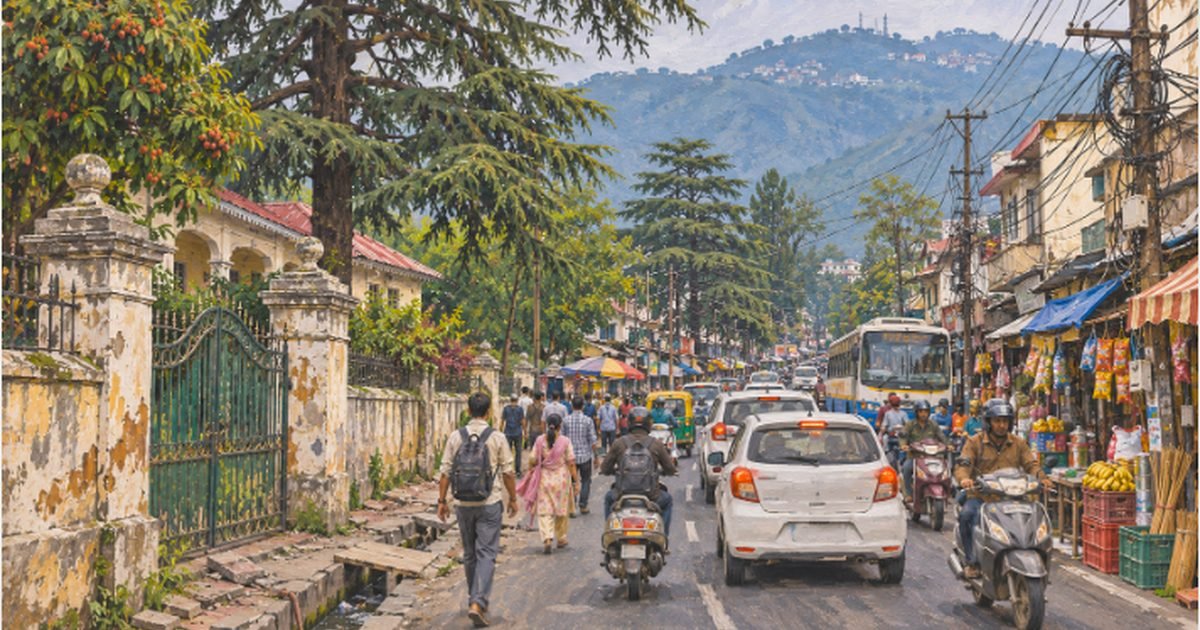
Rajpur Road is the only street in Dehradun that is also the city’s property market, its rush-hour problem and its history lesson, all at once. It begins where the old town ends, at the Clock Tower end of town, and climbs five and a half kilometres north-east to a village that was trading with Tehri Garhwal before Dehradun existed as a town. Everything expensive in this city is on it or just off it.
It is also the most misunderstood stretch of road in the Doon valley. Visitors are told it is “the road to Mussoorie” and drive it expecting a hill road; residents describe it as the posh part of town and quote a per-square-foot rate that may belong to a different locality entirely; and the property portals disagree with each other by ₹1,650 a square foot on the same kilometre of tarmac. The village at the top, Old Rajpur, is where the British waited a day before climbing to Mussoorie on ponies — and almost nothing on the road tells you that.
This guide covers what Rajpur Road actually is and where it begins and ends, why a 1676 revenue-free land grant put it on the map, what the 1930 motor road did to the village that had lived off the bridle path, what you see walking it in 2026, what the traffic and parking really cost you, and what it costs to rent or buy on it this month.
Last verified: 3 November 2026, against the Garhwal Post’s histories of Rajpur and Rajpur Road, the Times of India’s reporting on the President’s Bodyguards Estate, Old Rajpur’s heritage buildings and the 2026 traffic disruptions, Dainik Jagran’s report on the Municipal Corporation’s Rajpur Road parking scheme, the Nagar Nigam Dehradun and NIEPVD addresses, live Magicbricks, 99acres and Square Yards listings and locality pages, and road distances measured on the OSRM routing graph.
Quick answer: Rajpur Road runs about 5.8 km from the Clock Tower area to Pacific Mall and on to Rajpur village, climbing from the valley floor to roughly 3,000 feet. It is Dehradun’s premium address: flats average ₹9,366 a sq ft on Magicbricks for July–September 2026 and ₹10,150 on Square Yards for September 2026, with 3 BHK rents from about ₹32,000 to ₹65,000 a month. The village at the top was a revenue-free grant to Guru Ram Rai in 1676 and a pony-and-palanquin staging post until a motorable road to Mussoorie opened in 1930. Expect congestion, not scenery, between 9 am and 8 pm.
01Rajpur Road at a glance
| What it is | Dehradun’s main north-bound arterial and its most expensive residential and commercial corridor, running from the old city towards the Mussoorie ridge |
|---|---|
| Runs from | The Clock Tower / Astley Hall end of the old city to Rajpur village, where the Mussoorie road proper begins |
| Length, measured | 5.8 km from the Clock Tower to Pacific Mall; 10.4 km to the Old Mussoorie Road junction above Rajpur village |
| Elevation | About 640 m at the Clock Tower end, roughly 3,000 ft (about 915 m) at Rajpur — a climb of some 275 m |
| What is on it | Banks, schools, two malls, government institutions, the President’s Bodyguards Estate, hospitals, showrooms, cafés and, at the top, the old village |
| Traffic | Two-lane for most of its length. A fallen tree on a June 2026 evening produced a 9 km queue; a VIP movement in August 2026 stopped it for hours |
| Parking | No on-street parking worth the risk. The Municipal Corporation runs seven temporary sites on the stretch each December–January |
| Property | ₹9,366 a sq ft average asking for flats, July–September 2026 (Magicbricks); ₹10,150 (Square Yards, September 2026); ₹8,500 (99acres, April–June 2026) |
| Best time | Weekday mornings before 10 am, or after 8.30 pm. Sunday morning is the only time the road is pleasant |
| Watch out for | Rates quoted for “Rajpur Road” that belong to Dalanwala, Jakhan or Sahastradhara Road — check the address on every listing |
02What Rajpur Road actually is
Dehradun sits in a doon — a flat, gravel-filled valley between the Shivalik foothills to the south and the first Himalayan ridge to the north. Rajpur Road is the one road that leaves the valley floor and climbs onto that northern ridge, which is why it has always been the road out: to Mussoorie, to Landour, to Tehri, and before any of them, to the trade mart at Rajpur.
The road’s character changes three times in five kilometres. From the Clock Tower to about Dilaram Bazaar it is old-city commercial — narrow frontages, wholesale, hardware, sweets, the tail end of Paltan Bazaar’s economy. From there to Jakhan it is institutional and retail Dehradun: schools, banks, the National Institute for the Empowerment of Persons with Visual Disabilities at 116 Rajpur Road, showrooms, and the two malls. Past Jakhan it turns residential and then semi-rural, the shops thin out, the deodars and litchi orchards start, and the last kilometre into Rajpur village is a climb between stacked houses with the Mussoorie ridge filling the view ahead.
That last stretch is the reason the road exists at all. Rajpur sits at what a Garhwal Post history calls “the southern-most extension of the Himalayas” — the point where the flat valley ends and the hill begins, at about 3,000 feet, with a perceptible change in temperature and flora from the valley below. Six miles from old Dehradun, seven miles from Mussoorie: in the days of the bridle path, that was exactly one day’s staging.
Two things follow from the geography and they explain the property market. First, the road has a hard western edge — the Rispana valley and the ridge — so there is no room to widen it and very little land to build on. Second, the altitude and the tree cover make the top of it the coolest residential address in the city, which is why the British built their summer houses there and why buyers still pay a premium for the last two kilometres.
03The name, and the grant behind it
Rajpur is the village, not the road; the road is named after it. Before the British, Rajpur was a hatnala — a rudimentary trade mart — on the route east to Tehri Garhwal over the Saklana hills. It was also, from 1676, one of the villages granted revenue-free to Guru Ram Rai by the then Raja of Garhwal, which is the same grant that let the Darbar Sahib in the old city grow into the institution it is today.
That is the fact most visitors never connect: the shrine in Jhanda Mohalla and the village at the top of Rajpur Road were funded by the same 1676 exemption, and for two centuries the road between them was the spine of the grant. If you want the other half of the story, our guide to the Guru Ram Rai Darbar covers it.
The spelling is stable — Rajpur, Rajpur Road, sometimes Old Rajpur for the village core. What is not stable is what people mean by it. Estate agents use “Rajpur Road” for everything from the Clock Tower to the Mussoorie diversion, including side lanes that are technically Jakhan, Kishanpur or Kanwali. Locals use “Rajpur” for the village at the top and “Rajpur Road” for the commercial stretch below it. When someone quotes you a rate for Rajpur Road, the first question to ask is which kilometre.
041815 to 1930: the road that made the town, then emptied it
The modern history starts with a bungalow. Captain, later Colonel, Frederick Young — a Donegal Irishman who ran the Doon for the East India Company after the Anglo-Gorkha war of 1814–15 — built his mansion on Rajpur Road, in what the Garhwal Post’s history of Dehradun’s bakeries describes as “a pleasant spot with a clear view of the alluring ridge that went on to become Mussoorie”. Young is the man credited with the accidental “discovery” of Mussoorie in 1823, and his house on this road is the first recorded European address on it.
What followed was a logistics boom. Every British family heading for the hills came up from Saharanpur — the nearest railway station until 1900 — through the Mohand pass, along the valley, and stopped at Rajpur. There they rested a night, handed their luggage to transport agencies, and hired the men who carried it up: a class of porters the Garhwal Post history records, with a historian’s dryness, as being called “Faltoos” despite their physical prowess.
By the 1860s Rajpur had three hotels — the Prince of Wales’ Hotel, the Caledonia and the Agency Hotel — a police station, a post office and a public dispensary. Its heyday was 1860 to 1890, and for its size it eclipsed the Doon below. The Caledonia kept its own burial ground for guests who did not survive the change of air; 28 marked graves were still there not long ago.
- 1860s–1890s. Rajpur is the staging town for Mussoorie: hotels, transport agencies, porters, a grass market (Ghass Mandi) for the ponies, and troughs for them at the roadside — one is still used as a waste bin at the bottom of the village.
- 1870s. A private cart road built by a Mr Mackinnon, for his brewery, opens the valley to wheeled traffic. It is twice as long as the bridle path, so the ponies and jampans — sedan chairs carried by four men — survive alongside it.
- 1900. The railway reaches Dehradun. Travellers now arrive in the valley rather than at Saharanpur, and the road’s traffic grows.
- 1930. A motorable road to Mussoorie opens. The transport agencies and hotels collapse; Rajpur becomes, in the historian’s phrase, a deserted ghost town, and the road becomes a commuter corridor instead of a pilgrimage route.
- 1847. In the middle of all this, the first batch of Governor General’s Bodyguard horses arrives at the estate on Rajpur Road that is now the President’s Bodyguards Estate — 237 acres, built to keep the horses out of Delhi’s summer.
The road’s later history is the ordinary history of an Indian arterial: shops replacing bungalows, the malls arriving in the 2000s, the traffic arriving with them. What survived is at the top. Old Rajpur’s houses — locals put many of them at 270 years old — still carry Mughal-inspired window frames, alcoves and balcony awnings, and the village still has the Baori Shiva temple where Swami Vivekananda rested for about three weeks in 1890 before going on to the Himalayas, the Bengali Ashram that holds the shrine of his brother-monk Swami Akhandananda, and the Tibetan community and monastery school that followed the Dalai Lama’s flight in 1959.
05What you actually see, stretch by stretch
Walk it, or drive it in sections, because five kilometres of Rajpur Road is three different places.
- The Clock Tower end. Start at the Ghanta Ghar and the Astley Hall side of the old city. This is the busiest, least photogenic kilometre: wholesale, hardware, sweets, loading vehicles, and the point where every Mussoorie-bound tourist bus joins the queue. Our Clock Tower guide explains why every distance in Dehradun is measured from here.
- Dilaram Bazaar to Jakhan. The institutional stretch. NIEPVD’s 116 Rajpur Road campus — the Central Braille Press is inside it — banks, schools, St Joseph’s Academy, Scholars Home, showrooms and the two malls. Pedestrian-hostile: narrow footpaths, open drains, no shade.
- The President’s Bodyguards Estate. Behind high gates and a tree line on the left going up: 237 acres, eight stables, the summer quarters of the horses that carry the President’s escort. Not open to visitors. The gates are worth a look from the road; the colonial-era horse trough that stood outside was demolished in 2016 during “beautification” work, which tells you what official Dehradun thinks of its own heritage.
- Jakhan to Rajpur village. The road narrows, climbs, and turns green. Litchi and mango orchards, old bungalows behind hedges, cafés in converted houses, and the smell of deodar after rain. This is the two kilometres that justify the price.
- Rajpur village. Steep lanes, stacked houses, a WWI memorial with 78 names next to the post office, roadside troughs from the pony era, the Ghass Mandi sign, and the bridle path leaving for Jharipani and Mussoorie. Ten minutes on foot here explains the whole road.
What is not there: a viewpoint, a promenade, a heritage walk with signage, or a single interpretive board about any of it. The history is entirely in the architecture and the archives.
06The estates and institutions that set the tone
Rajpur Road’s property market is not driven by IT. There is no IT park on it — the city’s IT park is elsewhere, and listings that mention “IT park” as a landmark for a Rajpur Road flat are describing something two kilometres away. What sets the tone here is a different kind of anchor tenant.
The biggest is the state itself: government offices, the forest department headquarters, and the institutions that come with a capital city. The most unusual is the President’s Bodyguards Estate — 237 acres of colonial stables and bungalows, built after the first batch of bodyguard horses arrived in 1847, with an original construction estimate of ₹8,365 submitted by the superintendent of Dehradun. It is one of the last intact colonial estates in the city and the single largest piece of open land on the road.
The most consequential for families is education. Scholars Home and St Joseph’s Academy both sit on or immediately off the stretch, and the concentration of schools in the Jakhan–Rajpur belt is the reason a large part of the rental demand is parents of schoolchildren rather than office workers. Add two malls, a row of banks, and a specialist national institute, and you have a corridor whose daytime population is students, patients, shoppers and government employees — which is exactly what the traffic pattern shows.
Two practical consequences. First, the road’s peak hours follow school and shop timings, not office timings: expect 7.45–8.45 am and 1.30–2.30 pm to be as bad as 6 pm. Second, commercial ground-floor rents on the stretch are set by frontage and footfall, not by area, which is why a 200 sq ft shop can cost more per square foot than a 2,000 sq ft flat.
072026: the traffic, the parking scheme and what changed
Rajpur Road’s present condition is best described by three incidents and one policy.
The storms. On the evening of 4 June 2026, high winds and rain brought trees down on Rajpur Road — two of them near Silver City Mall and the NIVH campus — and the queue that formed was reported by Dainik Bhaskar at nine kilometres, with traffic diverted to Canal Road. The Times of India’s report the same evening describes fallen trees opposite Rashtrapati Niketan and diversions onto Canal Road. A road with no alternative and a mature tree canopy will do this every monsoon.
The VIP movements. In August 2026 a visit by a dignitary closed or slowed Rajpur Road, Canal Road and Supply Road for hours, and residents questioned why the trips could not be timed or routed better. Nothing about the road’s capacity changed as a result.
The parking scheme. Every December, the Municipal Corporation turns seven stretches of Rajpur Road into temporary paid parking for the Christmas–New Year tourist rush. For the 2025–26 season it notified seven sites — JJ Tower near HDFC Bank, Pacific Hills, Patel Park at the Clock Tower, the stretch from Punjab Jewellers to Park View Hotel, Scholars Home to ICICI Bank, Anandam Sweets, and the forest department headquarters to Silver City — operating from 20 December, with capacity for more than 500 two- and four-wheelers. Charges: ₹10 for two hours and ₹50 for the day for a two-wheeler; ₹20 for two hours and ₹100 for the day for a car.
The policy. The road is two-lane for most of its length and cannot be widened: the ridge is on one side and the built frontage on the other. Every proposal for the corridor therefore manages demand rather than adds capacity — parking sites, one-way experiments, diversions — and none of them has changed the peak-hour experience in a decade.
08Practicalities
- Do not drive it between 9 am and 8 pm if you have a choice. A 5.8 km run to Pacific Mall takes eight minutes at 7 am and thirty-five at 6 pm.
- Parking. The malls have paid basement parking and are the only reliable option mid-road. Elsewhere, the December parking sites are seasonal; the rest of the year, park off the road in a side lane and walk.
- Walking. Footpaths exist from the Clock Tower to Jakhan but are broken, occupied by shop displays, and interrupted by open drains. From Jakhan up, there is mostly no footpath — walk facing traffic.
- Autos and Vikrams. Shared Vikrams run the corridor to Rajpur village. Agree the fare before boarding an auto; the unmetered rate to Rajpur from the Clock Tower is a negotiation.
- Crossings. There are no signalised pedestrian crossings on the stretch. Cross at the malls or at the Clock Tower end.
- Monsoon. Tree fall and localised flooding at the Dilaram Bazaar end. Avoid the road during a storm; the diversions add twenty minutes.
- What to carry. Water — the stretch has long gaps between shops — and cash for parking, because several of the seasonal sites take cash only.
09How to reach Rajpur Road
All distances below were measured on the OSRM routing graph in this session, from fixed points to Pacific Mall on Rajpur Road, because the published figures vary by up to two kilometres.
| From | Road distance | Notes |
|---|---|---|
| Clock Tower / old city | 5.8 km | About 6 minutes outside peak hours; 30–35 minutes at 6 pm |
| Dehradun railway station | 7.6 km | About 9 minutes; via the city centre, so it inherits the old-city jam |
| ISBT Dehradun | 13.7 km | About 14 minutes via Haridwar Road on the routing graph; considerably more at peak |
| Jolly Grant airport | 29.5 km | About 36 minutes |
| Rajpur village (Old Mussoorie Road) | 10.4 km from the Clock Tower | The top of the road; about 10 minutes without traffic |
| Mussoorie (town) | 29.1 km from the Clock Tower | About 30 minutes; Rajpur Road is the first third of that run |
| Dehradun Zoo, Malsi | 9.1 km from the Clock Tower | About 3.3 km past Pacific Mall, on the same road |
10The best time to be on it
| Window | What you get | The trade-off |
|---|---|---|
| Weekday, 7–9.30 am | The road at its best: light traffic, shops opening, the ridge clear | School-run traffic starts at 7.45 am |
| Weekday, 10 am–5 pm | Everything open, all banks and showrooms working | The worst of the parking problem and the heat |
| Weekday, after 8.30 pm | Free-flowing, lit, and the only time the top stretch feels like a hill road | Most shops shut; footpaths empty and poorly lit |
| Sunday morning | The one genuinely pleasant window — locals walk the Rajpur stretch for exercise | Cafés at the top fill by 10 am |
| Christmas–New Year | The road at full commercial volume, with the seasonal parking sites running | The worst congestion of the year, plus tourist traffic for Mussoorie |
| Monsoon (July–September) | Green, cool, the orchards at their best | Tree fall, waterlogging at the lower end, and the 4 June 2026 kind of evening |
If you have one drive, take it on a Sunday in October or November, at 7 am, from the Clock Tower up to Rajpur village and back. You will see the whole road in the only conditions that show what it was.
11Five things the standard guides get wrong
- “Rajpur Road is the road to Mussoorie.” It is the first third of it. The Clock Tower to Mussoorie town measures 29.1 km on the OSRM routing graph; Rajpur Road accounts for 5.8 km of that, and the climb to Mussoorie begins after Rajpur village. Guides that treat the whole run as one scenic road leave visitors expecting switchbacks at Jakhan.
- “It has always been Dehradun’s posh address.” It has always been the road out. Until 1930 it was a staging town for porters and ponies; the “posh” part arrived with the motor car, the malls and the schools, mostly after 1990. The colonial bungalows that people point at are in Old Rajpur and inside the President’s Bodyguards Estate, not along the commercial frontage.
- “Rates on Rajpur Road are about ₹10,000 a sq ft.” Three portals, three answers, same month: Square Yards gives ₹10,150 for September 2026, Magicbricks ₹9,366 for July–September 2026, 99acres ₹8,500 for April–June 2026. They are measuring different baskets — Square Yards weights villas at ₹10,550, 99acres excludes newer launches. The honest answer is a ₹8,500–10,150 band, and a specific flat can sit outside it: a 2,920 sq ft 4 BHK listed on 24 October 2026 asks ₹4.67 crore, which is ₹16,000 a sq ft.
- “The President’s Bodyguards Estate is a tourist sight.” It is a working military establishment of 237 acres, not a monument, and it is not open to the public. The heritage walk version of Rajpur Road that appears in blogs describes gates and walls from outside.
- “Rajpur Road is a 10-minute drive from the station.” It is 7.6 km, and the ten minutes assumes no traffic on the old-city stretch before you even reach Rajpur Road. The realistic figure at any civilised hour is 20–25 minutes.
12What living on Rajpur Road is actually like
This is the most expensive residential corridor in Dehradun, and it prices like a prestige market rather than a yield market: 99acres puts the average rental yield at 2 per cent, which is a number you accept because you want the address, not because the rent covers the loan.
What you are buying is altitude, tree cover, schools and the fact that the ridge stops further supply. What you are paying for, separately, is a car you will use less than you think and a parking space you will fight for.
| Segment | Current range, November 2026 | Source |
|---|---|---|
| Flats, average asking | ₹9,366 a sq ft (July–September 2026, +2% QoQ); ₹10,150 (September 2026); ₹8,500 (April–June 2026) | Magicbricks, Square Yards and 99acres locality pages, read this month |
| Villas | ₹10,550 a sq ft average asking, +1.07% | Square Yards, September 2026 |
| Plots and land | ₹8,900 a sq ft average, range ₹6,150–12,050 | 99acres, April–June 2026 |
| Builder floors | ₹6,350 a sq ft average | 99acres, April–June 2026 |
| 3 BHK rent, furnished | ₹46,000 for 1,800 sq ft in Pacific Hills (posted 24 October 2026); ₹65,000 for 2,780 sq ft in Whispering Willows (posted 24 October 2026) | Magicbricks listings, live this month |
| 3 BHK rent, semi-furnished | ₹32,000 for 1,800 sq ft in the same Pacific Hills tower; ₹35,000–45,000 for 1,900–2,185 sq ft elsewhere on the road, plus ₹3,500–6,000 maintenance | Magicbricks listings, May–August 2026 |
| 2 BHK rent, average | ₹25,350 a month | Square Yards, September 2026 |
| Demand driver | Schools, the two malls, government and institutional employment, and second-home buyers from Delhi and the NCR — a services and lifestyle market, not an IT one | — |
Note what the table cannot tell you: the difference between the two Pacific Hills 3 BHKs — ₹32,000 semi-furnished in August and ₹46,000 furnished in October, same tower, same 1,800 sq ft — is furnishing, floor and negotiating appetite, not a market move. Ask what is actually included before you compare.
The honest downsides:
- The traffic is the price of the address. You will sit in it every evening. A 5.8 km commute becomes 35 minutes; a fallen tree makes it two hours.
- Water and drainage. The upper stretches depend on local supply and tankers in summer; the lower stretch floods at Dilaram Bazaar in a heavy monsoon. Ask which line serves the building and when the tank was last cleaned.
- No footpaths at the top. Walking to a shop from a Rajpur village house means walking on the road.
- Construction noise. Redevelopment is continuous — old bungalows coming down, four-storey builder floors going up. Check what is being built next door before you sign a two-year lease.
- Prestige pricing on resale. Flats have moved 0.6 per cent in a year on 99acres’ series while plots moved 28.1 per cent. If you are buying for appreciation, the land is the asset, not the apartment.
What is on the board on this corridor is on our marketplace, and owners can list free, without brokerage. If you are letting rather than looking, start with how to rent out a flat in Dehradun without a broker; anyone buying land on the ridge should run our plot and title checks first, and tenants new to the city should read where to look for a PG in Dehradun.
13Frequently asked questions
How long is Rajpur Road?
About 5.8 km from the Clock Tower area to Pacific Mall on the measured road network, and 10.4 km to the Old Mussoorie Road junction above Rajpur village. The road continues as the Mussoorie road for another 20 km to the hill town itself.
Is Rajpur Road the same as the road to Mussoorie?
It is the first section of it. The Clock Tower to Mussoorie measures 29.1 km on the OSRM routing graph, of which Rajpur Road is the 5.8 km through the city. The climb starts after Rajpur village, not before it.
Why is Rajpur Road so expensive?
Altitude, tree cover, schools, and a hard supply limit: the ridge is on one side and built frontage on the other, so there is nothing to develop. Average asking prices for flats were ₹9,366–10,150 a sq ft in the September 2026 quarter, against ₹8,750 in Dalanwala and ₹8,050 on GMS Road.
What is there to see on Rajpur Road?
Not a sight, a stretch: the old-city commercial kilometre, the institutional middle with NIEPVD and the malls, the President’s Bodyguards Estate gates, and then Old Rajpur village with its 270-year-old houses, the Baori Shiva temple, the WWI memorial and the start of the Jharipani bridle path.
Can you visit the President’s Bodyguards Estate?
No. It is a working military establishment of 237 acres where the President’s Bodyguard horses spend the summer, as they have since 1847. You can see the gates and the tree line from the road.
Where do you park on Rajpur Road?
The mall basements are the only dependable option. Each December the Municipal Corporation opens seven temporary paid sites between the Clock Tower and the Mussoorie diversion — ₹10 for two hours and ₹50 a day for a two-wheeler, ₹20 and ₹100 for a car — but they run only for the Christmas–New Year season.
How bad is the traffic, honestly?
Bad. A fallen tree on 4 June 2026 produced a reported 9 km queue and diversions to Canal Road; a VIP movement in August 2026 stopped the road for hours. Plan 30–35 minutes for the 5.8 km to Pacific Mall at peak, eight minutes before 7 am.
Is Rajpur Road a good place to rent?
If you have children in school on the corridor or want the coolest address in the city, yes — a 3 BHK runs ₹32,000–65,000 a month depending on furnishing and size. If you commute to the other side of Dehradun daily, the traffic makes a cheaper locality a better deal.
What is Old Rajpur?
The village at the top of the road, at about 3,000 feet — a pre-colonial trade mart and one of the villages granted revenue-free to Guru Ram Rai in 1676. It became the staging post for Mussoorie travellers until the motor road opened in 1930, and it still has the houses, troughs and memorials from that period.
14Where to go next
Drive the road to its end and keep going: the same tarmac becomes the Mussoorie road, and 3.3 km past Pacific Mall it passes the gates of Malsi Deer Park, now the Dehradun Zoo — the one stop on this corridor that is actually built for visitors. If you turn off at Jakhan instead, Sahastradhara is a short run east to the sulphur springs and the ropeway.
At the bottom end, the road runs into the old city: Paltan Bazaar for the market, the Clock Tower for the point every distance in Dehradun is measured from, and the Guru Ram Rai Darbar, whose 1676 land grant put Rajpur on the map in the first place.
And if the road is on your list as somewhere to live rather than to drive, walk the last two kilometres on a weekday morning before you decide. The gradient, the footpath situation, the walk to the nearest place you can park a car and the state of the drains after rain will tell you more in twenty minutes than any listing will. Our marketplace carries what is currently listed; owners can add a property free.
Dates, distances and rates in this guide were checked on 3 November 2026 against the Garhwal Post’s histories of Rajpur village and Rajpur Road’s bakeries, the Times of India’s reports on the President’s Bodyguards Estate (2016), Old Rajpur’s heritage buildings (2023), the 4 June 2026 tree-fall disruption and the August 2026 VIP-movement congestion, Dainik Bhaskar’s report of the June 2026 jam, Dainik Jagran’s report of the Municipal Corporation’s Christmas parking scheme, the Nagar Nigam Dehradun and NIEPVD addresses, live Magicbricks, 99acres and Square Yards pages, and road distances measured on the OSRM routing graph. Traffic, rents and rates change without notice — check before travelling or signing.
5 Comments
[…] zoo is a stop on a road worth doing properly. Rajpur Road is the corridor that brings you here — its history, its old village and its property market are […]
[…] that matters most — what the same money buys on the city side of Premnagar — read the Rajpur Road guide before you commit to the […]
[…] account if you want new Raipur listings as they appear. To compare the two ends of the market, read Rajpur Road for what Rs 6,000 a sq ft buys in the north, and Paltan Bazaar for the commercial market in the […]
[…] account if you want new Dalanwala listings as they appear. For the comparison that matters, read Rajpur Road for the newer, more expensive neighbour, and Clement Town for what a third of this budget buys 12 […]
[…] account if you want new Vasant Vihar listings as they appear. For the comparison that matters, read Rajpur Road for the newer, freer market, and Dalanwala for the other old-money quarter on the east side of […]