

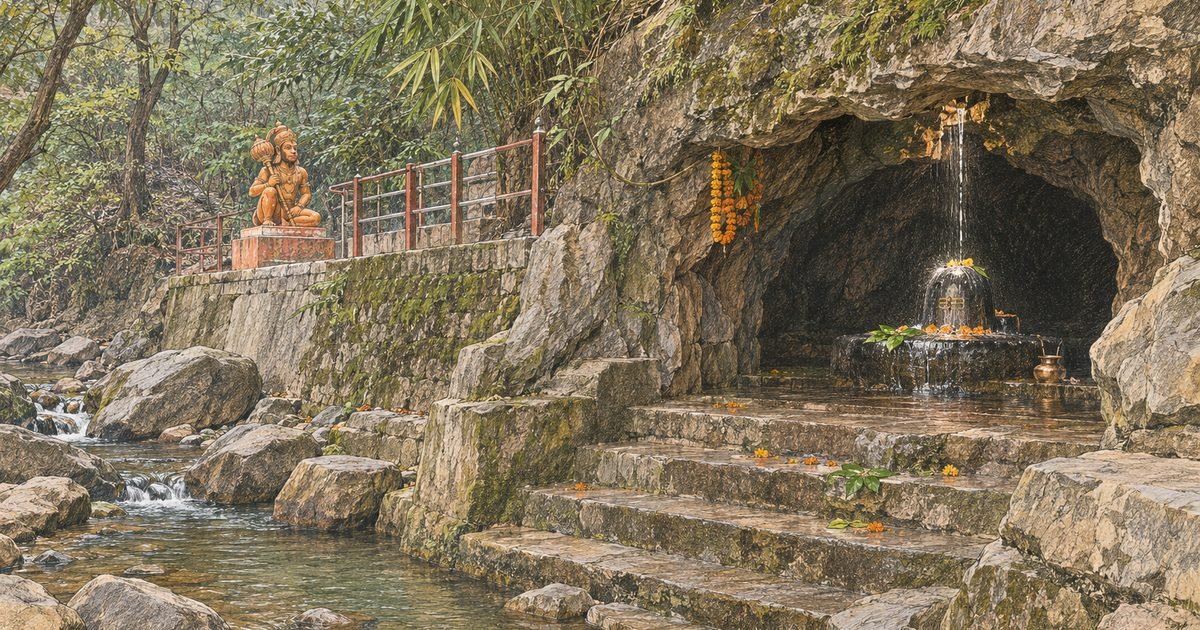
Tapkeshwar is the only temple in Dehradun where the deity is a piece of plumbing you can hear. Water comes through the roof of a natural cave and falls, drop by drop, on a shivalinga that nobody carved. Stand in the sanctum for a minute and the sound is the whole experience — tapak, tapak — and it is also the name.
Everything else about the place is contested. Three government documents give the stream outside three different names. The temple is described as 6,000 years old in the Hindi press and as “ancient” everywhere else, on the strength of a Mahabharata association rather than a date. The visitor listings do not agree on the timings. And in September 2025 the stream rose into the courtyard, up to the Hanuman statue, which is the most concrete thing that has happened here in years.
This guide deals with all of it: what the cave is, what the legend actually claims, what the fair is like, what it costs (nothing), how to get there without the 7 km figure that everyone copies, why the state is now buying land for a sewage plant on the temple’s doorstep, and what it is like to rent or buy in Garhi Cantt.
Last verified: 1 November 2026, against the district administration’s fair and festival page, the Nagar Nigam Dehradun’s own temple page, the 2026 flood and infrastructure reporting, the temple’s priest as quoted in the Hindi press, and road distances measured on the OSRM routing graph.
Quick answer: Tapkeshwar Mahadev Temple is a cave shrine in Garhi Cantt, 5.7 km by road from the Clock Tower (about 9 minutes outside peak hours) and 6.9 km from the railway station. Entry is free. The cave holds a self-manifested shivalinga under a continuous drip of water; the cave has been linked to Guru Dronacharya and is called Drona Gufa. Allow 45 minutes; on Mahashivratri the fair runs for over a week.
01Tapkeshwar at a glance
| What it is | A cave temple to Shiva, built around a natural shivalinga that receives a continuous drip of water through the cave roof; the surrounding site is associated with Guru Dronacharya and is called Drona Gufa |
|---|---|
| Also called | Tapkeshwar Mahadev, Dudheshwar Mahadev, the Drona cave temple; the district administration notes that the Skandapurana refers to the place as Deveshwara |
| Address | Tapkeshwar Road, Birpur (Garhi Cantonment), Dehradun, Uttarakhand 248001 |
| Distance from the Clock Tower | 5.7 km by road, about 9 minutes outside peak hours |
| Entry | Free. No ticket, no ticket counter |
| Hours | No official schedule is published. Wikipedia gives 6 am–7 pm daily, with the temple kept open day and night through Shravan; commercial listings quote anything from 4 am to 10:30 pm. Arrive before 9 am and the question does not arise |
| Time needed | 30–45 minutes; an hour on a Monday or during Shravan |
| The water | Seepage through the cave roof onto the shivalinga — continuous, not a spring, and not a fountain |
| Festivals | Maha Shivratri, when a fair runs for over a week; the month of Shravan; every Monday |
| Best months | October–March; July–August for Shravan if you want the crowds and can take the monsoon |
| Watch out for | The stream floods the courtyard in heavy monsoon rain; in September 2025 water reached the Hanuman statue and logs came in with it |
02Where it is, and the stream with three names
The temple sits in Garhi Cantonment, on Tapkeshwar Road, in the north-west quadrant of the city — the side that runs up towards the Mussoorie road, not the side that runs out to the airport. It is the closest of Dehradun’s cave and riverside sites to the centre, which is why it is a twenty-minute auto ride rather than a half-day outing.
The geography is a small gorge. A seasonal hill stream comes down through the Doon’s limestone and conglomerate belt and cuts a shallow ravine; the temple is built against the ravine wall, with ghats stepping down to the water and the cave opening behind them. The district administration’s account places it on the eastern bank of the Tons. The Nagar Nigam’s own page calls the same watercourse the seasonal Asan river. And when the stream flooded the temple in September 2025, the press reports called it the Tamsa.
All three are in use, and this is not a scandal so much as a naming problem the city has never resolved: the stream is seasonal, it has a local name and a revenue name, and the two get interchanged in official documents. What matters practically is that it is small, it is fast, and after heavy rain in the catchment it comes up quickly — which is exactly what happened in 2026.
03The name, decoded
Tapak is Hindi for a drip. Tapkeshwar is the lord on whom water drips — not a poetic title but a description of the building: the water falls from the roof of the cave onto the lingam, and the name says so.
Two other names attach to it. Drona Gufa, the Drona cave, after the Mahabharata’s guru of the Pandavas and Kauravas, who is said to have lived here. And Dudheshwar Mahadev — the lord of milk — which is the older form of the same story: the drip was milk before it was water. The district administration’s page adds a third, older name from the Skandapurana, where the place is referred to as Deveshwara, which pushes the site’s textual history back before the Mahabharata association and is the closest thing to a documentary anchor the temple has.
04The legend, and what is actually old
The story, as the district administration tells it: during the Dwapara Yuga this was Dronacharya’s home. His son Ashwatthama was born here. When the infant cried for milk and his father was too poor to keep a cow, Drona told him to pray to Shiva. Shiva appeared and said that milk would be made available, and Ashwatthama found milk falling onto the shivalinga, drop by drop. Because he had prayed to the lord by the name Tapkeshwar, the place took the name.
Wikipedia’s version names Drona’s wife — Kalyani, unable to breastfeed the newborn — which is the same story with the mother put back in it. The Hindi press tells it in the past tense, which is the tell: “a 6,000-year-old temple of Lord Shiva, where milk used to drip from the cave, know the belief.” Note the last two words. Even the headline selling the number files it under manyata, belief.
Now the part that requires care. The district administration’s own page hedges exactly where a historian would: “It is believed that during Dwaparyuga, this place was abode of Guru Dronacharya.” There is no excavation record, no inscription and no architectural dating that puts any structure here at 4000 BCE, and the Mahabharata is not a dated document that could supply one. What the district page can support is the cave, the shivalinga and the continuity of worship at the spot. What it cannot support is an age.
What is old is the cave and the shivalinga. What you see standing — the ghats, the courtyard walls, the Hanuman statue, the shrines around the sanctum — is recent construction around that core. The honest way to hold the two together is this: the site is genuinely ancient as a place of worship, and the “6,000 years” is what the temple says about itself. Both statements are true and only one of them is a measurement.
05What you actually see
The visit is short and runs in one direction: down.
- The approach. Tapkeshwar Road ends in a cluster of shops and stalls; the last stretch is on foot, past the parking and down steps towards the ravine. Auto-rickshaws will drop you at the top.
- The courtyard and the ghats. A paved terrace above the stream with a large Hanuman statue — the one the September 2025 flood reached — and steps down to the water. This is where the fair happens and where families sit.
- The cave. A low natural chamber, wet underfoot, with the shivalinga directly beneath the seep. You will queue, you will crouch, and you will be moved along. It takes less than a minute and it is the point of the place.
- The drip. Water falls continuously through the rock onto the lingam. This is what the name means and what people come for. It is not a spring, it is not hot, and there is no plumbing involved — it is rain that entered the hill above and is coming out here.
- The springs. Pilgrims bathe in the water near the temple before darshan — the “sulphur springs” of the tourism copy. The pools are part of the ritual, not a spa; no water analysis is published anywhere, and the stream’s water quality is precisely the thing the state is now spending money on (section 07).
- The market outside. Prasad, flowers, coconuts, plastic bottles, and the ordinary commerce of a working shrine. Dakra Bazaar is the nearest proper market, and the lane in from it is the one used by anyone walking up from the city side.
06The fair, Sawan and Mondays
The fair is the reason this place is on the district administration’s calendar at all. On Maha Shivratri a mela runs here for over a week, and the district’s own page states that thousands of devotees congregate on the day. The temple committee organises mahaprasad and free meals for visitors, and Wikipedia’s account — the only one that mentions it — records that sadhus in the Aghori form come down from Kedarnath and Badrinath for the occasion.
The second season is Shravan, the month of Shiva, roughly July to August, when the temple is described as being kept open through the night so that devotees can get darshan. That is also when the Shobha Yatra is taken out: on 26 August 2026 the Chief Minister joined a procession that started from Shivaji Dharamshala in Arhat Bazaar and wound through the city, an annual event organised by devotees and saints during Shravan.
Third, and easiest to use if you live here: Monday, Shiva’s day, when local families come and the queue at the cave is at its longest. If you want the temple without a crowd, go on a Tuesday or Wednesday morning; if you want to understand what the place is for, go on a Monday.
One local institution worth knowing about: every Holi, the Dehradun theatre group Hamari Pehchan opens its season of performances at this temple. It is a small thing that tells you the temple functions as a neighbourhood cultural venue, not only a pilgrimage site.
07The flood, the sewage plant and the procession
Three things have happened here in the last two years, and together they describe the temple’s real situation better than any description of the cave.
It flooded. Heavy rain through the night of 15 September 2025 sent the Tamsa — the name the reports used — into the temple. Water entered the courtyard and rose to the Hanuman statue; the sanctum sanctorum stayed safe and nobody was hurt. The priest, Acharya Bipin Joshi, told ANI that the river had been running hard since five in the morning and that the whole premises were submerged, and that “this kind of situation had not taken place in a very long time.” A local described the water reaching 10 to 12 feet and rising above the shivalinga, with people getting out on a rope. Logs came down with the flow and damaged the structure. It was not a freak: during the August 2022 cloudburst, water entered the caves here too.
That matters practically. The courtyard is the fair ground and the bathing area, the ghats are the first thing to go under, and nothing about the layout prevents a repeat.
The state is buying land for a sewage treatment plant next door. On 25 July 2026 the Chief Minister approved ₹6.62 crore for land acquisition for an 8 MLD sewage treatment plant at Tapkeshwar Mahadev, Garhi Dakra Cantonment, as part of a ₹62 crore development package. Read that alongside the flood and the picture completes itself: the stream the temple’s ritual depends on needs cleaning, and the plant is going into the same catchment. For residents of Garhi Cantt this is the most consequential infrastructure decision for the area in years — worth knowing if you are buying anywhere near the ravine, because it moves both the flood risk and the nuisance factor.
It has become a political stop. On 26 August 2026 the Chief Minister walked in the Tapkeshwar Mahadev Shobha Yatra, the annual Shravan procession, which started from Shivaji Dharamshala in Arhat Bazaar; the police issued route diversions for the day. Expect the festival calendar to bring more footfall, more road closures and harder parking than the guidebooks imply.
08Practicalities
- Entry is free. There is no ticket. You will pay for shoes, flowers and prasad, and for parking if you drive.
- Timings are folklore. Wikipedia gives 6 am–7 pm daily, with the temple kept open day and night through Shravan. Commercial temple listings quote everything from 4 am to 10:30 pm, with an evening aarti somewhere in the middle of it. Neither the district administration nor the municipal corporation publishes a schedule at all, so morning and late afternoon are the safe bets.
- Footwear comes off before the steps down to the cave. There is a shoe stand; keep a token or small change.
- The cave floor is wet and the ceiling is low. Watch your head, hold the rail, and do not carry a bag you cannot hold in front of you.
- Photography is tolerated around the courtyard and not welcome in the sanctum. Ask, or just don’t.
- Monsoon. Do not go down to the water when the stream is up. The ghats are the first thing to flood and the last thing anyone closes.
- What to carry. Nothing much — water, and cash for the shoe stand and offerings. There is no café worth planning around.
- Accessibility. The courtyard is level, but the cave is reached by steps and requires crouching. Anyone with knee or back trouble should worship from the terrace.
09How to reach Tapkeshwar
One road in: Tapkeshwar Road, off the Garhi Cantt side. Every auto driver in the city knows it as Tapkeshwar Mandir, and the run from the Clock Tower is short enough that the fare is the only negotiation.
| From | Road distance | Notes |
|---|---|---|
| Clock Tower / city centre | 5.7 km | About 9 minutes outside peak hours |
| Dehradun railway station | 6.9 km | The “7 km” figure in the press is this one, not the Clock Tower distance |
| ISBT Dehradun | 9.6 km | Across the city; about 16 minutes |
| Jolly Grant airport | 29.9 km | About 40 minutes; the Nagar Nigam quotes 32 km, the district page 32 km — measured by road it is 29.9 km |
| Mindrolling Monastery (Clement Town) | 13.8 km | About 25 minutes — the opposite corner of the city |
10The best time to go
| Window | What you get | The trade-off |
|---|---|---|
| October–November | Cool, dry, the stream low and clear, the ghats usable | Post-monsoon weekend crowds from the city |
| December–February | The quietest weeks of the year; the cave is sheltered and warm relative to the air | Cold, damp steps; fog in the morning |
| March–April | Best all-round visit, and Holi brings the Hamari Pehchan performances | Fair crowds around Maha Shivratri in February or March |
| May–June | Early mornings are still cool | Hot courtyard with no shade; go at 7 am |
| July–August (Shravan) | The temple at full volume — all-night opening, Shobha Yatra, kanwarias | Monsoon flooding risk, crowds, and the one season you should not go down to the water |
If you get one visit: a weekday morning in late October, before 9 am, when the priest is still setting up and the cave is empty. If you get two: come back on a Monday in Shravan and see what the place is actually for.
11Five things the standard sources get wrong
- “6,000 years old” is a belief claim wearing a date. The Hindi headline that spreads furthest runs “a 6,000-year-old temple of Lord Shiva, where milk used to drip from the cave — know the belief”, and files it under manyata. The district administration’s own page says only that it “is believed” Dronacharya lived here. The cave is genuinely old; the number is not a measurement, and nobody has excavated the site.
- The river has three official names. The district administration’s page says Tons. The Nagar Nigam’s own temple page says the “seasonal Asan river”. The September 2025 flood reports say Tamsa. It is one small seasonal stream and the city has never settled the paperwork.
- The two government pages disagree about the distance. The district administration says Tapkeshwar is “about 5 kms from the Bus-Stand and 5.5 kms from Railway Station”; the Nagar Nigam says “6.5 km from Dehradun city” and lists the railway station at 7 km. Measured on the road network from a fixed point: 5.7 km from the Clock Tower, 6.9 km from the railway station, 9.6 km from ISBT. Use the measured figures and say what they are measured from.
- Nobody publishes the timings. The district and municipal pages both skip the subject; Wikipedia says 6 am–7 pm and all-night opening in Shravan; commercial listings run from 4 am to 10:30 pm. Every one of those pages presents itself as the visitor guide. Arrive in the morning and the discrepancy never costs you anything.
- “Sulphur springs” is tourism copy with nothing behind it. The bathing pools exist and pilgrims use them. No water analysis is published, and the stream’s water quality is bad enough that the state is acquiring land next door for an 8 MLD sewage treatment plant. Bathe if it is your practice; do not drink it and do not sell it to anyone as a cure.
12What living in Garhi Cantt is actually like
Garhi Cantonment is Dehradun’s quiet north-west, and it behaves like a cantonment should: wide roads, low-rise houses, deep plots, a lot of green, and the Rashtriya Indian Military College close by. The temple is the landmark people use, but the locality’s real character is institutional — army establishments, schools and old family houses rather than new apartment towers.
The consequence for a tenant is a market that behaves differently from the rest of Dehradun. Stock is mostly independent houses on their own plots rather than apartments in a society, rents sit in a narrow band, and the buildings are old enough that the wiring, the plumbing and the water tank are the things you inspect. The tenant mix follows: families, defence-adjacent staff, and people who would rather have a garden than a gym.
| Segment | Current range (late 2026) |
|---|---|
| Buy — per sq ft, all residential | ₹4,600 at the entry, ₹5,253 on average, up to ₹6,234 |
| Buy — plots | ₹38 lakh to ₹1 crore, depending on size and road access |
| Buy — independent house | From about ₹90 lakh for a 2,500 sq ft 3 BHK |
| Rent — 2 BHK flat | From about ₹23,000 a month for a semi-furnished unit |
| Market direction | The locality index is quoted at +50.1% year on year. Treat a figure that steep as asking prices rather than registered sales, and check the circle rate before you believe it |
| Demand driver | The ring road, the cantonment’s schools and hospitals, and a market that is walkable — not an IT corridor. This is a live-in locality, not a rental play |
The honest downsides:
- Cantonment rules. Large parts of the area are defence land or under cantonment administration. Building permissions, plot subdivisions and transfers are not municipal matters here, and a cheap plot is often one with a restriction attached.
- The stream is the flood line. Anything within reach of the ravine takes water in a heavy monsoon, as the temple itself demonstrated in September 2025. Walk the plot in July, not in April.
- Noise and access during events. Shravan, Maha Shivratri and the Shobha Yatra close roads around the temple for hours. If you are buying near Tapkeshwar Road, that is a recurring inconvenience, not a one-off.
- Water. Ask about supply hours and tanker dependence. The same question, everywhere in Dehradun, and the older cantonment colonies answer it less well than new developments.
- Thin rental stock. The area is dominated by owner-occupied houses. What does come up rents fast and rarely reaches the portals — which is why a board or a local contact still beats a listing site here.
What is on the board in this part of the city is on our marketplace, and owners can list free, without brokerage. If you are letting a house rather than looking for one, start with how to rent out a flat in Dehradun without a broker. Tenants new to the city should read where to look for a PG in Dehradun, and anyone buying land should run our plot checks before paying a token.
13Frequently asked questions
Is there an entry fee at Tapkeshwar Temple?
No. Entry is free and there is no ticket counter. You pay only for shoes, offerings and parking.
What are the Tapkeshwar temple timings?
There is no published official schedule, and the online guides contradict each other — 6 am–7 pm, 4 am–10:30 pm, and 9–1 with 1:30–5:30 all appear. The temple is kept open day and night during Shravan. Go in the morning.
How far is Tapkeshwar from the Clock Tower?
5.7 km by road, about nine minutes outside peak hours. It is 6.9 km from the railway station and 9.6 km from ISBT.
Why is it called Tapkeshwar?
From tapak, a drip. Water falls continuously from the cave roof onto the shivalinga, and the name means the lord on whom water drips. An older name, Dudheshwar, refers to the same drip in its milk form.
Is the temple really 6,000 years old?
That is the temple’s own claim, reported in 2026 from the head priest. The cave and the unhewn shivalinga are genuinely old and the site is linked to Drona in the district administration’s own account, but no excavation or inscription dates the shrine to the Mahabharata.
Can you bathe in the springs?
Pilgrims do, in the water next to the temple, before darshan. No water quality analysis is published, and the stream is polluted enough that the state is building an 8 MLD sewage treatment plant in the catchment.
What is the Maha Shivratri fair like?
A mela that runs for over a week, with thousands of devotees on the main day, free meals organised by the temple committee, and Aghori sadhus arriving from the Kedarnath and Badrinath routes. It is the busiest and most interesting time to see the temple — and the worst time to try to park.
Does the temple flood?
Yes. On the night of 15 September 2025 the Tamsa swelled after heavy rain, entered the courtyard and rose to the Hanuman statue — locals described it at 10 to 12 feet, above the shivalinga — while the sanctum stayed dry. Water entered the caves in the 2022 cloudburst as well. Do not go down to the ghats when the stream is running high.
Is Tapkeshwar worth visiting?
Yes, and it is the easiest of Dehradun’s cave and river sites to reach — twenty minutes from the centre, free, and genuinely unusual. It is a 45-minute stop, not a day out, and it is better on a weekday morning than a Sunday.
14Where to go next
Tapkeshwar pairs with the north of the city. Robber’s Cave at Gucchupani is the same idea at a much larger scale — a roofless limestone gorge rather than a cave — and makes the other half of a morning. Mindrolling Monastery in Clement Town is the city’s other great religious site and the complete opposite in temperament: 185 feet of stupa instead of a low wet chamber. For the colonial set piece, FRI is on the far side of the valley with six museums in it. And if this is your first week in Dehradun, start with the Clock Tower and Paltan Bazaar guide, because everything else is measured from it.
If Garhi Cantt is on your list as somewhere to live, walk it on a weekday: the run in from the Clock Tower, the traffic at the temple turn, the walk to the market and the state of the stream in monsoon will tell you more in twenty minutes than any listing will. Our marketplace carries what is currently listed; owners can add a property free.
Fees, distances and dates in this guide were checked on 1 November 2026 against the district administration’s fair and festival page, the Nagar Nigam Dehradun’s Tapkeshwar page, the Hindi press’s own “6,000-year-old temple … know the belief” framing, ANI’s reporting of the September 2025 flood as carried by First India, the July 2026 sanction of ₹6.62 crore for the sewage plant, and road distances measured on the OSRM routing graph. Festival dates and temple hours change without notice — check before travelling.
3 Comments
[…] it is caves you are here for, two more. Tapkeshwar Mahadev is a cave shrine rather than a cave, 5.7 km from the Clock Tower, with water dripping from the roof […]
[…] this junction, two places worth the drive. Tapkeshwar Mahadev is 5.7 km away — the cave shrine where the shivalinga sits under a permanent drip — and […]
[…] you are doing the religious circuit, Tapkeshwar Mahadev is the cave shrine on the other side of the ridge, and Mindrolling Monastery in Clement Town is the […]