

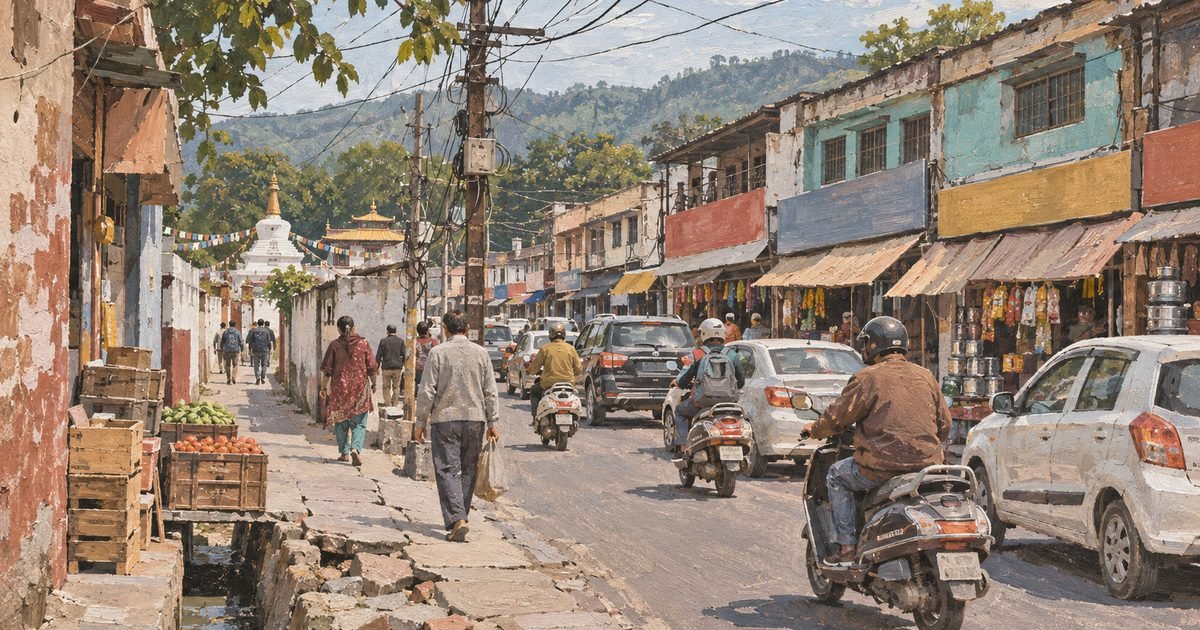
Clement Town is the Dehradun locality most often described by the wrong noun. Search for it and you get the monastery; ask a property agent and you get “Tibetan colony”; the cantonment board’s own website calls it a hill station seven kilometres from the Clock Tower. None of those is a lie and none of them is the place. Clement Town is a cantonment town of 7.06 square kilometres on the southern edge of Dehradun, with a Tibetan settlement of about a hundred acres inside it, a deemed university of 25 acres inside that, and a market street — Turner Road — that most of the 22,000-odd residents use as their high street.
It is also the cheapest way to live inside Dehradun’s municipal orbit. A three-bedroom independent house rents here for Rs 12,000 a month. A 2,497 sq ft freehold plot on an eight-metre road is asking Rs 1.68 crore, or Rs 6,727 a sq ft, which is roughly two-thirds of what the same money buys on Rajpur Road. The trade is distance and drainage: the drive into the city is 12.2 km, not the 7 km every listing quotes, and the drain that carries the settlement’s storm water into the Bindal river is the subject of a public interest case that the Uttarakhand High Court disposed of in October 2026.
This guide covers Clement Town as it stands in November 2026: the cantonment that gave it the name, the settlement that gave it its reputation, the two deaths in a monsoon drain this July, and what a house here actually costs.
Quick answer: Clement Town is a Category II cantonment town 12.2 km south of the Clock Tower on the OSRM routing graph (about 12 minutes without traffic), PIN 248002, population 22,577 at the 2011 census over 7.06 sq km. It contains the Tibetan settlement of Dhondupling, roughly 100 acres granted in 1964, and Graphic Era university. Houses list at Rs 1.51–1.96 crore (median Rs 1.65 crore) and plots at Rs 1.06–3.95 crore; rents run from Rs 12,000 for a three-bedroom house to Rs 25,000 for a furnished builder floor.
Last verified: 8 November 2026, against the Clement Town Cantonment Board’s history, city-map and about pages, the 2011 census town table for Clement Town, the Central Tibetan Administration’s settlement records for Dhondupling, PTI’s report of 14 October 2026 on the High Court drain case, Times of India reports of 30 July and 17 August 2026, Pioneer Edge’s report of 31 July 2026, live Magicbricks sale and rent listings read the same day, and distances measured on the OSRM and Valhalla routing graphs.
01At a glance
| What it is | A Category II cantonment town on Dehradun’s southern edge, containing a Tibetan settlement, a Buddhist monastery and a private university |
|---|---|
| Where | Clement Town, Dehradun district, Uttarakhand 248002 — on the Saharanpur road, 12.2 km south of the Clock Tower |
| Distance from the Clock Tower | 12.2 km, about 12 minutes on the OSRM routing graph (measured 8 November 2026); 7.6 km in a straight line |
| Population | 22,577 at the 2011 census, over 7.06 sq km — 3,195 people a sq km |
| What it is known for | Dhondupling, the Tibetan settlement; Mindrolling Monastery and its stupa; Graphic Era university; the cantonment itself |
| Land prices | Plots Rs 1.06–3.95 crore (median Rs 1.68 crore); houses Rs 1.51–1.96 crore, November 2026 |
| Rents | Rs 12,000 for a furnished 3 BHK house to Rs 25,000 for a furnished 2 BHK builder floor |
| Entry | None. It is a residential town, not a ticketed site; the monastery is open to visitors on its own terms |
| Time needed | Half a day to see the settlement and the monastery; a full day if you are also looking at property |
| Best months | October to March; avoid the July–September drain season if you are inspecting low-lying lanes |
02What and where Clement Town really is
The Doon valley narrows as it runs south, and Clement Town sits where the city finally gives up. North of it is the Dehradun municipal area; east is the Haridwar bypass and the Rajaji foothills; west are the Sal forests and the road to Selaqui; south is the plain that runs down to Saharanpur, 65 km away by the cantonment board’s own measure, with Haridwar 54 km off on the other side.
The town stands at about 410 metres, which is 230 metres lower than the Clock Tower and explains a good deal of its weather: warmer afternoons, milder nights, less of the winter fog that shuts the northern city down in December. It is built on the flat ground between the Bindal river and the foothills, and that flatness is the whole problem. Water that falls on the settlement has nowhere to go except the drains, and the drains run west into the Bindal.
Three things occupy the space. The cantonment is the oldest layer: bungalows on large compounds, a military station, roads laid out on a grid that predates the housing colonies. The Tibetan settlement, Dhondupling, is the middle layer, a compact grid of lanes with three monasteries and a market. Graphic Era is the newest, a walled campus on Bell Road that has pulled in hostels, PG accommodation and a small economy of its own. Between and around them are the ordinary colonies — Turner Road, Subhash Nagar, Bhagirathipuram — where most people actually live.
It is worth being clear about the shape, because the name misleads. Clement Town is not a village with a monastery in it. It is a cantonment of seven square kilometres that happens to contain one of the largest Tibetan settlements in India, and the two institutions have separate rules, separate land records and separate ideas about who may build what.
03The name
The cantonment board is unambiguous about this, which is rare. Clement Town is named after Father R. C. Clement, an Italian who settled here in 1934. The board’s history page states it plainly and gives no further detail, and no gazetteer entry I could find adds any: the man’s order, his parish and his reason for being on this stretch of the Saharanpur road are not recorded in any source I could reach. What is documented is the sequence — Clement arrives in 1934, the settlement acquires his name, and in 1941 the place is formally constituted as a cantonment board.
The spelling drifts. The cantonment and the census both write “Clement Town”; Magicbricks indexes a large part of the locality as “Clementown”, one word, and has a separate page under that name. The result is that two searches for the same street return different sets of listings, and a buyer who only looks at one of them sees perhaps half the market.
The Tibetan settlement inside the town has its own name, which almost nobody outside the community uses: Dhondupling. That is the name that appears in the Central Tibetan Administration’s settlement records and in the Dehradun Tibetan Settlement Office’s notices, and it refers specifically to the colony, not to the cantonment or the market. If you are dealing with a Tibetan institution — the monastery, the school, the settlement office — Dhondupling is the word that identifies the place precisely.
04A cantonment, a prison camp and a settlement
Clement Town’s history arrives in four dated layers, and only the last is the one the internet knows.
1934 and 1941: the cantonment. Father Clement settles; seven years later the Government of India constitutes the Clement Town Cantonment Board, and during the Second World War the site is used as a prisoner-of-war camp. The board today is a Category II cantonment with seven elected and seven nominated members, presided over by the Station Commander, with a Chief Executive Officer as member secretary. Its office is on the main road and its telephone number, 0135-2972966, is the one number in this guide that a resident may actually need.
1948 to 1954: the academy that left. Independent India’s first tri-service academy was raised here. The Joint Services Wing was set up at Clement Town on 15 December 1948, renamed the National Defence Academy on 1 January 1950, and moved to Khadakwasla in December 1954 — which is why the town’s military history is a paragraph in the NDA’s story rather than a continuing institution. What stayed is the cantonment, the bungalows and the military station.
1964: the settlement. Dhondupling was established in 1964 on about 100 acres of land that Vinoba Bhave’s Bhoodan movement handed to Gungthang Tsultrim for the resettlement of Tibetan refugees. The Central Tibetan Administration’s settlement record puts the first group at 609 people, notes that Swiss Aid built the first hundred houses, and puts the present population at 1,023. Three monasteries were established in the colony — Mindroling for the Nyingma tradition, Tashikyil for the Geluk, and Pal Dechen Chokhorling for the Drukpa Kagyu — which is why a hundred-acre settlement supports three full monastic campuses and a Tibetan market between them.
1965 onwards: the monastery, the stupa and the university. Mindrolling was re-established at Clement Town in 1965, after the original monastery in Tibet was destroyed; its Great Stupa was inaugurated on 28 October 2002 in a two-acre garden with a 103-foot Buddha statue, which is the single fact that puts Clement Town on the tourist map and is covered in detail in our Mindrolling guide. In 1993 the Graphic Era Educational Society was founded, in 1997 it opened the Graphic Era Institute of Technology, in 2008 it became a deemed university, and in 2022 the NAAC gave it an A+ grade. Its campus is 25 acres on Bell Road, and it describes itself as having more than 12,000 students.
05What you actually see
Arrive from the city and the first thing you see is the road. Turner Road runs from the ISBT roundabout down through the town, and it is the spine: shops on both sides, the cantonment board office, a branch of every bank that matters, chemists, tyre repairers, and traffic that moves at the speed of the school run because that is what it mostly is.
Turn off Turner Road towards the settlement and the character changes within a hundred metres. The lanes are narrow, the houses are two storeys with flat roofs and painted woodwork, and the signage switches to Tibetan script. The Tibetan market sells carpets, incense, jewellery and winter clothing, and the food is the reason many Dehradun residents come out here at all: momos, thukpa and butter tea at prices the city centre stopped offering a decade ago.
The monastery complex is the one thing in Clement Town that looks like a destination. The Great Stupa is genuinely large — 103 feet of statue inside a structure that you can walk around — and the gardens are maintained. What is not there is equally worth knowing: there is no museum, no ticket window, no audio guide and no cafe worth the name, and the compound is a working monastic institution rather than a visitor attraction. Photography inside the prayer halls is restricted, and during festival days the courtyards are full of the community rather than tourists.
Graphic Era is a walled campus with a gate, security and no reason for a visitor to enter. Its presence is felt instead in the streets around it: hostels, tiffin services, photocopy shops, and the two-wheeler traffic that arrives and leaves in waves at the start and end of the academic day.
And then the cantonment proper, which is the part visitors never see. Large compounds, old trees, bungalows with verandahs, roads with no commercial frontage at all. It is quiet in a way that the rest of Clement Town is not, and it is also off limits in the ordinary sense: military areas are not for wandering, and photographing installations is a bad idea anywhere in India.
06Current condition: the drain, the court and two deaths
The living news in Clement Town in 2026 is all about water, and it is grim.
On 14 October 2026 the Uttarakhand High Court disposed of a public interest petition filed by a Clement Town resident, Sanjay Kumar, concerning encroachments on and around a drain that flows through the Bharuwala area of the town and joins the Bindal river. A Division Bench of Acting Chief Justice Manoj Kumar Tiwari and Justice Subhash Upadhyay heard the state government and the Cantonment Board confirm that encroachments had in fact been made and that the area falls within the board’s jurisdiction. The court directed that a multi-department team identify the encroachments after the Dussehra holidays, that the affected parties be given a hearing, and that the District Magistrate decide the petitioner’s representation of 12 August within six months. The petitioner’s case was that portions of the drain had been filled, creating a serious risk of flooding.
That case did not come out of nowhere. On the evening of 30 July 2026 two sisters, aged three and seven, were swept away in an overflowing drainage channel in the Clement Town area while playing near their home in a slum settlement. The police account, reported by the Times of India the same night, is that the elder child’s body was found stuck at a ramp near the channel and the younger was recovered later. Their father was in Bihar; their mother was alone at home.
The next day, 31 July, the State Commission for Protection of Child Rights inspected the site. Its chairperson, Geeta Khanna, ordered an immediate safety audit of the drain, barricading and warning indicators, and a survey of other families living along it. The detail that matters for anyone thinking of living here is in what local residents told the commission: that in the rainy season water from a large area of the Tibetan settlement flows rapidly toward that drain, and that a wall built to separate the settlement’s runoff from the residential area had collapsed under the flow.
Add the third item and the pattern is complete. On 17 August 2026 the Times of India reported that footpaths across Dehradun are broken, encroached or waterlogged, and led with the death of an 18-year-old girl who was hit by a tractor while walking home in Clement Town on 9 August. The municipal corporation’s response was a plan for 21 vending zones to clear footpaths, which is a real measure and not a fix for a town that has no footpaths to clear.
None of this makes Clement Town dangerous in the way a stranger might read it. The deaths were in a slum on the drain’s edge, and the flooding is concentrated in the low lanes rather than the whole town. But the drainage is a genuine, documented, court-recognised problem, and if you are buying or renting in Clement Town, the single most useful question you can ask is where the water goes in July.
07Practicalities
There is nothing to pay to enter Clement Town and no opening hours to plan around. The practicalities are about the monastery, the roads and the season.
The monastery is a working institution: visitors are welcome in the courtyards and the stupa garden, the prayer halls have their own customs, and the festival calendar — Losar in particular — is the busiest week of the year. Our Mindrolling guide carries the timings and the visitor rules; do not rely on the tourist listings, several of which still print a closing day the monastery does not observe.
Parking is the weak point. Turner Road has no organised parking, the market stretch is worse, and the settlement’s lanes were laid out for pedestrians and scooters. If you drive, park off Turner Road and walk; if you take a bus, the ISBT is 4.2 km away and shared autos run from the roundabout into the town all day.
Carry water in summer — the town is 230 metres below the city and noticeably hotter — and shoes you can walk in, because the pavements are broken and the open drains are real. In the monsoon, avoid the lanes on the settlement’s western edge after heavy rain, which is where the runoff concentrates. And take the usual precautions around the cantonment: no photography of gates, barriers or installations, and no wandering into compounds that have a sentry.
08How to reach
Distances are road kilometres measured on the OSRM routing graph on 8 November 2026. The numbers are longer than the ones in circulation, and section 10 explains why.
| From | Road distance | Driving time |
|---|---|---|
| Clock Tower, Dehradun city centre | 12.2 km | 12 min |
| Dehradun railway station | 12.3 km | 12 min |
| ISBT Dehradun | 4.2 km | 5 min |
| Jolly Grant airport | 30.3 km | 36 min |
| Mindrolling Monastery | 3.8 km | 9 min |
| Graphic Era university | 2.4 km | 5 min |
| Doon University | 6.0 km | 8 min |
The shape of the route is the thing to understand. There is no direct road from the city centre south into Clement Town; the traffic goes west along the Haridwar Road to the ISBT roundabout and then south down Turner Road. That detour is why the drive is 12.2 km while the straight-line distance is 7.6 km. Valhalla’s routing graph, working the same two points, returns 10.2 km via Gandhi Road and the highway, so treat 10–12 km as the honest range and the OSRM figure as the conservative one.
09Best time
| Season | What you get | The trade-off |
|---|---|---|
| October–November | Clear air, the monastery at its best, good light for inspecting plots | Festival crowds around Losar and Dussehra; road repairs after the monsoon |
| December–February | The most comfortable weather in the Doon; the town is 230 m lower and warmer than the city | Cold nights in unheated houses; early fog on the Saharanpur road |
| March–June | Everything open; the university in session, so the rental market is live | Heat: this is the hottest part of Dehradun, and the walk from the market to the monastery is punishing by noon |
| July–mid September | Green, and the settlement’s gardens at their peak | The drain season — the low lanes on the western edge are the ones that flood |
10What the standard guides get wrong
- The distance. The Cantonment Board’s own city-map page says Clement Town is “7 km from clock tower” and, two lines later, that the town is “situated nine km south of Dehradun”. Graphic Era’s own site repeats the nine. Measured on the road, it is 12.2 km from the Clock Tower and 12.3 km from the railway station, because the only route runs west to the ISBT roundabout and then south. The 7 km figure is the straight-line distance, 7.6 km, rounded down.
- The population. The board’s about page gives 22,577; the census table for Clement Town gives 22,557. Twenty people is a typo, not a dispute — but it is a two-digit transposition, so the figure you quote tells everyone which page you copied.
- “Tibetan colony.” Clement Town is a cantonment town of 7.06 sq km with 22,577 residents. Dhondupling, the Tibetan settlement, is about 100 acres of that, with 1,023 residents. Describing the whole town as a Tibetan colony gets the geography, the institutions and the property market wrong at once.
- The pin code. 248002 covers Clement Town. 248001 is the city side, and listings that use it for a Clement Town address are usually advertising something nearer the ISBT.
- That it is walkable. The parts are kilometres apart: 2.4 km from the Turner Road centre to Graphic Era, 3.8 km to the monastery. Visitors who arrive expecting a village they can cross in ten minutes end up in an auto.
- The stupa as the town’s centre. It is inside the monastery compound at the settlement’s western end, 3.8 km from the market. Every photograph that presents it as the heart of Clement Town is a photograph of one institution’s campus.
11What living in Clement Town is actually like
Clement Town’s housing stock is four things: cantonment bungalows that rarely come to market, the settlement’s houses which are held within the community, ordinary builder floors and independent houses in the colonies along Turner Road, and the student rental market around Graphic Era. The market you can buy into is the third and fourth; the first two are effectively closed.
Magicbricks’ Clement Town sale page, read on 8 November 2026 with its price list updated on 6 November, carried ten properties: three houses between Rs 1.51 crore and Rs 1.96 crore with a median of Rs 1.65 crore, and five plots between Rs 1.06 crore and Rs 3.95 crore with a median of Rs 1.68 crore.
| Type | Units listed | Price range | Median |
|---|---|---|---|
| Independent house | 3 | Rs 1.51–1.96 crore | Rs 1.65 crore |
| Plot | 5 | Rs 1.06–3.95 crore | Rs 1.68 crore |
The individual listings are more instructive than the medians. A 2,497 sq ft freehold resale plot on an eight-metre road, main-road facing and inside a gated locality, is asking Rs 1.68 crore — Rs 6,727 a sq ft, and the cheapest per-foot land in the town. A 2,000 sq ft carpet-area 3 BHK independent house, furnished and freehold, is asking Rs 1.65 crore. A 6 BHK house of 185 sq yards near the post office by Graphic Era is asking Rs 1.50 crore, which is a house priced for the student market rather than for a family.
Square Yards’ locality page for Clement Town, read the same day, puts apartments at an average asking price of Rs 6,150 a sq ft and villas at Rs 6,600 — a useful cross-check, since its method is a locality average rather than a listing count. The gap between Rs 6,150 and the Rs 6,727 on that plot is the normal spread between an average and an asking price.
Rents are where Clement Town is genuinely cheap, and the portal’s own header tells the story: six rental properties in the whole locality, a range of Rs 13,750 to Rs 34,800 a month, and half of them between Rs 20,000 and Rs 50,000.
| What | Size | Monthly asking |
|---|---|---|
| 3 BHK independent house, furnished | 1,500 sq ft | Rs 12,000 |
| 3 BHK builder floor, semi-furnished | 1,300 sq ft carpet | Rs 22,000 |
| 2 BHK builder floor, furnished | 1,300 sq ft carpet | Rs 25,000 |
| 6 BHK house, furnished, for sharing | 2,500 sq yd | Rs 38,000 |
The demand drivers are unusual for a Dehradun locality and they are worth naming, because they decide what rents. Graphic Era brings 12,000 students and staff, and student housing is the reason a 6 BHK house exists as a rental product at all. The monastery and the settlement bring the Tibetan community, its institutions and a small diaspora of visitors. The cantonment brings a stable military population that rents rather than buys. And the ISBT, 4.2 km away, makes the town the first stop for anyone arriving from the south.
The honest downsides, in order. Drainage first: the July 2026 deaths and the October 2026 court case are not abstractions, and the low lanes on the settlement’s western edge carry the runoff. Footpaths second — most of Turner Road has none, and the Times of India’s August 2026 report on pedestrian deaths named this town. Water supply third: the cantonment and the settlement have their own arrangements, and the colonies depend on tubewells whose quality varies street by street. Fourth, the commute: 12.2 km and 12 free-flow minutes becomes 30 to 40 minutes at the school-run peak, because there is exactly one way in. Fifth, resale: the buyer pool is local and student-driven, so a Rs 1.65 crore house here is a home, not a liquid asset.
What you get for it is space. A 2,000 sq ft house with a compound, a monastery and a university within four kilometres, and a plot rate two-thirds of Rajpur Road’s. If your work is in the city, the arithmetic still works for a family that wants a garden; if your work is in the north, it does not.
Start with the marketplace to see what is listed across the southern side of the district, and create a buyer account if you want new Clement Town listings as they appear. To compare the two ends of this market, read Rajpur Road for what Rs 8,000-plus a sq ft buys in the north and Paltan Bazaar for the commercial centre.
12FAQ
Is Clement Town part of Dehradun city?
It is a separate cantonment town on Dehradun’s southern edge, with its own Cantonment Board, 12.2 km from the Clock Tower. It is inside the Dehradun urban agglomeration but not inside the municipal corporation.
How far is Clement Town from the Clock Tower?
12.2 km and about 12 minutes on the OSRM routing graph, measured on 8 November 2026. The straight-line distance is 7.6 km, which is where the “7 km” in most listings comes from. It is 4.2 km from the ISBT and 30.3 km from Jolly Grant airport.
What is the pin code of Clement Town?
248002. The cantonment board’s own address uses it, and the post office by Graphic Era uses it. 248001 is the city side and is often wrong for a Clement Town address.
Is Clement Town the same as the Tibetan colony?
No. Clement Town is a cantonment town of 7.06 sq km with 22,577 residents; the Tibetan settlement inside it is Dhondupling, about 100 acres with 1,023 residents, established in 1964. The monastery and the Tibetan market are in the settlement, not the town centre.
Can I visit Mindrolling Monastery and the stupa?
Yes, the monastery is open to visitors and the Great Stupa, inaugurated on 28 October 2002, sits in a two-acre garden. It is a working monastic institution: photography is restricted inside the prayer halls, and festival days are busy. Our separate Mindrolling guide has the timings.
How much does it cost to rent in Clement Town?
Live listings on 8 November 2026 ran from Rs 12,000 a month for a furnished 3 BHK independent house to Rs 25,000 for a furnished 2 BHK builder floor, with the portal quoting a locality band of Rs 13,750 to Rs 34,800. There were only six rental listings in the whole locality, so the market is thin and prices move with the academic year.
What does a plot cost in Clement Town?
Between Rs 1.06 crore and Rs 3.95 crore on 8 November 2026, median Rs 1.68 crore. The clearest example was a 2,497 sq ft freehold plot on an eight-metre road at Rs 1.68 crore, or Rs 6,727 a sq ft; Square Yards puts the locality’s apartment average at Rs 6,150 a sq ft.
Does Clement Town flood?
Parts of it do. The drain running through the Bharuwala area to the Bindal river was the subject of a High Court petition disposed of on 14 October 2026, after the state and the Cantonment Board confirmed encroachments on it. Two children died in an overflowing channel on 30 July 2026. The low lanes on the settlement’s western edge are the exposed ones; the cantonment and the higher colonies are not.
Is Clement Town a good place to buy?
For space and price, yes: Rs 6,727 a sq ft for freehold land in a town with a university and a monastery is the cheapest entry into Dehradun’s urban area. For liquidity and commute, no: there is one road in, the drive to the centre is 12 km, and the buyer pool is local.
13Where to go next
The next stop from here is the monastery, 3.8 km west, and it is the one place in Clement Town that rewards a dedicated visit: Mindrolling Monastery covers the Great Stupa, the 103-foot statue and the settlement’s history in full.
From the stupa, the road back to the city brings you to the Clock Tower — 12.2 km and the centre of everything in this series — and then north to the Forest Research Institute, the other great institutional campus of the Doon, on the opposite side of the valley and 12.2 km away. If you are comparing rents, Rajpur Road is the northern benchmark and Paltan Bazaar the commercial one. The opposite end of the same comparison is Dalanwala, the old estate quarter 12 km north, where the same money buys a fraction of the land and three schools instead.
And if the reason you are reading this is a house rather than a monastery, the next step is not another guide — it is the marketplace, where the southern side of Dehradun is listed with the locality printed on every row.
Last verified: 8 November 2026. The 1934 settlement by Father R. C. Clement, the 1941 constitution of the Cantonment Board and the wartime prisoner-of-war camp are from the Clement Town Cantonment Board’s history page; the 410 m elevation, the 7.06 sq km area, the 22,577 population, the 65 km to Saharanpur and 54 km to Haridwar, the Great Stupa’s 28 October 2002 inauguration, the 103-foot statue and the two-acre garden are from the board’s city-map and about pages, with the alternative 22,557 population from the 2011 census town table; the Dhondupling settlement’s 1964 foundation on about 100 acres, the Bhoodan grant to Gungthang Tsultrim, the 609 first settlers, the 1,023 current residents, Swiss Aid’s first hundred houses and the three monasteries are from the Central Tibetan Administration’s settlement record; the High Court’s 14 October 2026 order, the Division Bench, the Bharuwala drain, the Bindal river, the 12 August representation and the six-month direction are from PTI’s report carried by News18 and India Today on 15 October 2026; the deaths of the two children on 30 July 2026 are from the Times of India report of that date and SCPCR chairperson Geeta Khanna’s 31 July inspection is from Pioneer Edge; the 9 August 2026 tractor death and the footpath findings are from the Times of India report of 17 August 2026; Graphic Era’s 1993 society, 1997 institute, 2008 deemed status, 2022 NAAC A+ grade, 25-acre campus, 12,000-plus students and Bell Road address are from the university’s own about page and its Wikipedia entry, which also gives the 15 December 1948 Joint Services Wing, the 1 January 1950 renaming and the December 1954 move to Khadakwasla. Property figures are live Magicbricks sale and rent listings read on 8 November 2026, with the price list updated 6 November 2026, plus Square Yards’ locality averages read the same day. All distances were measured on the OSRM routing graph on 8 November 2026, with Valhalla’s 10.2 km recorded as the alternative.
0 Comments
No comments yet — be the first to share your thoughts.