

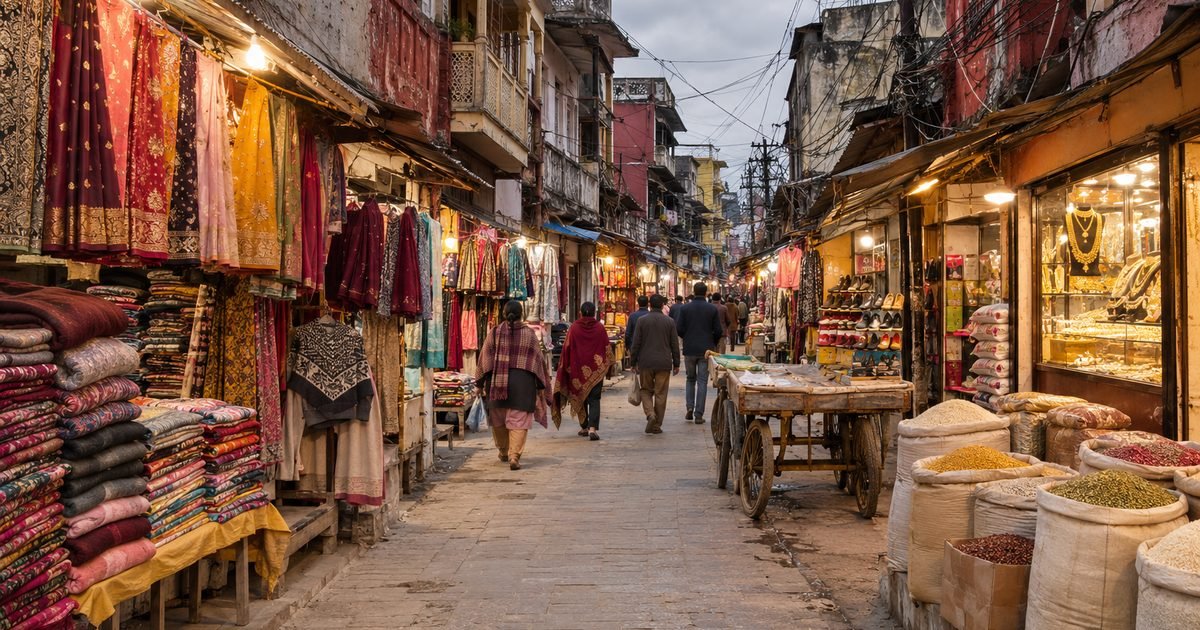
Paltan Bazaar is the street every Dehradun household uses and almost no guide describes accurately. It is not a mall, not a “3-km shopping district” and not a place you drive to: it is 937 metres of market street, 900 of which have been rebuilt as a pedestrian corridor, and it is where the city still buys its woollens, its rice, its fabric, its wedding jewellery and its school shoes.
It is also where Dehradun’s property market is at its most concentrated. A 150 sq ft shop here rents for more per square foot than a flat in the best part of town, and the difference between the main street and the lane behind it is a factor of three. This guide covers what the bazaar actually sells, what the Smart City rebuild changed, where the parking is (and where it is not), who gets fined, what the traffic plan does to a shopkeeper’s day, and what a shop, a floor or a house in this quarter costs to rent this month.
Start with the one thing that decides your visit: between 10 am and 9 pm you cannot bring a car or a loading vehicle into the street. Plan around that and Paltan Bazaar is easy; ignore it and you will spend an hour circling.
Last verified: 2 November 2026, against Dehradun Smart City’s Paltan Bazaar street project, Dehradun police’s 2026 festive and traffic plans as reported in the local press, the traders’ association’s statements to the press, the Times of India’s reporting on the pedestrianisation, live Magicbricks commercial listings, and road distances measured on the OSRM routing graph.
Quick answer: Paltan Bazaar is Dehradun’s main market street, 1.0 km from the Clock Tower and 1.4 km from the railway station. About 900 of its 937 metres are pedestrianised, and no four-wheeler or loading vehicle may enter between 10 am and 9 pm; illegal parking draws a ₹1,200 fine. It is famous for woollens, Doon basmati rice, fabrics, ayurvedic goods, jewellery, electronics and school supplies. Shops here rent for ₹51–180 per sq ft a month, the main street at the top of that range.
01Paltan Bazaar at a glance
| What it is | Dehradun’s principal wholesale-and-retail market street — an open bazaar, not a mall, running from the Clock Tower end down to Dhamawala and Arhat Bazar |
|---|---|
| Where | Old city, ward of Dehradun cantonment-adjacent core; the street is the spine between the Clock Tower and Jhanda Mohalla |
| Length | 937 m measured along the two ways labelled “Paltan Bazar” in OpenStreetMap; the pedestrianised first stretch is about 900 m |
| Distance from the Clock Tower | 1.0 km by road; the bazaar starts within sight of the tower |
| Vehicle access | Zero zone: four-wheelers barred, loading vehicles barred 10 am–9 pm, illegal parking fined ₹1,200 |
| Parking | Not on the street. MDDA’s Clock Tower complex is the nearest paid multi-level parking; two-wheelers use the Raja Road and Parade Ground side |
| What it sells | Woollens and ready-made garments, fabric, footwear, jewellery, electronics and mobile, ayurvedic and herbal goods, spices and dry fruit, Doon basmati rice, school uniforms and stationery, sweets and bakery |
| Shop rents | ₹51–180 per sq ft a month, depending on frontage and floor — see section 11 |
| Best months | October–November for stock and weather, December–January for woollens; avoid the Jhanda Mela and the pre-Diwali weekends if you dislike crowds |
| Time needed | 90 minutes for the main street; half a day if you are buying fabric or wedding clothes |
02What and where it actually is
Paltan Bazaar is a single continuous commercial street in the flat old core of Dehradun, running roughly north-east to south-west. At its north-east end it begins beside the Clock Tower, the 1950s municipal clock that the city uses as its zero point. At the south-west end it dissolves into Dhamawala and Arhat Bazar, and 300 m beyond that is the Darbar Sahib. Off it run the lanes that do half the bazaar’s real business: Ghosi Gali, Dispensary Road, Tilak Road, Raja Road, New Road, Pipal Mandi.
The geography matters because it explains both the crowds and the congestion. The old city sits on the flat gravel floor of the doon, between the Bindal and Rispana streams, with the railway line cutting across its south-west edge. There is one main street and a mesh of lanes with no grid and no room to widen anything — which is why the Smart City answer here was not a road but a pedestrian corridor.
Measured honestly, the bazaar is smaller than the internet says and bigger than a single street suggests. The two OpenStreetMap ways named “Paltan Bazar” total 937 metres. The Smart City project’s own description refers to “an initial stretch of approx. 900 m” to be pedestrianised — which matches, because the pedestrian corridor is essentially the whole street. When you read that Paltan Bazaar is “3 km long”, you are reading about the wider shopping district — Paltan Bazaar plus Dhamawala, Arhat Bazar, Pipal Mandi and the lanes off them — not one street. Section 10 deals with that.
03The name
Paltan means battalion, or regiment — the word came into Hindi and Urdu from the Portuguese pelotão by way of Marathi, and it is the ordinary word for a military unit across north India. The explanation you will hear in Dehradun, and read on most travel sites, is that the bazaar grew where a platoon of British soldiers was stationed, or where a regiment’s shops were.
Treat that as tradition rather than record. It is repeated everywhere and documented nowhere: no regimental history, gazetteer or municipal record names the unit, and the cantonment — which is where British troops actually were — lies south and east of the old city, not here. What the name does tell you reliably is that this quarter grew up around a military presence, in a town that was a cantonment before it was a market.
The older name for the area is said to be Khari Bazaar, and locally the street is still just “the bazaar”. If you ask an auto driver for Paltan Bazaar he will drop you at the Clock Tower end, which is the only end with room to stop.
04How the market grew
The lane is older than its shops. Jhanda Bazar, the street that runs from the Darbar Sahib’s gate, had traders on it from the seventeenth century, when the shrine was already pulling pilgrims into the valley. Paltan Bazaar as a shopping street is a twentieth-century creation, and the local accounts are unusually specific about it: until about 1935 there were only a handful of shops here, attached to the shrine’s traffic; the first proper shop is said to have been opened by a trader from Saharanpur; and the bazaar grew into the city’s main commercial hub after Independence, when the cantonment trade, the railway and the district courts all converged on the same few hundred metres.
By the 1970s it had the shape it still has: ground-floor retail, wholesale on the first floor, family accommodation above, and a lane network where each trade clustered. The Clock Tower end became the entry point; Dhamawala became the wholesale and grain end; the lanes behind became the tailors, the repair shops and the wholesale cloth merchants who never needed a shopfront facing the street.
The last decade has been about cars. By the 2010s the street carried traffic it was never built for, the pavements were gone under encroachment, and the pedestrianisation was proposed as the fix. What it actually delivered is section 06.
05What you actually see, and what it sells
Two hundred-odd shopfronts on a four-metre carriageway with three-metre walkways on each side, under a tangle of cables, with the goods spilling out of the doors. There are no brand showrooms on the main street; the brands are on Rajpur Road and in the malls. What Paltan Bazaar sells is everything the branded shops do not bother with, at prices set by bargaining, in shops run by families who have been there for three generations.
The trades that define it:
- Woollens and ready-made garments. The winter trade is what Paltan Bazaar is known for across Uttarakhand — shawls, sweaters, jackets, and the tweed and hosiery that get sold out of piles from October onwards.
- Fabric and tailoring. Cloth by the metre, lining, buttons, lace, and the tailors in the lanes behind who will run up a suit or a blouse in a week. This is the part of the bazaar that has no online substitute and knows it.
- Doon basmati and provisions. The valley’s own rice is sold here by the sack, along with spices, dry fruit, ghee and the pulse-and-flour trade that the Dhamawala end specialises in.
- Ayurvedic and herbal goods. Dehradun’s ayurvedic trade is old and the bazaar carries it — oils, churnas, honey, and the general-purpose hill remedies sold in unmarked jars.
- Jewellery. Silver and imitation on the main street, gold with the established jewellers at the Clock Tower end. Wedding season is when the shutters stay open late.
- Electronics and mobile. Phones, accessories, repairs, and the grey-market end of the trade that every Indian bazaar has.
- School and office supplies. Uniforms, shoes, bags, stationery — a June trade that is worth more to some shops than Diwali.
What is not there: parking, a public toilet worth the name, anywhere to sit, and any coherent signage. It is a working market, not a heritage precinct, and the shopping experience is the Indian bazaar experience — intensely good value if you know what you are buying, exhausting if you do not.
06The pedestrian zone, the traffic plan, and what it changed
This is the most important practical section in this guide, because the rules here are enforced and they are recent.
The Smart City project rebuilt Paltan Bazaar as a pedestrian corridor: an initial stretch of about 900 m with three-metre walkways on both sides, a four-metre carriageway for emergency and service access, new paving, drainage, lighting and a facade treatment. The pedestrianisation alone was reported at ₹13.8 crore; other reporting splits the spend into ₹8.2 crore for the pedestrianisation and ₹4.8 crore for the facade work, and a third account puts the total above ₹10 crore. The honest reading: about ₹13 crore of public money went into this street, and the exact split depends on which phase a report is describing.
What that bought, in rules:
- Zero zone. Four-wheelers are barred from the bazaar and from the lanes of Dhamawala, Peepal Mandi and the Paltan Bazaar block. Dehradun police enforce this with barricades and challans, and the fine for illegal parking is ₹1,200.
- Loading window. Goods vehicles may service shops only outside 10 am–9 pm, and only vehicles with the municipal token. Traders have asked for the window to be widened; the association’s position is that a shop cannot restock in the dark.
- Two-wheelers are allowed in more of the network than cars, but not on the pedestrian stretch itself, and not during the mela.
- Festival mode. During the Jhanda Mela and the Diwali fortnight the whole quarter goes vehicle-free with diversion points at Hanuman Chowk, and the administration opens grounds for parking.
Two honest problems remain. The first is encroachment: hawkers and shopkeepers pushing goods and counters past the walkway line, which is what the ₹1,200 fine and the periodic drives are aimed at, and which the traders’ body says is being enforced unevenly. The second is waterlogging — the new drainage handles ordinary rain but the street still ponds at the low points in a heavy monsoon burst, and the shops at the Dhamawala end know exactly where.
The change in footfall is the part nobody can settle. The pedestrian corridor made the street pleasanter and, by common account, brought back evening shoppers who had drifted to the malls; it also pushed the delivery, the loading and the parking into the lanes behind, where the residents carry the cost.
07Practicalities
- Cash still matters. UPI is everywhere, but the wholesale floors, the tailors and the loading crews are cash-first. Carry small notes.
- Go early or go late. The street is at its best between 10.30 am and noon, and again after 6 pm. Mid-afternoon in May is punishing; the corridor has shade on one side only.
- Bargaining is expected on garments, fabric and household goods, and not on groceries, medicines or jewellery with a rate board. Ask the price of three shops before you buy at the first.
- Watch your pockets in the pre-Diwali and wedding-season crush. The corridor is well lit and policed; the lanes off it, after the shutters come down at 9 pm, are quiet and dark.
- Buying rice: Doon basmati is sold by the sack and by the kilo; ask to see the grain, and buy from a shop that will show you the year’s lot rather than a pre-sealed bag.
- If you are shopping for a wedding, come on a weekday with measurements written down and a photograph of what you want. The tailors work to a queue measured in weeks, not days, in November and December.
- Accessibility: the pedestrian stretch is level and newly paved, which makes it far better than it was; the shop thresholds are still steps, and the lanes behind are not usable with a wheelchair.
08How to reach Paltan Bazaar
All distances below were measured on the OSRM routing graph from fixed points, because the published figures for the old city vary by a kilometre and most of them conflate the bazaar with the district around it.
| From | Road distance | Notes |
|---|---|---|
| Clock Tower | 1.0 km | Two minutes; the bazaar begins beside the tower. Park at the MDDA complex here |
| Dehradun railway station | 1.4 km | Three minutes by auto, or a fifteen-minute walk up Haridwar Road |
| ISBT Dehradun | 9.0 km | Nine minutes on the highway; autos charge by the seat |
| Jolly Grant airport | 24.8 km | About 32 minutes |
| Guru Ram Rai Darbar Sahib | 0.9 km | Through Jhanda Bazar, on foot most of the way |
| Forest Research Institute | 6.3 km | Eleven minutes; the other side of the city |
09The best time to go
| Window | What you get | The trade-off |
|---|---|---|
| October–November | New winter stock on the shelves, cool walking weather, the best of the garment trade | The pre-Diwali weekends are the busiest of the year; expect to be shoulder to shoulder |
| December–January | The woollen season at full strength, and the bazaar at its most Dehradun | Cold mornings, fog, and the tailors booked out for the wedding season |
| February–March | End-of-season rates on winter stock; the mela crowd adds a different kind of trade | The Jhanda Mela closes the surrounding lanes for three weeks in March |
| April–June | Early mornings are pleasant; school-uniform and stationery trade peaks in June | Hot by noon, shade on one side only, and the monsoon build-up is stifling |
| July–September | The quietest months and the best bargaining; monsoon sales | Waterlogging at the low points after heavy rain, and half the garment stock is under tarpaulin |
10Five things the guides get wrong
- It is not 3 km long. A widely quoted 2019 report describes “the 3-km-long Paltan Bazaar area”, and social posts say 1.5 km. Measured along the street itself, the two OpenStreetMap ways named Paltan Bazar total 937 m — and the Smart City corridor’s 900 m matches that. The 3 km figure is the whole shopping district including Dhamawala, Arhat Bazar and Pipal Mandi.
- You cannot drive through it, and there is nowhere to park on it. Half the listings still say “parking available”. The street is a zero zone, loading is barred from 10 am to 9 pm, and parking on it costs ₹1,200. The nearest real parking is the MDDA complex at the Clock Tower, a walk away.
- “Named after a platoon of British soldiers” is folklore, not record. Paltan means battalion or regiment, and the military association is real, but no regimental history, gazetteer or municipal record names the unit or the year. Say “believed” or leave it out.
- It is not Dehradun’s shopping mall. There are no brand showrooms on Paltan Bazaar; the branded retail is on Rajpur Road and in the malls. What the street does better than anywhere else in the city is unbranded trade — cloth, woollens, provisions, ayurvedic goods, repairs.
- The bazaar is not a heritage monument, and the 1935 date is about shops, not the street. Jhanda Bazar had traders in the seventeenth century; what dates from the 1930s is Paltan Bazaar’s emergence as a shopping street, with a handful of shops and, by local account, a first shopkeeper from Saharanpur. The lane is much older than the retail.
11What renting here actually costs
Paltan Bazaar is a commercial street before it is a residential one, so the property section starts with shops. The figures below are live listings this month, converted to a monthly rate per square foot so they can be compared — which is the only way to see how much the main street is worth over the lane behind it.
| Unit (and source) | Range, Nov 2026 | Per sq ft a month |
|---|---|---|
| Shop, main street, 250 sq ft — Magicbricks, Nov 2026 | ₹45,000 | ₹180 |
| Shop, Ghosi Gali, 150 sq ft — Magicbricks, 14 July 2026 | ₹25,000 | ₹167 |
| Shop, Dispensary Road, 2,505 sq ft — Magicbricks, 8 August 2026 | ₹2,50,000 | ₹100 |
| Shop, New Road, 450 sq ft — Magicbricks, 23 October 2026 | ₹30,000 | ₹67 |
| Shop, Dhamawala lane, 255 sq ft — Magicbricks, Nov 2026 | ₹13,000 | ₹51 |
| Flat above shops, 2 BHK, central Dehradun — Magicbricks, 24 August 2026 | ₹15,000–22,000 | — |
| Demand drivers: the pedestrian corridor, Clock Tower parking, the Jhanda Mela | — | — |
The pattern is the point. Frontage on the main street costs over three times what a lane one minute away costs per square foot, and small units cost more per foot than large ones — a 150 sq ft shop at ₹167 beats a 2,505 sq ft floor at ₹100. If you are taking a shop here, the questions that decide the rent are not the area but the door width, the floor, whether the shutter faces the pedestrian corridor, and whether the previous tenant’s licence transfers.
The honest downsides, from traders and from the record:
- The loading window is 10 am to 9 pm and it is enforced. A shop that cannot restock in daylight loses a day’s sales. Budget for a godown in the lanes and a handcart, and check whether your supplier will deliver inside the window at all.
- No parking for customers. Your footfall depends on the MDDA complex and on pedestrians. That is fine on the corridor and hard on the lanes.
- Waterlogging at the Dhamawala end in a heavy monsoon burst — ask the neighbours which shops took water in the last two seasons, and look at the plinth height before you sign.
- Deposits and lock-ins are informal. Two to six months’ deposit is normal, agreements are often on stamp paper without registration, and the “licence” that lets a shop trade is a separate negotiation. Get the deposit, the notice period and the restoration obligation in writing.
- Branded retail has left. The street’s trade is value and unbranded goods; the branded customer went to Rajpur Road and the malls, and did not all come back. Do not price a shop here as if it were a mall unit.
Commercial space in the old city is listed on our marketplace, and owners can list a shop or a floor free, with no brokerage. If you are letting a residential property in the same quarter, the paperwork is the hard part — start with how to rent out a flat in Dehradun without a broker. If you are buying rather than renting, run our title and plot checks before paying anything, because these are the oldest titles in the city.
12Frequently asked questions
How long is Paltan Bazaar?
937 metres, measured along the two ways named “Paltan Bazar” in OpenStreetMap, which matches the 900 m pedestrianised stretch in Dehradun Smart City’s own project description. The “3 km” figure you will read elsewhere is the wider shopping district.
Can I drive to Paltan Bazaar?
No. The bazaar and the lanes around it are a zero zone for four-wheelers, loading vehicles are barred between 10 am and 9 pm, and illegal parking is fined ₹1,200. Come by auto, or park at the MDDA complex at the Clock Tower and walk in.
Where do I park near Paltan Bazaar?
The MDDA multi-level complex at the Clock Tower is the nearest paid parking, about a kilometre from the Dhamawala end. Two-wheelers use the Raja Road and Parade Ground side. During the Jhanda Mela and Diwali, the administration opens additional grounds and diverts traffic at Hanuman Chowk.
What is Paltan Bazaar famous for?
Woollens and ready-made garments, cloth and tailoring, Doon basmati rice and provisions, ayurvedic goods, silver and gold jewellery, electronics and repairs, school uniforms and stationery. The winter garment trade is what the bazaar is known for across Uttarakhand.
What are the shop timings?
There are no official market hours. In practice shops open around 10.30 am and shut between 8 and 9 pm, later in the Diwali and wedding seasons, and many close for a half day on Sunday. The pedestrian street itself stays open and lit after the shutters come down.
Is Paltan Bazaar open on Sundays?
Partly. The street is always open, but a number of established shops take Sunday or Monday as their weekly off. If you are travelling for one particular shop, ring ahead rather than assume.
When is the cheapest time to shop here?
February for end-of-season winter stock and August for the monsoon sales. Bargaining is expected on garments, fabric and household goods all year; it is not the custom on groceries or on jewellery with a rate board.
Is it safe at night?
The pedestrian corridor is well lit, busy until about 10 pm and covered by police patrols. The lanes behind it are quiet and poorly lit once the shutters close at 9 pm, and that is where you should keep your phone in a pocket rather than in your hand.
Can I rent a shop in Paltan Bazaar?
Yes. Shops in the quarter are advertised at ₹51–180 per sq ft a month depending on frontage and floor, with two to six months’ deposit and mostly unregistered agreements. Check the loading access, the plinth height after rain and whether the previous tenant’s trade licence transfers before you pay a deposit.
13Where to go next
The bazaar is the middle of a walk that starts at the city’s origin and ends in the market that grew around it. Walk south-west out of the Clock Tower end and you reach the Clock Tower, the 1950s municipal clock that every distance in this guide is measured from. Keep going for 900 m and you are at Guru Ram Rai Darbar Sahib, the shrine whose pilgrims built the first shops on this street — the guide there explains the murals, the flag and the mela.
For the rest of the set: Sahastradhara is the sulphur-spring site up the valley, Robber’s Cave the gorge on the same road, Tapkeshwar Mahadev the cave temple on the other side of the ridge, and Mindrolling Monastery in Clement Town the Tibetan end of the city.
If you are looking at the quarter as a place to trade rather than to shop, the useful exercise is a weekday morning on foot: arrive at 10, watch where the loading stops, see which lanes flood if it rains, and count the shutters that are down. Our marketplace lists what is currently available, and owners can add a property free.
Distances, rents and rules in this guide were checked on 2 November 2026 against Dehradun Smart City’s Paltan Bazaar pedestrianisation project, the Times of India’s reporting on the pedestrian corridor and its budget, the Pioneer Edge’s reporting on the 2026 festive traffic plan and the ₹1,200 parking fine, statements by the Doon Valley Main Market United Vyapar Mandal to the press, live Magicbricks commercial and residential listings, OpenStreetMap street geometry for the measured length, and road distances measured on the OSRM routing graph. Shop hours, rents and traffic rules change without notice — check before travelling or signing.
1 Comment
[…] the two ends of the market, read Rajpur Road for what Rs 6,000 a sq ft buys in the north, and Paltan Bazaar for the commercial market in the city […]